
Reviewed · TEMPLES AND SHRINES
Tokyo: Meiji Shrine Walking Tour — Shinto & Imperial System
Tokyo’s quietest walk begins beside Harajuku. This tour makes Meiji Shrine’s forest more than a pretty shortcut, explaining Shinto customs, the imperial system, and Japan’s change from samurai rule to modern nation. I like the small groups of up to 10, and I especially like the practical help at the shrine, from walking correctly through the torii to handling offerings, fortunes, and charms. The main drawback is simple: the tour is English only, and the walking route can take anywhere from 90 to 135 minutes.
At $23 per person, the experience offers solid value if this is your first shrine visit. You are paying for context and calm guidance, not admission to an attraction. Guides such as Keiko, Yuuka, Ayaka, Yuki, and Nonoka have been praised for clear explanations, friendly energy, and patience with questions. The final stop at Café Mori no Terrace is a pleasant extra, though the café break is brief and food or drinks are not included.
In This Review
- What makes this Meiji Shrine walk worthwhile
- Starting at Harajuku Station
- Walking into the forest and past the sake barrels
- The big torii and the sacred central route
- Understanding Shinto at Meiji Shrine
- The imperial story behind the shrine
- Free time for charms, fortunes, and photographs
- A quiet finish at Mori no Terrace
- How much value do you get for $23?
- Timing, language, and who should book
- Should you book the Meiji Shrine walking tour?
- FAQ
- How long does the Meiji Shrine walking tour last?
- How many people can join the tour?
- What language is the tour conducted in?
- Where does the tour start and finish?
- Does the $23 price include food or drinks at Café Mori no Terrace?
- Can I cancel the booking for a full refund?
What makes this Meiji Shrine walk worthwhile
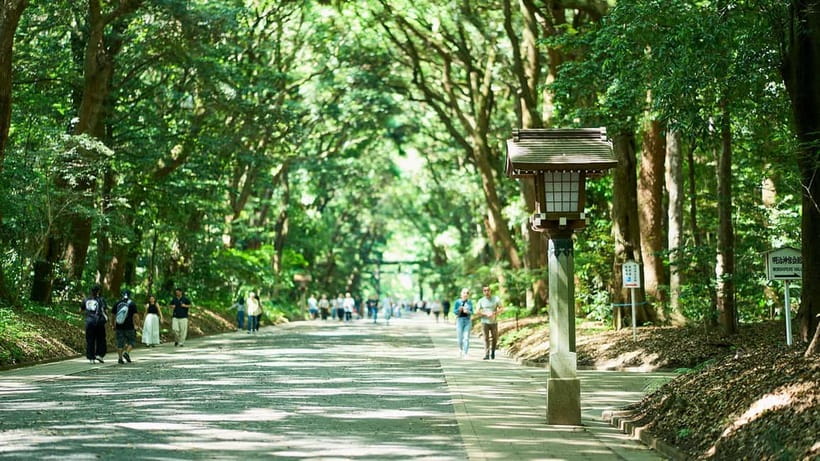
- A forest in central Tokyo: Approximately 100,000 trees create a shaded route where city noise can fade into birdsong.
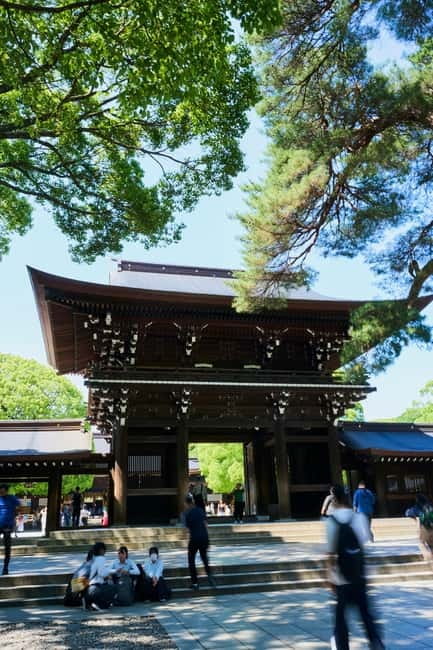
- A 12-meter torii with an unusual origin: The largest wooden torii here was made from 1,500-year-old Taiwanese cypress.
- Practical Shinto etiquette: You learn where to walk, how to approach the shrine, and how to make an offering respectfully.
- Imperial history in plain English: The tour connects Emperor Meiji and Empress Shoken with Japan’s shift from the samurai era to modern life.
- Small-group attention: A maximum of 10 people allows room for questions, photographs, and help with shrine customs.
- Tea and souvenirs at the finish: Mori no Terrace adds a relaxed ending, with Japanese tea, light snacks, and distinctive keepsakes.
Starting at Harajuku Station
The meeting point is at or near Harajuku Station, depending on the option you book. That makes the tour easy to pair with a day in Harajuku, but you should check the exact starting details before setting out because the meeting point can vary.
The guide leads you toward the first torii, known as Meiji Jingu Ichino Torii. This opening gate marks a change in mood. Harajuku is close by, yet the shrine approach quickly feels more spacious and restrained.
I would arrive early. The experience works best when you are not rushing from the station, searching for the group, or trying to catch up at the first explanation. One participant arrived five minutes late and still found the group after the guide kept them informed, but punctuality is the kinder choice for everyone.
The group limit of 10 matters here. A large crowd would make explanations at the gates and offering area harder to follow. In a small group, you can ask why a custom exists instead of simply copying the person in front of you.
More Temples and Shrines in Tokyo
- Tokyo: Meiji Shrine, Asakusa, Skytree Bus Tour and Cruise
★ 4.7 · 1,986 reviews - Tokyo: Asakusa Walking Tour with Sensoji Temple Visit
★ 4.8 · 1,583 reviews - Nikko: Kegon Falls, Lake Chuzenji & Toshogu Temple
★ 4.6 · 1,577 reviews
Walking into the forest and past the sake barrels
The approach to Meiji Shrine is one of the tour’s strongest features. About 100,000 trees shade the path, and the guide points out details that are easy to miss when you walk alone. The change from station noise to forest quiet is gradual, which makes the setting feel almost mysterious without needing any dramatic presentation.
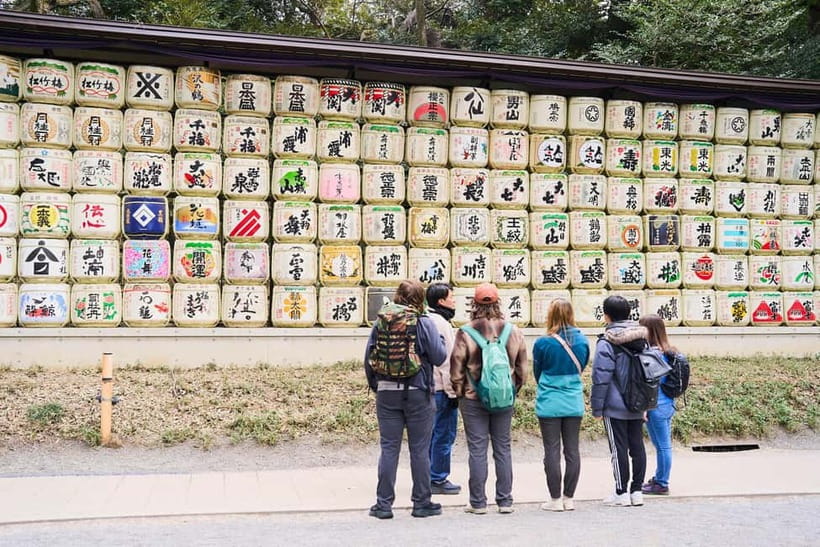
The route includes the consecrated wine barrels and sake barrels. These are not just colorful photo stops. They give the guide a chance to explain the relationship between shrine ritual, offerings, and Japanese tradition.
The tour also helps you read the site as you move through it. Instead of seeing a gate, a barrel, and a path as separate objects, you begin to understand their place in a Shinto setting. That is useful later, when you visit other shrines on your own.
The route is a walking tour, not a vehicle-based visit. The listed stops include roughly 10 minutes at the first torii, 10 minutes around the wine barrels, five minutes at the sake barrels, and another 10 minutes at the large torii. Those times are estimates, but they show the pace: steady, informative, and not rushed from one photo opportunity to the next.
The big torii and the sacred central route
The large torii is the visual centerpiece of the approach. It rises about 12 meters and was crafted from a 1,500-year-old Taiwanese cypress. Even if you are not especially interested in architecture, its size and age give the entrance real weight.
This is also where the guide introduces an important piece of shrine etiquette. The center of the approach is called seichu and is regarded as the route reserved for deities. You are encouraged to walk along the edge rather than through the middle.
That small instruction is exactly the kind of help that makes a guided visit worthwhile. You may notice people moving to the side but not know why. The guide gives you a reason, and the rest of your shrine visits become easier because you have learned a basic pattern rather than memorized a single rule.
The tour does not treat etiquette as a test. Guides help you take part without making you feel awkward. Darragh specifically appreciated receiving coins for an offering, since the group did not have any. Other participants received help with wishes, photographs, fortunes, and New Year shrine customs.
Understanding Shinto at Meiji Shrine
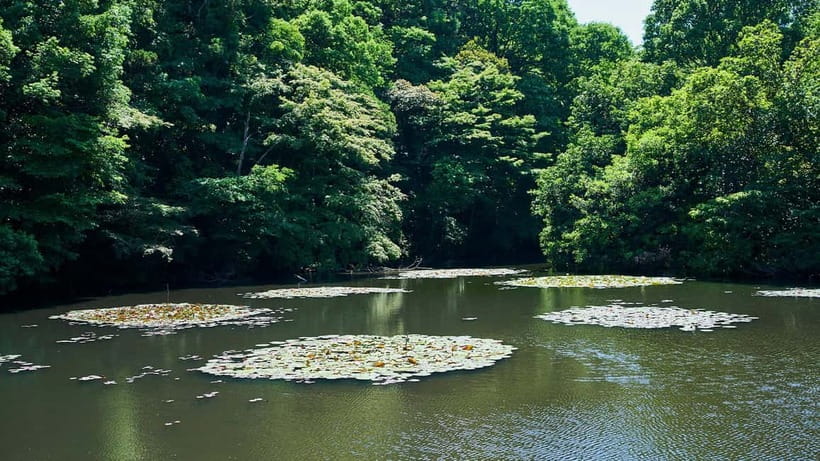
At the main shrine, the tour shifts from the forest and architecture to Shinto, Japan’s ancient religion. The focus is on respect for nature, harmony with the divine, and the role of shrines in Japanese life.
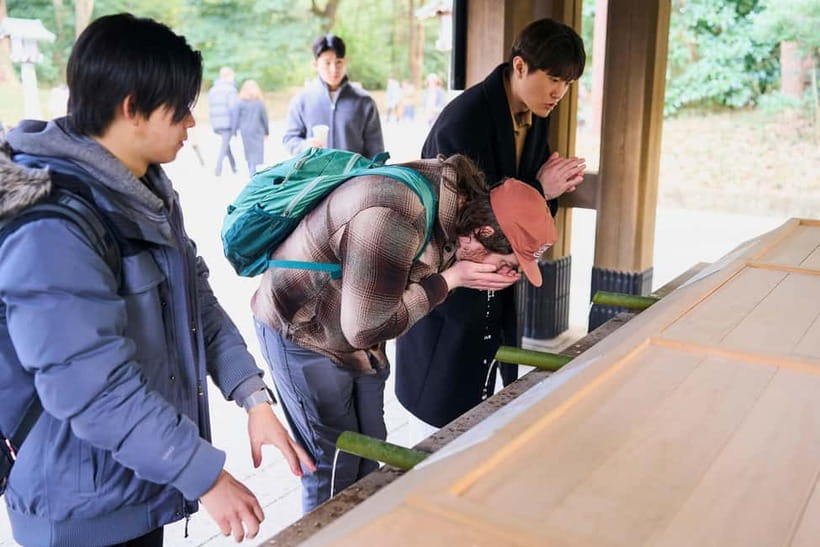
This part can be difficult to absorb if you are visiting independently. Shinto does not always present itself through the kind of formal explanation many international visitors expect. A guide can point out what you are seeing and explain how to behave without pretending that one short visit covers every part of the tradition.
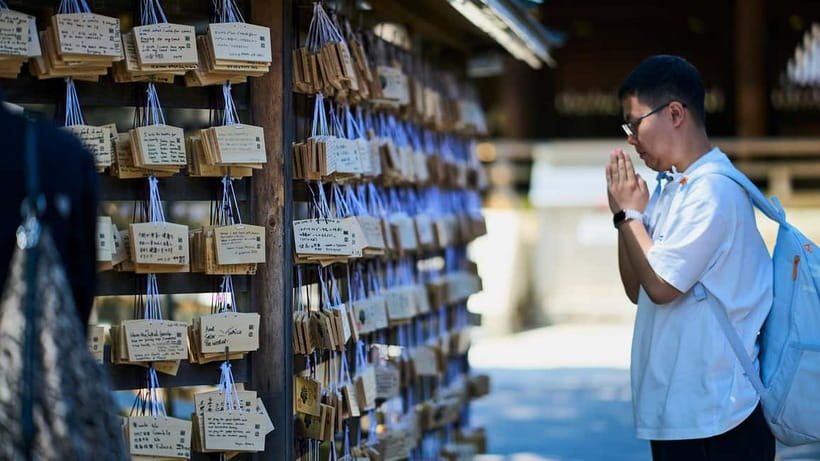
The experience includes free time at Meiji Shrine for sightseeing, shopping, photographs, and taking part in shrine activities. That balance is important. You get instruction first, then time to use it.
You might make an offering, pay your respects, or simply observe quietly. The tour is not only for people who want to perform every ritual. It also suits anyone who wants to understand the setting while remaining a respectful observer.
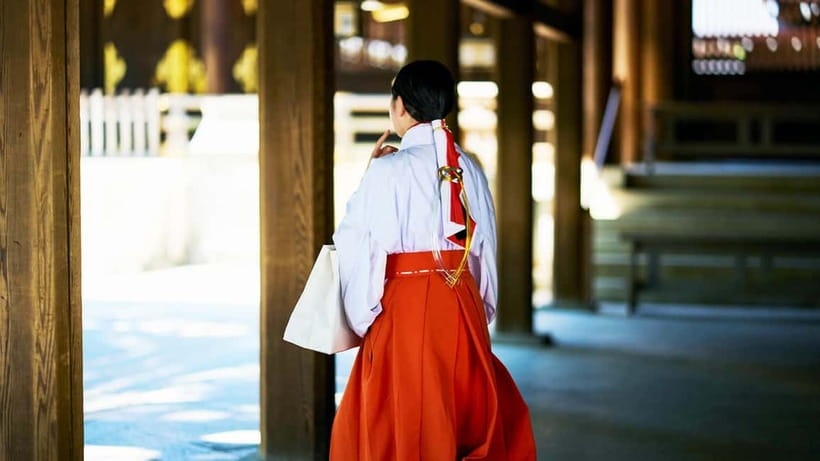
The guides are particularly useful at this point. Keiko has been praised for explaining the shrine’s place in the hearts of Tokyo residents. Nonoka has helped visitors understand the difference between shrines and Buddhist temples, as well as the difference between haiku and waka. Ayaka has been noted for explaining where to find fortunes and amulets and how to enter properly.
Those details add up. You leave with more than photographs. You know what the symbols and actions mean, and you feel less likely to make an accidental cultural mistake at the next shrine.
More Walking Tours in Tokyo
- Tokyo Tsukiji Fish Market Food and Culture Walking Tour
★ 5.0 · 3,184 reviews - Tokyo: Imperial Palace and Shogun Historical Walking Tour
★ 5.0 · 2,251 reviews - Tokyo: Shinjuku Local Bar and Izakaya Guided Walking Tour
★ 4.9 · 1,794 reviews - Tokyo: Tsukiji Fish Market Food and Walking tour
★ 5.0 · 1,724 reviews
The imperial story behind the shrine
Meiji Shrine is also a doorway into modern Japanese history. The tour presents Japan’s 2,600-year-old imperial system and explains the country’s movement from the samurai era toward modern Japan.
That broad subject could easily become a long lecture. The best guides keep it connected to the place around you. Yuuki has been praised for linking the shrine with Shinto, the imperial system, and Japan’s transition from the samurai era. Other guides use photographs showing the area before construction began, which helps you picture the site as something created within a changing Japan, not simply an ancient forest preserved untouched.
The tour also gives attention to Emperor Meiji and Empress Shoken. Their names are not treated as distant figures on a sign. They become part of the story of the shrine and its continuing meaning.
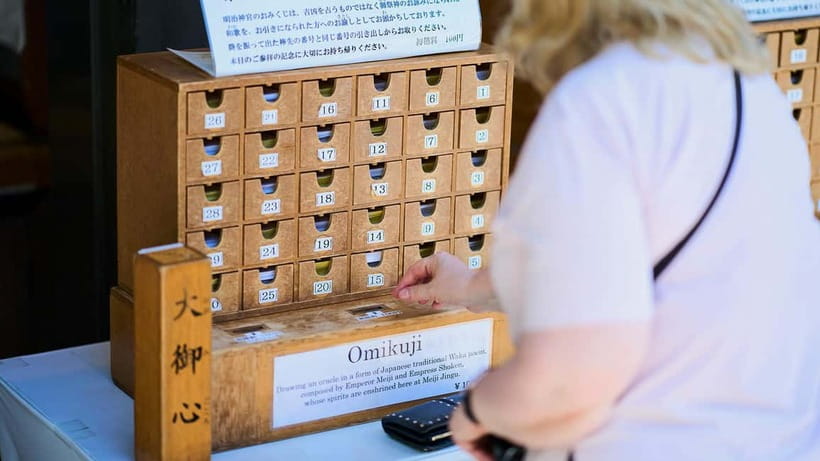
At one stop, you can learn about imperial poetry. The shrine sells an omikuji called Omigokoro, featuring poems written by Emperor Meiji and Empress Shoken. English translations make these poems approachable, especially if you are curious about the personal and reflective side of the imperial story.
This is a useful feature for English-speaking visitors. You do not need to read Japanese to take something meaningful from the poems. If you buy one, the guide can help explain the custom and the wording.
Free time for charms, fortunes, and photographs
The 45-minute visit at Meiji Shrine is the longest part of the schedule. It gives you enough room to take photographs, browse shrine goods, and try the customs without feeling that the guide is pulling you away immediately.
Omamori, or protective charms, are among the most popular purchases. The Omigokoro poetry fortune offers a different kind of keepsake. The choice depends on what you want from the visit: a practical charm, a written message, or simply a memory connected to the shrine.
Guides also help with photographs. Several participants appreciated having their pictures taken, and one guide carried historical images to show how the site looked before construction. That kind of personal attention is easier in a group of 10 than on a crowded general tour.
The shrine can be especially meaningful around New Year, when customs and wishes become a larger part of the visit. One participant used the visit to choose amulets for a growing family. You should not expect the tour to guarantee a private ceremony or special access, but you can expect guidance through ordinary shrine activities.
A quiet finish at Mori no Terrace
After the shrine, the group goes to Forest Terrace Meiji Jingu and Café Mori no Terrace. The scheduled break lasts about 15 minutes and includes time for photographs, shopping, and a short rest.
Japanese tea and light snacks are available, but they are not included in the $23 price. Think of this as a convenient stopping point rather than a full meal. If you are hungry, plan accordingly.
The gift shop has a few unusual souvenirs. Eco-blocks made from fragrant Japanese camphor offer a small, practical reminder of the forest. Miniature barrels of sacred sake make a more distinctive memento than the usual city souvenir.
I like this ending because it lets the visit taper off naturally. You have moved from the crowded station, through a quiet forest, into a sacred space, and then back toward ordinary Tokyo with tea and a small purchase. The drop-off is at Harajuku Station, so you can continue exploring the neighborhood afterward.
How much value do you get for $23?
At $23, this is a good buy for a first visit to Meiji Shrine, especially if you are curious about Japanese customs but do not know where to begin. The shrine itself is not presented as a paid attraction in the information provided, so the real value comes from the guide’s explanations, etiquette help, historical context, and time saved figuring out the site alone.
The small group improves that value. A private guide would cost far more, while a large free walk might not give you a chance to ask questions. Here, you get a middle ground: personal attention without the price of a private tour.
The value is lower if you already understand Shinto, shrine etiquette, and the Meiji period. You may prefer to walk through the forest at your own speed and spend longer taking photographs or shopping. The 90 to 135-minute schedule also gives you less freedom than an independent visit.
Still, the repeated praise for guides such as Yuuka, Keiko, Ayaka, Yuki, and Nonoka points to the central strength of the experience: the people leading it. Their role is not just to recite facts. They answer questions, adjust explanations to the group, help with photos, and show you how to participate respectfully.
Timing, language, and who should book

The tour runs in English only. Japanese language support is not available, so you should book it only if you can comfortably follow an English-speaking guide.
The duration varies from 90 to 135 minutes, and starting times depend on availability. A morning departure can work well if you want to visit before a full day in Harajuku. One participant liked a 9 a.m. start on a Monday because it made an efficient first activity.
I would recommend this tour to:
- First-time visitors to Tokyo who want cultural context early in the trip
- People unsure how to behave at a Shinto shrine
- Families who appreciate help with offerings, charms, and photographs
- Visitors interested in the imperial system and Japan’s move into the modern era
- Anyone who prefers a small group to a large walking crowd
I would skip it if you want a completely unstructured forest walk, a long café visit, or a tour in a language other than English. It is also not the best match if you only want a quick photo at the torii and do not care about the history behind it.
Free cancellation up to 24 hours before the start and the option to reserve now and pay later make the booking less risky. Check the meeting-point option carefully, then arrive with comfortable shoes and enough time to find the group.
Should you book the Meiji Shrine walking tour?
Book it if you want Meiji Shrine to make sense, not just look beautiful. The forest, the enormous torii, the sake barrels, and the main shrine are impressive on their own, but the guide adds the customs and historical links that turn a pleasant walk into a useful introduction to Japan.
At $23, the tour earns its price through small-group attention and practical help. I would choose it early in a Tokyo visit, especially if you want to feel comfortable at other shrines later. If you already know the basics or prefer to linger alone, visit independently instead. For most first-time visitors, though, this is a calm, well-paced way to meet Tokyo’s spiritual side.
FAQ
How long does the Meiji Shrine walking tour last?
The tour lasts between 90 and 135 minutes, depending on the selected departure and availability.
How many people can join the tour?
The group is limited to 10 participants, creating a small-group experience with room for questions and personal guidance.
What language is the tour conducted in?
The tour is conducted in English only. Japanese language support is not available.
Where does the tour start and finish?
The starting and drop-off options are at Harajuku Station, also written as 原宿駅. The exact meeting point may vary according to the option booked.
Does the $23 price include food or drinks at Café Mori no Terrace?
No. The café stop is included in the route, but Japanese tea, light snacks, and purchases at the café or gift shop are not stated as included in the price.
Can I cancel the booking for a full refund?
Yes. You can cancel up to 24 hours in advance for a full refund. You can also reserve now and pay later.
Just added in Tokyo
- Japanese Home Cooking Class & Walk in Todoroki Temple Tokyo★ 5.0 · 88 reviews
- A One-of-a-Kind Sushi Experience in a Special Place of Japan★ 5.0 · 15 reviews
- Tokyo Cute Bento Cooking Class – Make a Kawaii Character Lunchbox★ 5.0 · 126 reviews
- Japan Tokyo Tower Observatory Deck E-Ticket★ 4.0 · 34 reviews
- Catch a Baseball Game in Tokyo with a Local – Tickets Included★ 5.0 · 24 reviews
- JDM Experience with Fast&Furious RX-7 (English speaking Driver)★ 5.0 · 57 reviews
- Tokyo Private Day Tour by Car with English speaking Driver Guide★ 4.0 · 29 reviews
- Japan Classic 10 Day – One Life Adventures★ 5.0 · 129 reviews
Temples and Shrines, compared.
![[Kyoto & Nara Day Tour] Sagano Scenic Railway & Nara Park & Fushimi Inari Taisha Thousand Torii Gates & Togetsukyo Bridge & Bamboo Grove & Kimono Forest (Departing from Osaka)](https://media.japanvisits.com/wp-content/uploads/kyoto-nara-day-tour-sagano-scenic-railway-nara-park-fushimi-inari-taisha-thousand-torii-gates-togetsukyo-bridge-bamboo-grove-kimono-forest-departing-from-osaka-k110001-400x257.jpg)
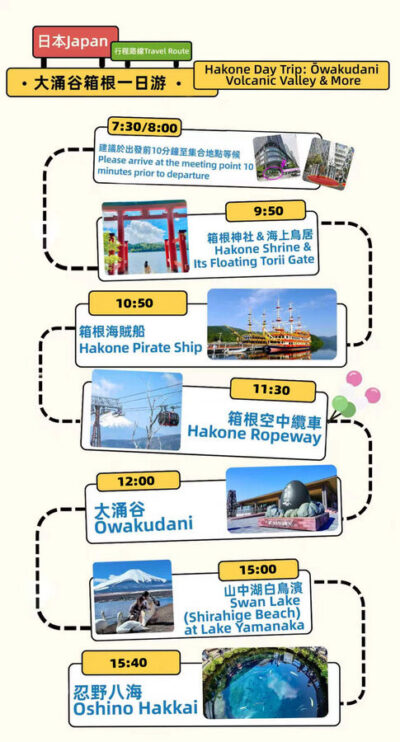
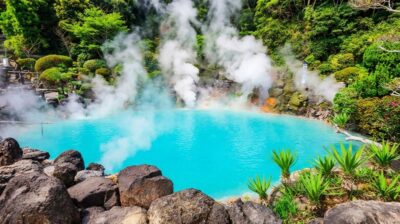
Kyushu One-Day Tour: Yufuin no Mori Train & Yufuin Town & Nyoirin-ji Temple & Dazaifu & Hell Hot Springs (Departing from Fukuoka)
Read our review →
Fushimi Inari, Kinkakuji, Bamboo Grove 1 Day Bus Tour
Read our review →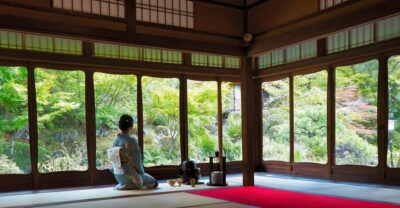
Tea Ceremony in a Traditional Tea House in Kiyomizu
Read our review →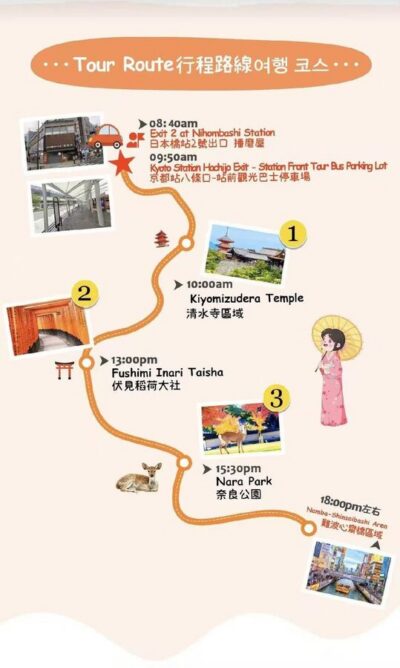
Kyoto Nara Day Trip │ Kiyomizu-dera Temple + Fushimi Inari-taisha Shrine + Nara Park (Departing from Osaka/Kyoto)
Read our review →

Browse the lists this tour appears in