
Reviewed · PRIVATE TOURS IN KYOTO
Treasures of Kyoto: Geishas & Traditions Private Tour
Kyoto’s old quarters reward a slower walk. This private 2-hour-30-minute outing takes you through Gion and nearby Higashiyama, linking kabuki, geisha traditions, Shinto, Buddhism, temples, and quiet lanes that can be hard to understand on your own. I like the private format, which lets your group ask questions and set a comfortable pace, and I like the way the route packs many sights into a compact part of Kyoto. The main drawback is that the tour is largely a walking orientation, with no meals, hotel transfers, or clearly stated admission to interior attractions included.
I would especially value this experience early in a Kyoto visit, when you want to get your bearings fast without being herded through a large group. Guides such as Ted, Guia, Shohei, Maha, Ahmed, and Kako have been praised for explaining Japanese customs clearly and adjusting their approach for children, rain, and different interests. You should still expect steps, extended walking, and a short schedule that cannot give every stop more than a brief look.
In This Review
- Key points at a glance
- Why this short Kyoto walk works
- Starting with kabuki at Izumo no Okuni
- Reading Gion beyond the costumes
- Chion-in and Maruyama Park: a change of pace
- Yasaka Shrine and the story of Kyoto’s old avenues
- Nene-no-Michi and the final pagoda view
- What the guides add to the experience
- Price, pace, and practical value
- Who should book this Gion experience?
- Should you book it?
- FAQ
- How long does the tour last?
- Is this a private tour?
- Where does the tour start?
- Where does the tour finish?
- Are food and drinks included?
- Are entrance tickets included?
- Is hotel pickup provided?
- Can I cancel for a full refund?
Key points at a glance
- Gion in a small private setting: Your party explores together, without strangers setting the pace or competing for the guide’s attention.
- A useful culture lesson: The route explains geisha and geiko traditions alongside the differences between Shinto and Buddhism.
- Kabuki begins the story: The Statue of Izumo no Okuni and Minamiza Theatre connect modern Kyoto sightseeing with the roots of kabuki.
- Eleven compact stops: The walk moves through Gion, Shinbashi, Maruyama Park, Yasaka Shrine, Shijo Dori, and Nene-no-Michi.
- Strong guide feedback: Ted is repeatedly praised for his warmth and detailed answers, while Guia, Shohei, Maha, Ahmed, and Kako are also singled out for friendly, clear guiding.
- Good for families and short visits: Guides have adapted explanations for children as young as 10 and for guests dealing with rain or limited time.
Why this short Kyoto walk works
Kyoto can be hard to read at street level. One lane may be lined with ordinary shops, the next with wooden banquet buildings, a shrine, or a temple gate. Without context, Gion can become a photo stop. With a good guide, the same streets become a lesson in entertainment, religion, architecture, and social custom.
This tour focuses on the eastern side of central Kyoto, so the route is geographically sensible. You are not spending half the time in a vehicle crossing the city. The stops are close enough to connect on foot, although the 2-hour-30-minute duration means the schedule is brisk in places.
The private setup matters here. In a large group, questions about geisha life or religious practice can be difficult to ask. With only your own party, you can pause for photos, ask for more detail, or tell the guide that your children need a simpler explanation. Shohei has been praised for keeping a relaxed pace, while Ted has been especially effective with families and curious children.
The tour has a current rating of 4.9 from 36 reviews, with 97 percent recommending it. Those numbers do not remove the need to check your own expectations. This is not a ticketed performance, a meal with a geisha, or a full temple tour. It is a guided neighborhood walk with cultural explanation.
More Private Tours in Kyoto
- Kyoto 6hr Private Tour with Government-Licensed Guide
★ 5.0 · 1,369 reviews - 10 Must-see Spots in Kyoto One Day Private Tour (up to 7 people)
★ 5.0 · 1,108 reviews - Kyoto 4hr Private Tour with Government-Licensed Guide
★ 5.0 · 629 reviews
Starting with kabuki at Izumo no Okuni
The first stop is the Statue of Izumo no Okuni, with about 20 minutes allotted. Okuni is identified as the originator of kabuki theater, making this a useful starting point for understanding Kyoto’s performance culture.
From there, you continue to Minamiza Theatre, another 20-minute stop. Its roots reach back to the early Edo period, from 1596 to 1615. Even if you only view the theater from outside, the stop gives the route a clear thread: Kyoto’s traditional entertainment is not an isolated museum display. It grew from public performance, theater districts, and long-running urban customs.
The limitation is simple. No performance is included, and the itinerary does not promise an interior visit. Think of this part as an introduction to kabuki’s place in Kyoto rather than a theater experience.
Reading Gion beyond the costumes
Gion receives several stops because it is the heart of the tour. You pass through Gion and the Gion Shinbashi area, which is designated as a traditional business preservation area. The section south of Shijo Street has also been designated for the preservation of historical scenery.
That official protection helps explain why the streets feel different from ordinary commercial Kyoto. The setting is part of the subject. Your guide can point out how the buildings, lanes, and businesses relate to the geisha world, rather than treating the district as a backdrop for pictures.
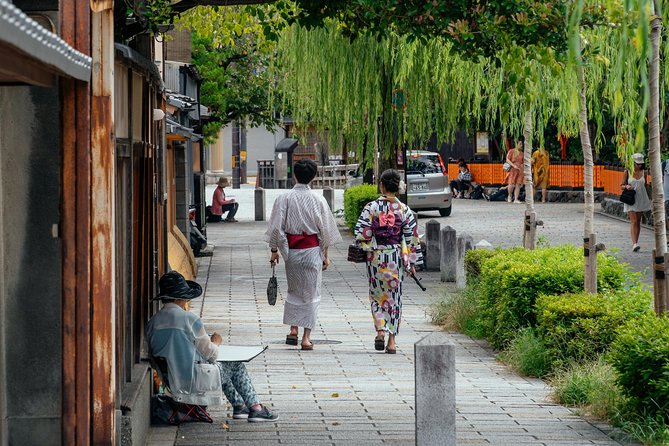
At Shinbashi Dori, you stand outside traditional banquet buildings where geisha entertained customers. This is one of the most useful parts of the walk because it deals directly with the culture visitors often misunderstand. The route focuses on the women’s training, education, and working life, not just their clothing.
You may see women dressed in geisha or geiko attire, but this should not be treated as a guaranteed sighting. The value lies in learning how the district functions and how to behave respectfully. A guide who explains the setting can help you avoid turning a working neighborhood into a spectacle.
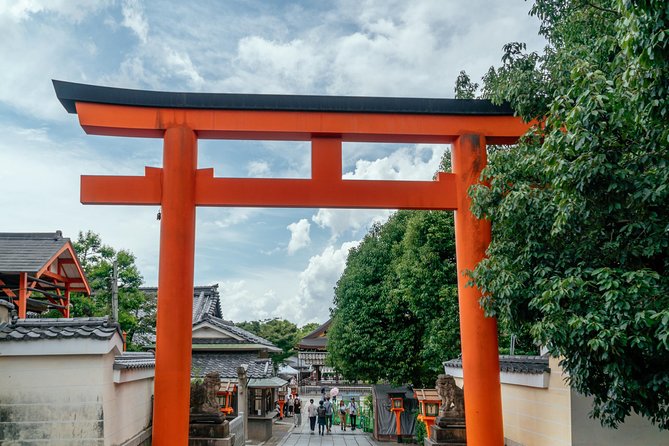
Tatsumi Daimyojin Shrine adds another layer. Here, the guide discusses Japanese religion and the way Shinto and Buddhism have mixed across the country. That distinction is worth hearing in person because shrines and temples can look mysterious when you do not know what you are seeing. The tour gives you a basic framework for recognizing the difference between the two traditions.
Chion-in and Maruyama Park: a change of pace
After the close streets of Gion, the route moves toward Chion-in Temple. The itinerary allows about 10 minutes, including walking up steps for a better view of the temple and its garden area.
This is a short stop, so do not expect a full examination of the temple complex. The steps also make the moderate fitness requirement important. You do not need an athlete’s condition, but comfortable shoes and steady footing will help.
From Chion-in, you walk toward Maruyama Park, with roughly 20 minutes allotted. The park gives the route some breathing room after the narrow lanes and traditional buildings. It is also a practical point for photos and questions, since the guide can connect the temple area, park, and surrounding historic district.
The timing here is a strength and a weakness. I like that the walk does not stay confined to one type of sight. At the same time, anyone hoping to study Chion-in in detail will find 10 minutes too short. If a particular temple matters most to you, ask the guide in advance how much time can be devoted to it.
A completely different kind of day out:
- PERFECT KYOTO 1-Day Bus Tour
★ 5.0 · 13,518 reviews - [Kyoto & Nara Day Tour] Sagano Scenic Railway & Nara Park & Fushimi Inari Taisha Thousand Torii Gates & Togetsukyo Bridge & Bamboo Grove & Kimono Forest (Departing from Osaka)
★ 4.9 · 10,942 reviews - Kyoto: Fushimi Inari, Kinkakuji, Bamboo Grove 1 Day Bus Tour
★ 4.8 · 4,316 reviews - Kyoto: Tea Ceremony in a Traditional Tea House in Kiyomizu
★ 4.9 · 3,519 reviews
Yasaka Shrine and the story of Kyoto’s old avenues
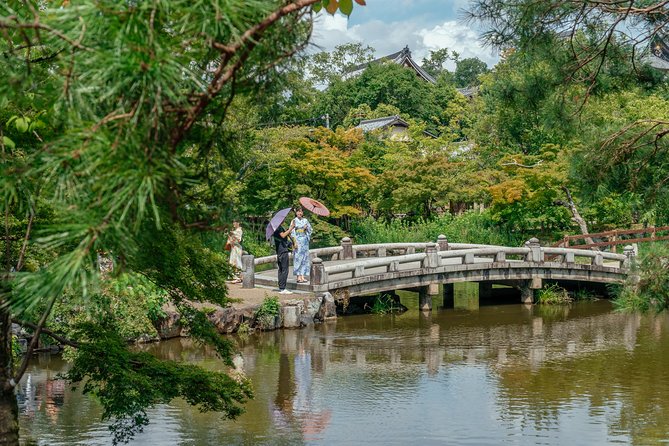
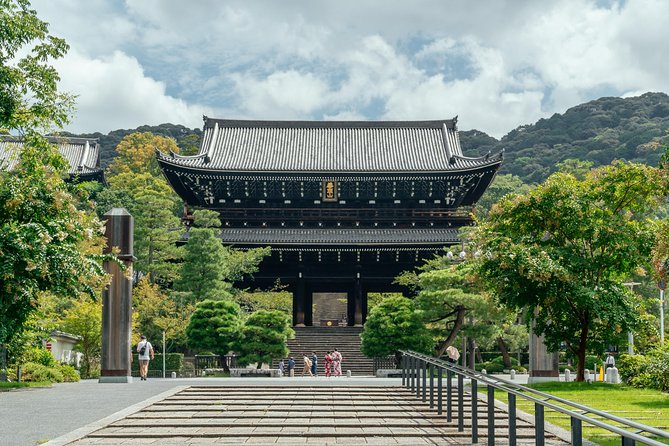
Yasaka Shrine receives a 10-minute stop. Its history is linked by legend to AD 656, well before the Heian period. The guide can help place the shrine within Kyoto’s religious and civic life, while also explaining how Shinto practice differs from what you see at a Buddhist temple.
The route then reaches Shijo Dori, literally Fourth Avenue of Heian-kyo, the ancient capital. This is a good reminder that Kyoto’s present-day streets often follow the plan of the old city. You are not simply crossing a shopping street. You are walking along part of the city’s historic grid.
The stop is brief, just 10 minutes, so the point is orientation rather than shopping time. If you want to browse stores or sample food along Shijo Dori, plan to return later. This guided walk is designed to keep moving.
Nene-no-Michi and the final pagoda view
Nene-no-Michi is another short stop, about 10 minutes. The lane takes its name from Nene, connected with Kodaiji Temple, which was built in 1605 at her direction.
This section shifts the focus from Gion’s entertainment culture to the historic lanes around Higashiyama. The route gives you a sense of how Kyoto’s old streets connect religious sites, residences, and local businesses. It is also a pleasant place to slow down for photographs, though the schedule leaves limited time.
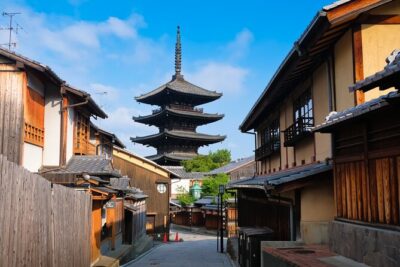
The itinerary ends near Yasaka no To temple in the Yasaka Kamimachi area. The final description refers to a picturesque five-story Buddhist pagoda with broad views from the top, followed by a finish at a nearby local cafe.
There is a small point to clarify here: food and drinks are not included, so any cafe purchase is your own expense. The available details also do not promise a paid interior visit or a specific cafe reservation. Treat the ending as a nearby stopping point rather than a formal meal.
What the guides add to the experience
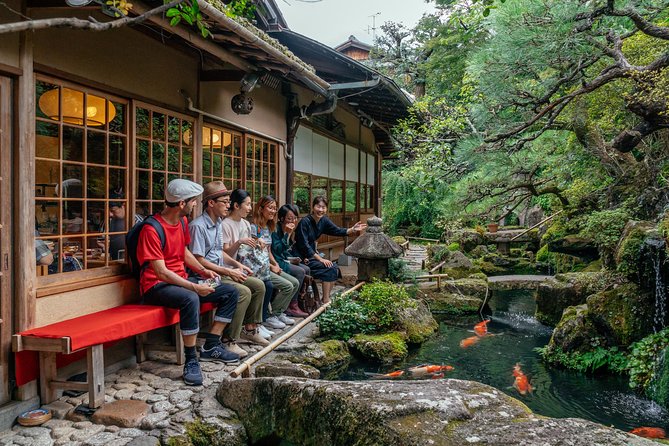
The strongest part of this tour is the guide’s ability to turn a short walk into a conversation. Ted receives repeated praise for his passion, warmth, and respect for Kyoto and the geisha community. He has also been effective with children aged 10 and 14, answering detailed questions without losing the adults in the group.
Guia is praised for bringing history and culture to life, especially when explaining geisha traditions and religious customs. Shohei’s style is described as warm, friendly, and relaxed, with time for photos and questions. Maha has been valued for steering a group away from crowds and finding a beautiful temple and grounds that might otherwise have been missed.
Ahmed has led discussions about Japanese culture and traditions, including on a New Year’s Day visit. Kako has handled rainy conditions well and made the shrine, Buddhist temple, and other stops enjoyable despite the weather.
Guide quality can vary because several hosts lead the experience. That is worth remembering when you book. Still, the pattern is encouraging: the praised qualities are not flashy entertainment but patience, cultural respect, clear explanations, and the ability to adjust the walk to the group.
Price, pace, and practical value
At $135.45 per person, the price needs to be judged against your group size. For one or two people, it is a considerable cost for a 2-hour-30-minute walk. For a family or small group, the private format can make better financial sense, especially with group discounts available.
You are paying for a local guide’s time and for a route designed around your interests, not for entrance tickets or transport. All listed stops are free of admission, and hotel pickup and drop-off are not included. That makes the tour best suited to people already staying near central Kyoto and willing to reach the Kawabatacho meeting point on their own.
The start is at Kawabatacho in Higashiyama Ward. The end is near Yasaka no To in Yasaka Kamimachi. Since the route finishes in a useful sightseeing area, you can continue exploring afterward, subject to your own plans and energy.
Wear shoes you can walk and climb in. Service animals are allowed, and the route is near public transportation. A moderate level of physical fitness is advised because of the walking and temple steps.
The tour is also described as carbon neutral. That is a useful feature for anyone trying to keep local sightseeing low-impact, particularly since this experience relies on walking rather than a private vehicle.
Free cancellation is available if you cancel at least 24 hours before the start time. Changes or cancellations inside that window are not accepted for a refund, and the cutoff follows Kyoto local time.
Who should book this Gion experience?
I would recommend it to first-time visitors who have limited time and want a clear introduction to Gion. It also suits families, couples, and small groups who prefer conversation over a fixed script.
You are likely to get the most from it if you want to understand:
- Why kabuki matters in Kyoto
- How geisha and geiko traditions fit into Gion
- The difference between Shinto shrines and Buddhist temples
- How Kyoto’s old streets connect to the former capital
- Where to walk next after the guided route ends
I would be more cautious if you want extensive temple interiors, a geisha performance, a food tour, or a full-day overview of Kyoto. The itinerary moves quickly, and several stops last only 10 minutes. It gives you a strong introduction, not a complete study of each site.
Should you book it?
Book this private walk if you want a friendly guide, a compact route through Gion and Higashiyama, and clear explanations of geisha culture and Japanese religion. The repeated praise for Ted, Guia, Shohei, Maha, Ahmed, and Kako suggests that the human side of the experience is its main strength.
Skip it if you prefer to explore alone, already know Gion well, or want admission-based sightseeing rather than street-level interpretation. For most first visits, though, the price is reasonable for a small group that values personal attention, especially when you use it as an early Kyoto orientation and continue on foot afterward.
FAQ
How long does the tour last?
The tour lasts approximately 2 hours and 30 minutes.
Is this a private tour?
Yes. Only your own group participates, with a private local guide.
Where does the tour start?
The meeting point is in Kawabatacho, Higashiyama Ward, Kyoto, at postal code 605-0076.
Where does the tour finish?
The route ends in the Yasaka Kamimachi area of Higashiyama Ward, near Yasaka no To temple.
Are food and drinks included?
No. Food and beverages are not included unless specifically listed, and the nearby cafe stop at the end is at your own expense.
Are entrance tickets included?
The listed stops have no admission ticket charge. The experience does not state that interior admission to paid attractions is included.
Is hotel pickup provided?
No. Hotel pickup and drop-off are not included.
Can I cancel for a full refund?
Yes, if you cancel at least 24 hours before the experience start time. Cancellations or changes made less than 24 hours before the start time are not accepted for a refund.
Just added in Kyoto
- The “Golden Route” and Ancient Japan by DIAMIR Erlebnisreisen – 14-Day Tour★ 2.0 · 2 reviews
- Japan: Castles & Cuisine by G Adventures – 6-Day Kyoto to Osaka Tour★ 4.5 · 4 reviews
- Cycle Japan by Explore! – 13-Day Kyoto to Tokyo Tour★ 4.7 · 12 reviews
- Cycle Japan by Intrepid Travel – 11-Day Kyoto to Tokyo Tour★ 4.8 · 2 reviews
- Classic Japan by Intrepid Travel – 11-Day Kyoto to Tokyo Tour★ 4.4 · 14 reviews
- Ancient & Modern Japan 14-Day Tour by Exodus Adventure Travels★ 4.4 · 40 reviews
- 5 Day Cultural Adventure of Kyoto, Nara & Osaka by Tourist Journey★ 2.5 · 2 reviews
- 12 Days Kinosaki Onsen Escape: A Journey Through Japan’s Timeless Towns by UME Travel★ 4.8 · 5 reviews
Private Tours in Kyoto, compared.
Kyoto 6hr Private Tour with Government-Licensed Guide
Read our review →
10 Must-see Spots in Kyoto One Day Private Tour (up to 7 people)
Read our review →
Kyoto 4hr Private Tour with Government-Licensed Guide
Read our review →
Private Kyoto Tour with Licensed Guide & Vehicle (Max 15 persons)
Read our review →
Kyoto Customized Private Tour: See Top Attractions in 1 Day
Read our review →
Explore Kyoto | Private Tour – Local English Driver(guide option)
Read our review →
Highlights & Hidden Gems With Locals: Best of Kyoto Private Tour
Read our review →Browse the lists this tour appears in