
Reviewed · CITY TOURS AND SIGHTSEEING
Kyoto Half Day Highlights Tour
Kyoto packs centuries into one afternoon. This 3.5-hour walking tour links Gion, Kiyomizu-dera Temple, and Fushimi Inari-taisha Shrine without asking you to plan every turn yourself. I like the smart route and the chance to hear local stories from guides such as Mari and Marie. I also like the small maximum of 12 people, which keeps the walk more personal. The main catch is pace: this is a lot of Kyoto on foot, and the route includes slopes, steps, and the long paths at Fushimi Inari.
I especially appreciate the included Kiyomizu-dera admission and the easy one-way design, starting near Gion-Shijo Station and ending by Fushimi Inari. You do not waste time circling back across the city. Still, the 3 p.m. start means the tour is best for an afternoon and evening plan, not for seeing every part of either major site at length.
In This Review
- Key points to know before booking
- Why this route works for a short Kyoto visit
- Gion at 3 p.m.: Kyoto’s old entertainment district
- Yasui-Konpiragu and Hokan-ji: small stops with strong character
- Ninenzaka and Sannenzaka: Kyoto on foot
- Kiyomizu-dera: the main temple visit
- The move to Fushimi Inari and its famous torii gates
- What the guides add to the experience
- Is $50 a fair price?
- Who should book this Kyoto walk?
- Final verdict: a smart first look at Kyoto
- FAQ
- How long does the Kyoto Half Day Highlights Tour last?
- Where does the tour start?
- Where does the tour end?
- How many people can join the tour?
- Is admission to the temples and shrines included?
- Is public transportation included?
- What happens if the weather is poor?
Key points to know before booking
- Six major Kyoto stops in 3.5 hours: Gion, Yasui-Konpiragu, Hokan-ji, Ninenzaka and Sannenzaka, Kiyomizu-dera, and Fushimi Inari.
- A small group of up to 12 people: This gives the guide room to answer questions and adjust the experience when possible.
- A one-way route with a useful finish: The tour ends at Inari Station, near both the Fushimi Inari JR and Keihan stations.
- The best parts require walking: Expect historic lanes, stone slopes, temple grounds, and the torii gate paths at Fushimi Inari.
- Strong guide-led storytelling: Mari and Marie are praised for clear explanations, humor, local customs, and help with photos.
- Good value at $50 per person: You pay for guiding, route planning, and Kiyomizu-dera admission, while public transport and snacks cost extra.
Why this route works for a short Kyoto visit
Kyoto can swallow a day before you reach the places you came to see. Gion, Kiyomizu-dera, and Fushimi Inari are spread across the southern and eastern parts of the city, so a first-time visit can involve plenty of map checking and station confusion.
This tour solves part of that problem with a logical southbound route. You meet at Gion-Shijo Station, walk through the old Higashiyama area, visit Kiyomizu-dera, then continue by public transportation toward Fushimi Inari. The tour ends in front of the shrine, at Inari Station, rather than returning you to the start.
That one-way arrangement matters. You get a compact look at Kyoto’s traditional streets and two major religious sites, then remain in a useful spot for continuing your evening. The tour does not pretend to show all of Kyoto. It gives you a strong first taste of the city’s old lanes, Buddhist temple culture, Shinto worship, and famous photo spots.
The group limit of 12 is another practical advantage. A smaller group makes it easier to hear the guide in crowded lanes and ask about details that might otherwise pass unnoticed. The experience has also been praised for its relaxed mood, with guides adding humor and local facts instead of delivering a dry lecture.
More Sightseeing Tours in Kyoto:
- Kyoto: Private Highlights Tour with Guide and Luxury Vehicle
★ 4.6 · 316 reviews - Kyoto: Full-Day City Highlights Bike Tour with Light Lunch
★ 5.0 · 52 reviews - Kyoto & Uji: Full Day Sightseeing Tour from Osaka or Kyoto
★ 5.0 · 25 reviews
Gion at 3 p.m.: Kyoto’s old entertainment district
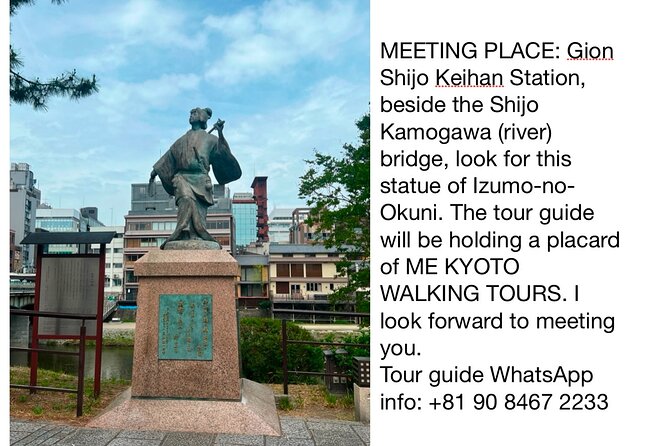
The meeting point is at Gion-Shijo Station, at 1 Chome Miyagawasuji in Higashiyama Ward. The walk begins in Gion, Kyoto’s famous geisha district, where narrow streets and traditional buildings give you an immediate sense of the city’s older character.
You spend about 30 minutes here, with no separate admission fee. That is enough time to get oriented and hear about geisha culture, customs, and the role of the district, but not enough for a lengthy exploration of every lane.
Gion is often treated as a photo backdrop. A guide adds useful context by explaining what you are seeing and helping you understand why the district looks and feels different from modern Kyoto. The guides Mari and Marie have received particular praise for mixing historical details with local fun facts and humor.
Keep your expectations sensible. Gion can be busy, and the tour is a walking introduction rather than a performance or a private geisha encounter. You should also be respectful around residents and working businesses. The value here comes from seeing the district as a living part of Kyoto, not simply collecting photographs.
Yasui-Konpiragu and Hokan-ji: small stops with strong character
The next stop is Yasui-Konpiragu Shrine, reached during a short walk through Higashiyama. You have about 10 minutes in the peaceful grounds, where the main feature is a large power stone with a passageway through it.
The stone has a symbolic role connected with breaking unwanted ties and forming better ones. The stop is brief, but it gives the tour a quieter pause between the busy streets of Gion and the famous temple route ahead. I like this kind of inclusion because it keeps the outing from becoming a simple parade of headline attractions.
Hokan-ji Temple follows, with about 10 minutes to see the structure commonly called Yasaka Pagoda. The five-story pagoda rises 46 meters and is the last remaining structure from a temple complex dating to the sixth century.
You will not have time for a long visit here. Instead, the guide helps place the pagoda within Kyoto’s older cityscape and explains why it is such a recognizable part of Higashiyama. This is also one of the areas where the walk becomes especially photogenic, though narrow streets and crowds can make stopping difficult.
These two short visits work best as part of the larger route. If you want extended time at every shrine and temple, the schedule will feel tight. If you want the guide to point out meaningful places you might otherwise pass without understanding, the stops earn their place.
Ninenzaka and Sannenzaka: Kyoto on foot
The walk then reaches Ninenzaka and Sannenzaka, two historic stone-paved slopes leading toward Kiyomizu-dera. You spend about 20 minutes here, moving through lanes lined with traditional buildings, small shops, and places selling local goods and food.
This section is one of the clearest reasons to choose a walking tour instead of a purely vehicle-based sightseeing trip. You experience the change in elevation and the old street layout at ground level. The route also connects the smaller stops to Kyoto’s best-known temple in a natural way.
The slopes are attractive but not effortless. Wear comfortable shoes, as several people specifically praised the route while warning that it requires plenty of walking. The stone paving can also make the going slower, especially in a group.
You may want to resist spending too much time browsing here. The itinerary gives you a short window before Kiyomizu-dera, and lingering in shops could mean less time at the temple. If you want souvenirs, note potential purchases for later and stay with the group.
A few more options to weigh up in Kyoto
- PERFECT KYOTO 1-Day Bus Tour
★ 5.0 · 13,518 reviews - [Kyoto & Nara Day Tour] Sagano Scenic Railway & Nara Park & Fushimi Inari Taisha Thousand Torii Gates & Togetsukyo Bridge & Bamboo Grove & Kimono Forest (Departing from Osaka)
★ 4.9 · 10,942 reviews - Kyoto: Fushimi Inari, Kinkakuji, Bamboo Grove 1 Day Bus Tour
★ 4.8 · 4,316 reviews - Kyoto: Tea Ceremony in a Traditional Tea House in Kiyomizu
★ 4.9 · 3,519 reviews
Kiyomizu-dera: the main temple visit
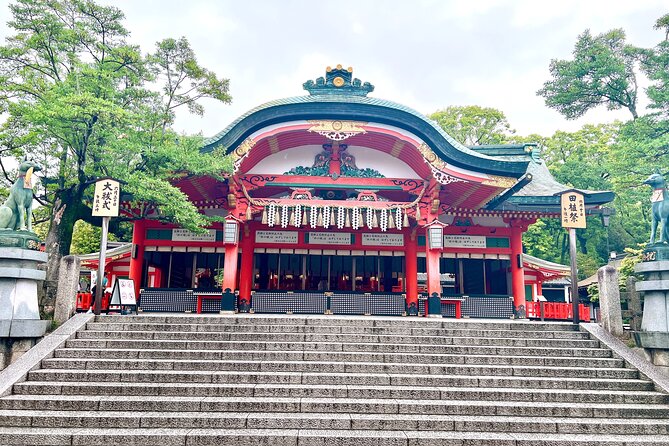
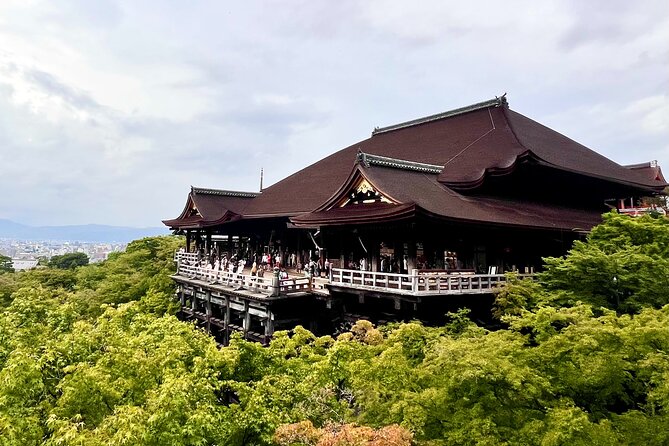
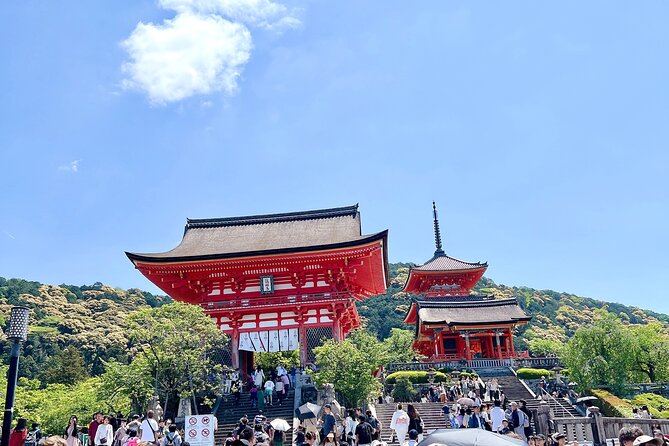
Kiyomizu-dera receives about 45 minutes, the longest stop before Fushimi Inari. Admission is included, which helps the $50 price feel more reasonable.
The temple is famous for its broad wooden terrace and views over Kyoto. The grounds also include pagodas and sacred waterfalls, with water believed to have special powers. Your guide can help explain the Buddhist setting, customs, and meaning behind the features rather than leaving you to guess what each area represents.
Forty-five minutes gives you time to see the main points and take photographs, but it is not a full temple study. Kiyomizu-dera is a place where you could easily spend much longer, especially if you want to inspect side buildings, shop in the approach streets, or pause at each religious feature.
That time limit is the tour’s central tradeoff. You gain access and structure, but you give up the freedom to explore at your own speed. I would choose this format if Kiyomizu-dera is one of several priorities. If it is your single most important Kyoto sight, plan a separate return visit.
The temple section also follows a fairly active walk through Higashiyama, so tired legs may affect how much you enjoy it. The guide-led format helps you keep moving and avoid losing time, but you should not expect a slow, meditative temple visit.
The move to Fushimi Inari and its famous torii gates
Public transportation is not included. The listed cost is ¥220 per person, so you should keep that amount ready for the transfer toward Fushimi Inari. This is a small added expense, but it is worth noting when comparing the tour price with a self-guided route.
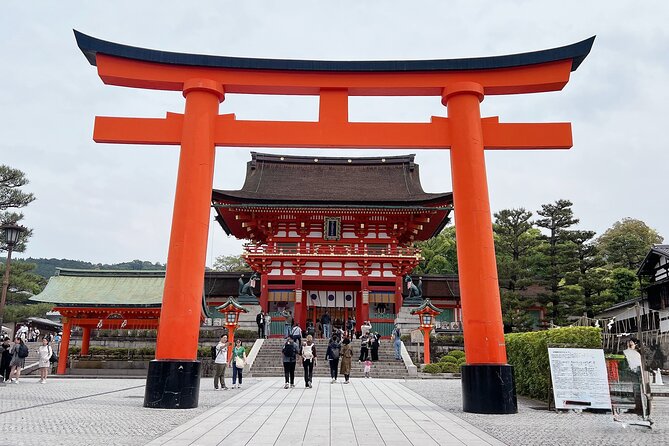
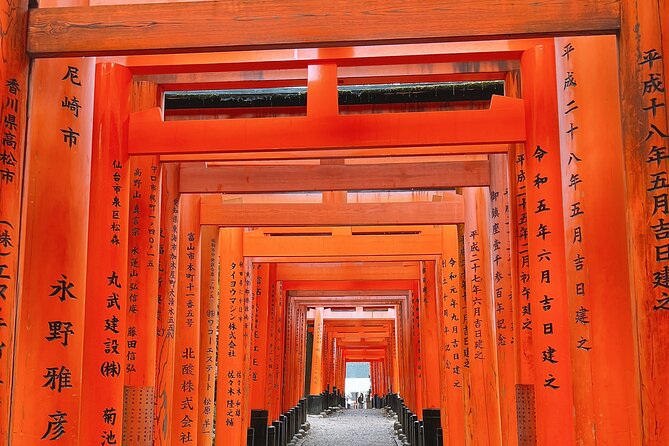
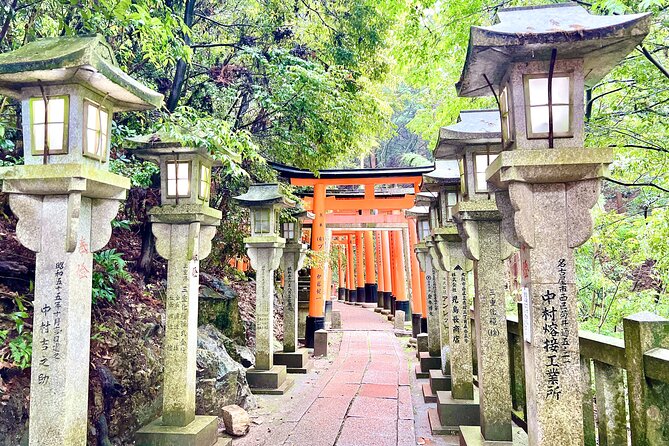
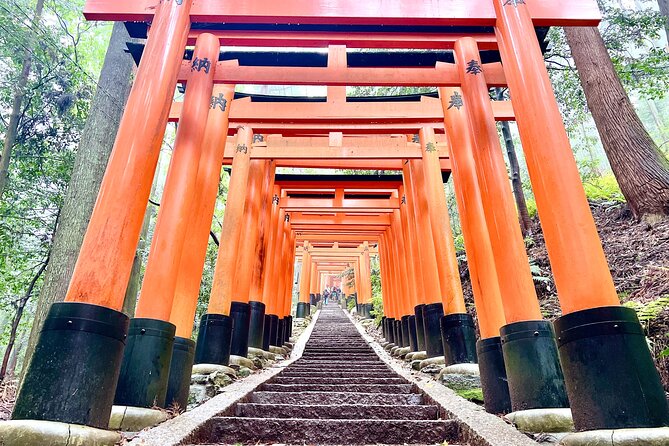
Fushimi Inari-taisha receives about one hour. The shrine is dedicated to the god of rice and prosperity, and its most famous feature is the long series of orange torii gates winding up the mountain.
The first gate tunnels are often the busiest and most photographed. The path continues uphill, so the experience can become more demanding the farther you go. In one hour, you can enjoy the striking lower section and walk far enough to understand the scale of the shrine, but you should not expect to complete the mountain route.
This is the tour’s strongest visual finish. After the streets, pagoda, temple terrace, and stone slopes, the repeated torii gates create a very different mood. The guide’s explanations about the shrine’s purpose and history add meaning to what could otherwise become a quick photo stop.
The route ends in front of Fushimi Inari Shrine, close to Fushimi Inari JR Station and the Keihan Line station. That is convenient if you plan to continue on your own, but remember that the formal tour ends there. You are not being returned to Gion.
What the guides add to the experience
The strongest praise centers on the guides. Mari is described as funny, flexible, and full of useful information about geisha culture, Shinto shrines, Buddhism, local customs, and Kyoto’s past. Marie is also praised for clear explanations, humor, good photographs, and a friendly manner.
That matters because the route is easy to photograph but less easy to interpret. A pagoda is more than a tall building when you understand its place in a former temple complex. A torii gate is more than an orange frame when you know why it was placed there and what Fushimi Inari represents.
The guide style also appears adaptable. One guide adjusted timing for a participant delayed by travel problems, and another adjusted the route to suit the group. I would treat that as a welcome possibility, not a promise that every late arrival or personal request can be accommodated.
The best guide-led walks leave you with questions answered and a few details to notice later. This tour seems particularly suited to you if you enjoy learning the meaning behind customs and buildings while walking, rather than reading a guidebook after the fact.
Is $50 a fair price?
At $50 per person, the tour is not the cheapest way to see these locations. You could visit the public areas independently and avoid the guide fee. You would still need to organize the route, manage transport, research the sites, and work out how much time to spend at each stop.
The value comes from the combination of planning and explanation. The route covers six distinct stops in a short period, includes Kiyomizu-dera admission, and finishes at a useful station rather than sending you back to the beginning. For a first afternoon in Kyoto, that can save more effort than the price suggests.
The small group also strengthens the case for the cost. With no more than 12 people, the guide can offer a more direct experience than a large coach outing. You are paying for structure, not luxury.
Budget separately for ¥220 in public transportation and for snacks. Food is not included, and the 3 p.m. start may place you between lunch and dinner. Bring water, particularly in warm or humid weather. One account specifically noted that Kyoto humidity can be tough.
Who should book this Kyoto walk?
I would recommend it most strongly to first-time visitors with limited time. It is also useful for solo visitors who want company, families with older children who can manage a long walk, and anyone who prefers a guide to handle the route.
It suits you if you want:
- A compact introduction to Kyoto’s major southern and eastern sights
- Context about geisha culture, Buddhism, Shinto customs, and local history
- A small group rather than a large sightseeing crowd
- A practical route that ends near a train station
- A guide who can help with photos and answer questions
I would hesitate if you have limited mobility, dislike hills and steps, or prefer to linger at one temple. The tour requires a moderate level of physical fitness. The schedule is also less suitable if you want a quiet, unhurried visit to Kiyomizu-dera or a long climb through the Fushimi Inari gates.
The 3 p.m. start can work well for a half-day plan, but check your wider schedule carefully. The experience depends on good weather, and poor conditions may lead to a different date or a full refund. Free cancellation is available up to 24 hours before the start time. Changes or cancellations inside that window are not refunded.
Final verdict: a smart first look at Kyoto
I would book this tour if I had only a short stay and wanted to see Kyoto’s essential southern sights with a local guide. The route is efficient, the group is small, and the finish at Fushimi Inari makes practical sense.
The tradeoff is speed. You will see a lot, but you will not fully explore every temple, lane, or torii path. Bring comfortable shoes, budget ¥220 for transport, and treat the experience as an informed introduction rather than your complete Kyoto plan.
For a short visit, that is a fair bargain. You get the city’s old streets, a major Buddhist temple, an important Shinto shrine, and guide commentary that can make familiar photographs mean much more.
FAQ
How long does the Kyoto Half Day Highlights Tour last?
The tour lasts approximately 3 hours and 30 minutes. It begins at 3 p.m.
Where does the tour start?
The meeting point is Gion-Shijo Station at 1 Chome Miyagawasuji, Higashiyama Ward, Kyoto.
Where does the tour end?
The tour ends in front of Fushimi Inari Shrine, near Fushimi Inari JR Station and the Keihan Line station.
How many people can join the tour?
The tour has a maximum of 12 travelers.
Is admission to the temples and shrines included?
Admission to Kiyomizu-dera Temple is included. The other listed stops have no separate admission ticket shown.
Is public transportation included?
No. Public transportation costs ¥220 per person and is not included in the tour price.
What happens if the weather is poor?
The experience requires good weather. If it is canceled because of poor weather, you can choose another date or receive a full refund.
Just added in Kyoto
- The “Golden Route” and Ancient Japan by DIAMIR Erlebnisreisen – 14-Day Tour★ 2.0 · 2 reviews
- Japan: Castles & Cuisine by G Adventures – 6-Day Kyoto to Osaka Tour★ 4.5 · 4 reviews
- Cycle Japan by Explore! – 13-Day Kyoto to Tokyo Tour★ 4.7 · 12 reviews
- Cycle Japan by Intrepid Travel – 11-Day Kyoto to Tokyo Tour★ 4.8 · 2 reviews
- Classic Japan by Intrepid Travel – 11-Day Kyoto to Tokyo Tour★ 4.4 · 14 reviews
- Ancient & Modern Japan 14-Day Tour by Exodus Adventure Travels★ 4.4 · 40 reviews
- 5 Day Cultural Adventure of Kyoto, Nara & Osaka by Tourist Journey★ 2.5 · 2 reviews
- 12 Days Kinosaki Onsen Escape: A Journey Through Japan’s Timeless Towns by UME Travel★ 4.8 · 5 reviews
City Tours and Sightseeing, compared.
Private City Highlights Tour with Local Guide
Read our review →
Tokyo Private Sightseeing Tour by Car- English speaking chauffeur
Read our review →
Naha: North Okinawa Sightseeing Tour & Churaumi Aquarium
Read our review →
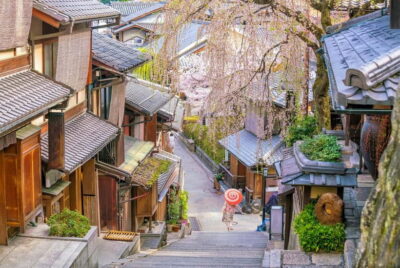
Private Highlights Tour with Guide and Luxury Vehicle
Read our review →
Custom Hidden Gems & Highlights Tour with Local Guide
Read our review →
Mount Fuji Full Day Sightseeing Tour from Tokyo
Read our review →Browse the lists this tour appears in