
Reviewed · CASTLES AND HISTORIC SITES
Osaka: Learn Bushido – Trial Slashing with Samurai Sword
Put on the hakama, then face the tatami. This Osaka experience turns a costume photo into a short but serious introduction to bushido, with sword manners, basic stances, guided practice, and a final cut using a real Japanese sword. I like the small groups, limited to four people, and the clear step-by-step teaching from a certified instructor. I also like that your photos are sent by email, so you can enjoy the session without holding your phone.
The main consideration is time. The advertised duration is one hour, but changing clothes and the teaching pace can make the visit longer. The activity costs $92 per person, which is fair for a private-feeling class with clothing, instruction, test cutting, and photographs, but it is more than a simple samurai dress-up stop.
In This Review
- Key points before you book
- What this samurai class near Osaka Castle really offers
- Finding the dojo at Shiginonishi
- Changing into dogi and hakama
- Beginning and ending with a bow
- Walking with the sword belt
- Practising kata with an iai sword
- The real Japanese sword and trial cutting
- Why the photographs add real value
- How the one-hour format affects the experience
- Is $92 a fair price?
- Who will enjoy this most?
- Booking advice and final verdict
- FAQ
- Where does the samurai experience take place?
- Is the activity inside Osaka Castle?
- How do I identify the meeting point?
- How early should I arrive?
- What language is used during the class?
- What clothing should I bring?
- Is the sword-cutting target bamboo?
- Are photographs included?
Key points before you book
- You practice before cutting: The instructor teaches stances, sword swings, drawing, symbolic blood removal, and returning the blade to its sheath before you handle a real sword.
- The group is tiny: With a limit of four participants, the instructor can watch your movements and adjust the lesson to your pace.
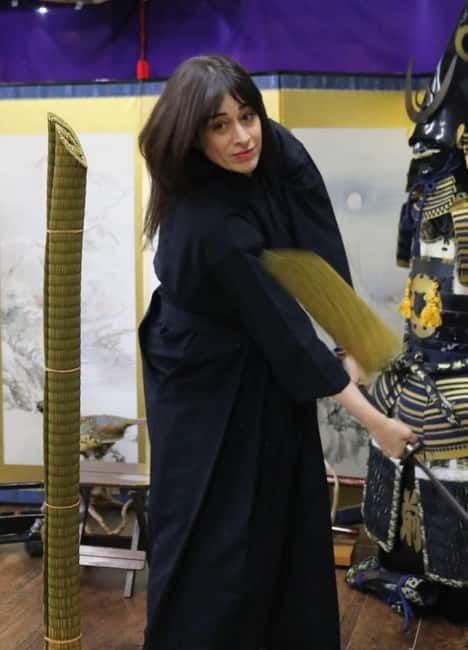
- The final cut uses rolled tatami: It may look like bamboo in photographs, but the target is a rolled straw mat fixed to a stand.
- You wear proper training clothes: The experience provides a dogi and hakama, giving the lesson a more authentic feel than a quick rental costume.
- The setting is close to Osaka Castle Park: The venue is across the river from Osakajokoen Station, though the actual address is in Joto-ku rather than inside the castle grounds.
- Photos are included: Staff photograph the sword-cutting moment and send the images to your designated email address.
What this samurai class near Osaka Castle really offers
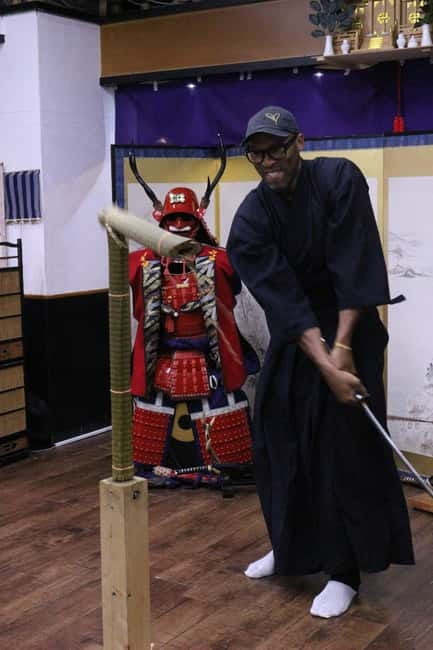
This is not a stage show where you watch a swordsman perform and then pose with a prop. You take part in a compact martial arts lesson. The instructor first teaches the customs and body positions, then has you repeat the movements with an iai practice sword. Only after that preparation do you attempt tameshigiri, the cutting of a rolled straw target.
That difference matters. You are not simply handed a katana and told to swing. The lesson treats the sword as a serious weapon with rules around how you hold it, walk with it, draw it, and put it away. The tone is respectful, but the class is still friendly and approachable.
The English and Japanese instruction works best for visitors who are willing to watch closely and copy the movements. An English interpreter is the default, and staff may be able to arrange Italian, Spanish, French, Chinese, Thai, or Indonesian support if you ask about availability before booking. Other-language assistance is not guaranteed, since staff schedules are limited.
More Castles and Historic Sites in Osaka
- Osaka Castle Ticket
★ 4.7 · 12,450 reviews - Osaka Castle: Museum and Tower Entry Ticket
★ 4.5 · 2,380 reviews - Ultimate Osaka Walking Tour: Castle, Dotonbori & Hidden Gems
★ 5.0 · 862 reviews
Finding the dojo at Shiginonishi
The actual venue is Bushi no Homare, also described as Samurai Honor. Its address is Excellence Takayama 1F, 2-3-19 Shiginonishi, Joto-ku, Osaka-shi, Osaka 536-0014.
Osakajokoen Station is the useful rail reference. One participant found the building easy to reach from the station, across the river. Still, do not assume the venue is inside Osaka Castle Park. You are visiting the castle area first, then heading to a nearby neighborhood location for the class.
Look for a wooden sign marked Honor of the Samurai. A rack of activity pamphlets sits in front of the shop, and hanging kimono and hakama may help you spot the entrance. Use Google Maps rather than Apple Maps, since the Apple Maps address is reported as incorrect.
Arrive 30 minutes before your booked start. That buffer is needed for directions and changing clothes, not for sightseeing or a formal welcome ceremony. Wear a T-shirt underneath, since it is the one item specifically requested.
Changing into dogi and hakama
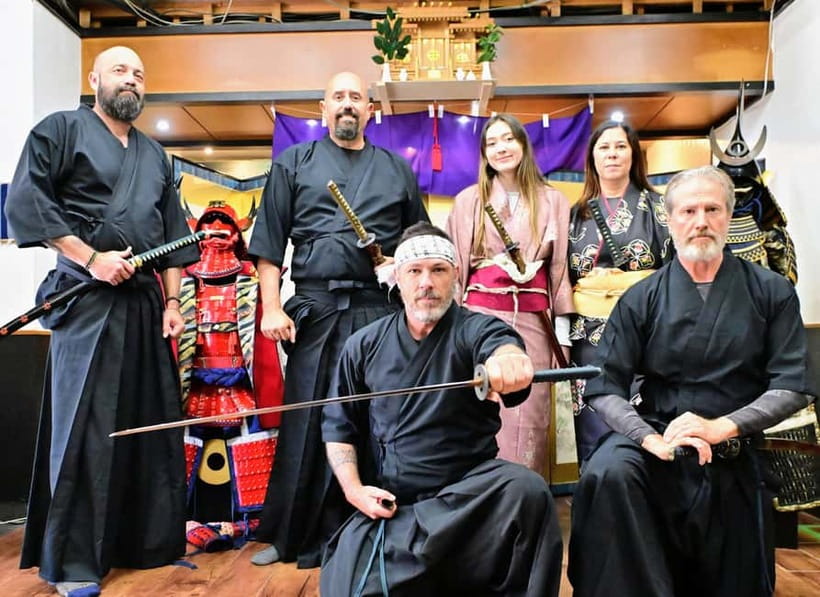
The session begins with preparation. You change into a dogi, the white training jacket, and hakama, the pleated trousers traditionally linked with samurai clothing. This is more practical than a loose costume because the clothing supports the formal movements of the class.
You may also have the chance to try on real samurai armor, though that detail is not presented as a guaranteed part of every session. Treat it as a possible extra moment rather than the central promise of the class.
The clothing helps you shift from sightseeing mode to training mode. You will be learning foot positions, holding a blade correctly, and following rules of courtesy. The outfit makes those actions feel less like a photo prop and more like a lesson.
The practical drawback is that changing takes a portion of your visit. If you have a packed Osaka Castle schedule, leave enough space between this activity and your next reservation.
Beginning and ending with a bow
The dojo contains a shrine, and training begins and ends with a bow before it. This simple ritual gives the hour a clear shape. The point is not theatrical mystery. It reflects the idea that budo joins mind, technique, and body, rather than treating sword work as a sport alone.
You also learn about samurai manners and the place of the sword in samurai life. The instructor explains that a sword was tied to personal responsibility, honor, and status. Historical points include the tradition of learning sword use from an early age and receiving permission to wear a serious sword belt at around age 15.
Some of the cultural explanation is deliberately traditional in tone. You hear about loyalty, discipline, courtesy, and the belief that the sword was the soul of the samurai. For you, the value is not in memorizing every historical detail. It is in understanding why the movements are controlled and why the instructor insists on ceremony before action.
The class also introduces samurai language connected with the Warring States period. This is a small section, but it adds cultural context to the physical practice.
More Castles and Historic Sites in Japan:
- Tokyo: Imperial Palace and Shogun Historical Walking Tour
★ 5.0 · 2,251 reviews - Tokyo: Samurai Restaurant Show Ticket with 2 Drinks
★ 4.5 · 1,307 reviews - Kyoto Samurai Experience
★ 5.0 · 1,294 reviews - Tokyo Castle & Imperial PalaceーShogun Walking Tour
★ 4.7 · 1,068 reviews
Walking with the sword belt
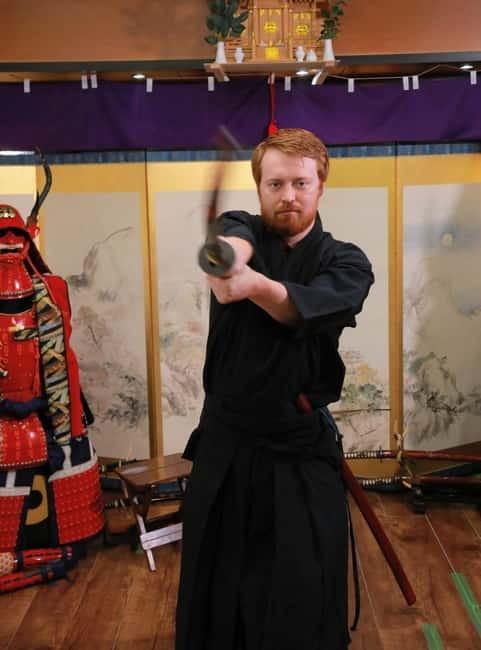
Before swinging, you practice how to wear the belt and how to walk with a sword. This can be easy to overlook, but it is one of the most useful parts for understanding samurai manners.
A sword was not treated like a modern sports tool. It was carried close to the body, and the way you moved around other people mattered. The lesson uses basic gestures to show how a samurai handled the weapon with care.
You will likely find this section less exciting than the final cut, especially if you arrive hoping for fast action. Still, it slows the experience down in a good way. The instructor is teaching control before power, which is exactly what you need before touching a live blade.
Practising kata with an iai sword
The first sword work uses an iai practice sword rather than the real blade used for tameshigiri. The instructor demonstrates the core sequence and has you repeat it under supervision.
The main actions include:
- Battou: drawing the sword from its scabbard as part of the cutting action
- Chiburui: symbolically removing blood from the blade after a cut
- Nottou: returning the sword to its sheath
You also work through basic stances. These include middle stance, upper stance, lower stance, eight-phase stance, and side stance. The names may come quickly, but the small group gives you a chance to copy each position and correct your body before moving on.
The instructor then adds basic kata and sword swings. The key instruction is not to force the sword downward with your arms. Instead, you are taught to use the weight of the sword and keep the movement controlled. When the swing is done correctly, the blade should make a hi-nari sound.
That sound becomes a useful check. It is not about making the loudest noise or swinging hardest. It tells you that the blade and your movement are working together. The lesson becomes more satisfying when you stop trying to act like a movie samurai and begin following the mechanics.
The real Japanese sword and trial cutting
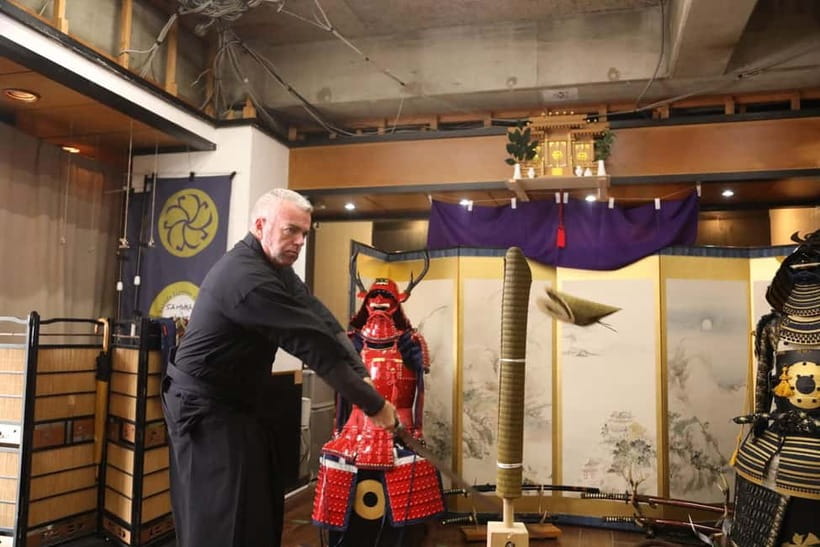
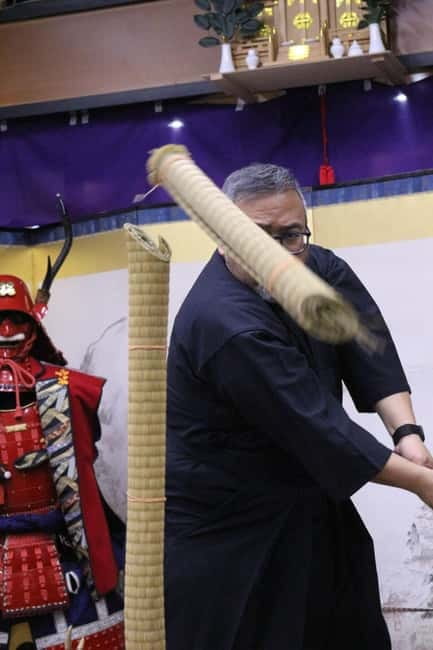
The final stage is the part most people are waiting for: cutting a rolled straw target with a real Japanese sword. The target is rolled tatami, not bamboo, despite its appearance in some photographs.
You do not begin with this step. The master swordsman first watches your stance, grip, and swing. Once the instructor is satisfied with your basic movements, you progress to more advanced actions and then prepare for the cut.
This order makes the activity safer and more meaningful. A real Japanese sword is sharp, and the lesson treats it accordingly. You get the excitement of handling an authentic blade without being pushed into a dangerous stunt at the start.
The cut itself is brief. Your preparation takes much longer than the moment when the sword passes through the tatami. That is part of the value. The class shows that a clean cut depends on angle, alignment, timing, and follow-through, not brute force.
You might find the target-cutting section easier or harder than expected. Success depends on your movement and the instructor’s corrections, so the experience is not just a guaranteed photo opportunity. The final attempt feels earned because you have already repeated the stance and swing many times.
Why the photographs add real value
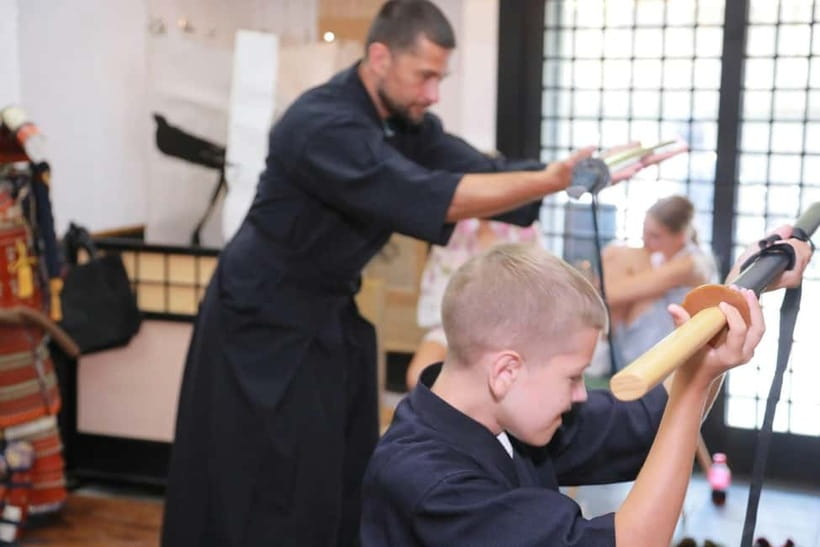
A staff member photographs the session, including the moment of test cutting. The images are sent to your designated email address after the activity.
That service is especially useful here. You will be wearing formal clothing, handling a sword, and trying to maintain a precise stance. Stopping to take your own pictures would interrupt the lesson and could be unsafe around the blade.
Staff are also willing to take pictures on your phone, according to the experience details. You should still follow the instructor’s directions about when a phone can be used. The included photographs make the $92 price easier to justify, particularly if you are sharing the activity with family or friends.
The photos capture more than the final cut. They can record the clothing, the formal poses, and the training process. If you want a polished personal record of the visit, this is stronger than a basic costume rental.
How the one-hour format affects the experience
The official duration is one hour, but you should plan more time around it. Arriving 30 minutes early for changing is required, and some sessions may run longer depending on group size, interpretation, and the pace of instruction.
One family described the lesson as a quick bushido introduction, while another said the teaching took almost two hours. That difference may come from the number of participants, changing time, explanations, photographs, or the instructor’s pace.
The small group limit helps. With no more than four people, you are not lost in a large class, and the master can move from basic to advanced movements when the group is ready. If you are alone, you might receive a more personal session. One solo participant had the class to themself and praised the guide’s explanations and the number of photographs.
If you need to catch a train or reach a timed dinner, do not schedule it immediately afterward. Give yourself a generous cushion.
Is $92 a fair price?
At $92 per person, this is not the cheapest cultural activity in Osaka. You are paying for a certified professional instructor, samurai clothing, English or Japanese support, the training session, the real-sword cutting attempt, tax, tips, and photographs.
The value is strongest if you want active participation. You receive far more than a short demonstration because you learn the basic movements and the etiquette around the sword. The small group also gives the class a more personal feel than a large attraction.
The price is less compelling if your main goal is only to wear a costume for a few minutes. In that case, a simpler photo experience may suit you better. Here, the clothing is only the doorway into the lesson.
There are no extra charges for tax, tips, or the included photo service. Paid movie shooting is separate, and transportation to the venue is not included. You arrange your own route from the station or hotel.
Who will enjoy this most?
I would recommend the class to adults and children age 10 or older who can listen carefully and follow physical instructions. The activity suits families particularly well because parents can take part rather than simply watch. One family of four enjoyed the experience together, with both children and adults excited to handle the swords.
It also suits anyone who grew up watching samurai films or Japanese historical dramas. The class replaces screen choreography with controlled body movements, formal etiquette, and the challenge of making a clean cut.
You should skip it if you want a passive show, dislike changing clothes, or have no patience for repeated practice. It is not designed for bachelor or bachelorette groups, party groups, or anyone bringing food, drinks, alcohol, or drugs into the activity.
Baby strollers and baby carriages are not allowed. Children under 10 and people over 95 are not suitable for the experience. The information also lists people with altitude sickness as unsuitable, though altitude is not a central feature of this Osaka class.
Booking advice and final verdict
Book this if you want a hands-on cultural activity after visiting Osaka Castle, especially if you value patient instruction and good photographs. The strongest features are the group size, the gradual training, the chance to cut rolled tatami with a real Japanese sword, and the cultural explanation behind each gesture.
Before reserving, confirm the starting time, check the language arrangement if you need support beyond English or Japanese, and save the Google Maps location. Plan to arrive 30 minutes early and allow extra time after the advertised hour.
I would choose this for a family, a solo visitor interested in martial arts, or anyone seeking a memorable Osaka activity that is more substantial than dressing up. I would not choose it for a rushed itinerary or for a party-style outing. With a 4.9 rating from 59 bookings, the experience has a strong record, and the praise centers on the things that matter most here: friendly teaching, patient correction, useful cultural detail, and the thrill of cutting tatami after proper preparation.
FAQ
Where does the samurai experience take place?
It takes place at Bushi no Homare, also called Samurai Honor, at Excellence Takayama 1F, 2-3-19 Shiginonishi, Joto-ku, Osaka-shi, Osaka 536-0014.
Is the activity inside Osaka Castle?
No. The venue is near the Osaka Castle area, across the river from Osakajokoen Station. Use the separate venue address and Google Maps directions.
How do I identify the meeting point?
Look for a wooden sign reading Honor of the Samurai. A rack with Samurai Honor activity pamphlets is in front of the store, and hanging kimono and hakama may also help identify the location.
How early should I arrive?
Arrive 30 minutes before your reserved start time. This allows time for instructions and changing clothes.
What language is used during the class?
The standard languages are English and Japanese. Italian, Spanish, French, Chinese, Thai, and Indonesian interpretation may be possible, but you must ask about staff availability before booking.
What clothing should I bring?
Bring a T-shirt to wear under the provided samurai clothing.
Is the sword-cutting target bamboo?
No. The target is a rolled straw or tatami mat. It may look like bamboo in photographs, but the activity uses rolled tatami for the trial cut.
Are photographs included?
Yes. Staff photograph the experience, including the test-cutting moment, and send the images to your designated email address. Movie shooting is a paid option.
Just added in Japan
- Yokosuka: Boat Trip to an Uninhabited Island★ 5.0 · 16 reviews
- Yokosuka : Scenic Hidden Gem Hike and Naval Port Cruise★ 5.0 · 13 reviews
- Very popular in Harajuku♡Animal petting zoo★ 4.6 · 39 reviews
- Yokohama Port: Private Customizable Tour with Transfer★ 5.0 · 19 reviews
- Yokohama Private Tour with a Local: Highlights & Hidden Gems★ 4.4 · 13 reviews
- Yokohama Half Day Tour with a Local Expert Guide★ 4.0 · 20 reviews
- Yokohama Full Day Tour with a Local Expert Guide★ 4.3 · 23 reviews
- Kamakura: Private Guided Walking Tour with Local Guide★ 4.8 · 60 reviews
Castles and Historic Sites, compared.



Imperial Palace and Shogun Historical Walking Tour
Read our review →
Tokyo Castle & Imperial PalaceーShogun Walking Tour
Read our review →
Nijo-jo Castle and Ninomaru Palace Guided Tour
Read our review →
Samurai Ninja Museum Guided tour and Experience
Read our review →Browse the lists this tour appears in