
Reviewed · TEA CEREMONIES
Kyoto: Tea Ceremony with Maiko Premium
Meet Kyoto’s living tradition face to face. This 90-minute Kyoto experience brings you close to a Maiko, Japan’s apprentice entertainer, for matcha-making, questions, dances, games, and photos. I like the direct conversation, and I like that the program gives you much more than a staged tea demonstration. The main catch is the setting: it takes place in a modern building, not a traditional tea house.
For $50 per person, the Premium program offers a lot in a short time. You get two Japanese sweets, matcha, a commemorative photo, a Senjyafuda lucky charm, and two dances. I also appreciate the relaxed tone, which works well for families, though people expecting a formal tatami-room ceremony may find the room plain.
In This Review
- Key points to know before booking
- Why meeting a Maiko matters in Kyoto
- Gojo Station makes the meeting point simple
- The 90-minute schedule, from matcha to farewell
- Making matcha with a Maiko
- The Q&A gives the experience its personal side
- Two dances show the Maiko’s careful artistry
- A playful game breaks the formal mood
- Photos and the Senjyafuda keepsake
- The modern room is the main compromise
- Is the $50 Premium price good value?
- Who will enjoy this Kyoto experience most?
- Practical details for a smoother visit
- Should you book the Kyoto Maiko Premium experience?
- FAQ
- Where is the Maiko tea ceremony held?
- How long does the experience last?
- What is included in the Premium program?
- Is this held in a traditional tea house?
- Will a Maiko always appear?
- Is English available?
- Are children allowed to participate?
- Can I cancel for a full refund?
Key points to know before booking
- The Premium version includes the best parts: two Maiko dances and an interactive game are part of the fuller program.
- You make your own matcha: the Maiko demonstrates the process, then guides you as you prepare your tea.
- The Q&A is a major highlight: you can ask about training, clothing, daily life, and the Maiko tradition.
- Photos are taken up close: you can pose beside the Maiko, and you receive a Senjyafuda as a keepsake.
- The venue is modern rather than historic: expect tables, stools, stairs, and company advertising in some photos.
- Go early and arrive on time: the meeting point is one minute from Gojo Station, but late arrivals cannot delay the program.
Why meeting a Maiko matters in Kyoto
Kyoto’s Maiko are young women training in the traditional arts of dance, music, conversation, hospitality, and formal presentation. Their kimono, elaborate hairstyles, white makeup, and careful movements are not simply costumes for a show. They reflect a demanding cultural path that still exists in modern Japan.
That context gives this experience its value. You are not just watching a performer cross a stage. You have a chance to ask direct questions and hear an explanation of Maiko life from the person sitting in front of you.
The program may sometimes feature a Geiko instead of a Maiko. That is not a lesser version. A Geiko is a more senior entertainer, so the change can give you a different view of Kyoto’s traditional arts. Several participants were pleasantly surprised to find a Geiko leading the session.
This is also a useful option for visitors who cannot arrange a private evening in one of Kyoto’s traditional entertainment districts. The experience offers a friendly introduction without requiring special clothing, etiquette training, or knowledge of Japanese customs.
More Kimono Experiences in Kyoto
- [Kyoto & Nara Day Tour] Sagano Scenic Railway & Nara Park & Fushimi Inari Taisha Thousand Torii Gates & Togetsukyo Bridge & Bamboo Grove & Kimono Forest (Departing from Osaka)
★ 4.9 · 10,942 reviews - Kyoto Geisha Walking Tour: Gion District & Hidden Gems
★ 4.7 · 3,273 reviews - Kyoto: Gion Magical Night Walking Tour with Geisha Trivia
★ 4.9 · 2,393 reviews
Gojo Station makes the meeting point simple
The venue is a one-minute walk from Exit 1 of Gojo Station on the Subway Karasuma Line. The entrance faces Gojo-dori, the main street, so you do not need to hunt through a maze of narrow lanes.
That easy access is a real plus. You can reach the activity directly by subway and avoid building an entire sightseeing day around it. Still, give yourself extra time. The organizers do not hold the event for late arrivals, and the information specifically warns that travel costs are not refunded if you miss the session.
Arriving about 15 minutes early is a smart idea. One participant enjoyed seeing the Maiko arrive by taxi before the program, and staying briefly afterward may let you see her leave. That small moment can feel surprisingly memorable, although it is not a guaranteed part of the activity.
The building has no elevator. You need to use stairs to reach the room, so keep that in mind when planning your day and when deciding if this activity suits everyone in your party.
The 90-minute schedule, from matcha to farewell
The published schedule begins with a greeting from the Maiko. She then leads the tea portion, followed by questions, photos, a small gift, two dances, and a game.
The formal program is expected to finish around the 75-minute mark, followed by chatting time before you leave the room at about 90 minutes. Actual timing can vary. One participant felt the experience lasted closer to 70 minutes, so do not schedule a tight connection immediately afterward.
The pace generally works in your favor. You get several different activities rather than one long talk, and the changes keep children interested. The format also gives you a chance to see the Maiko at close range without making the entire event feel like a quick photo stop.
Making matcha with a Maiko
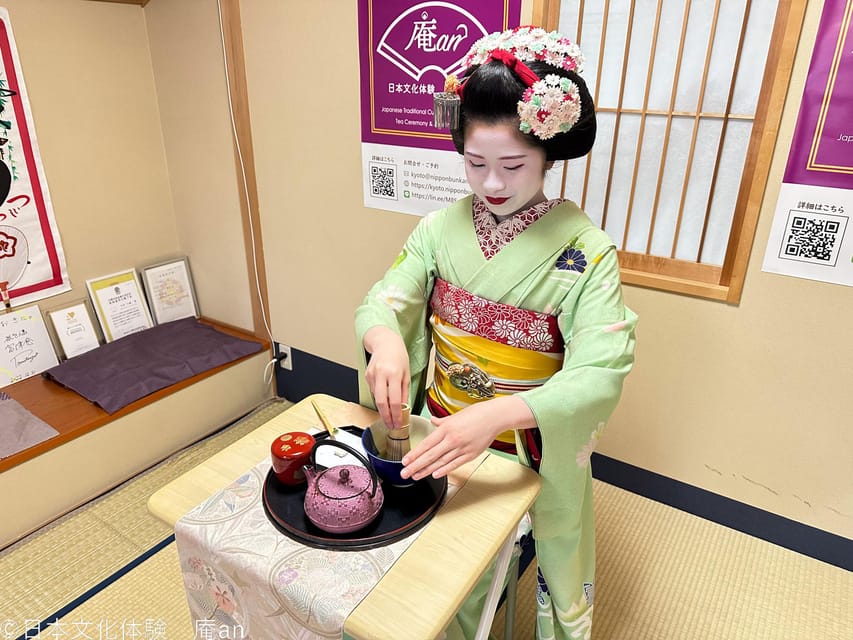
The tea ceremony begins with a demonstration. The Maiko shows you how to prepare matcha and explains the basic method, then you make your own cup.
This is an introductory activity, not an advanced lesson in formal tea ceremony. You should expect a simple, approachable explanation rather than the full discipline and quiet ritual of a traditional tea school. That makes it easier for first-time participants, especially families and people who want to take part instead of only watching.
Your matcha comes with two dried Japanese sweets. The sweets help balance the tea’s strong, grassy flavor and give you a small taste of the presentation that accompanies Japanese tea service.
If you have attended a formal tea ceremony before, this part may seem basic. If this is your first encounter with matcha, it provides a pleasant starting point. You get to handle the whisk, follow the instructions, and drink something you prepared yourself.
The activity includes snacks and a drink according to the stated inclusions. Additional drinks may be available inside for a moderate charge. The tea itself is the main focus, so do not book this expecting a full meal.
More Tea Ceremonies in Kyoto
- Kyoto: Tea Ceremony in a Traditional Tea House in Kiyomizu
★ 4.9 · 3,519 reviews - Kyoto: Tea Ceremony Ju-An at Jotokuji Temple
★ 4.9 · 3,207 reviews - Kyoto: 45-Minute Tea Ceremony Lesson Experience
★ 4.3 · 2,378 reviews - Kyoto: Table-Style Tea Ceremony at a Kyo-Machiya
★ 4.9 · 1,211 reviews
The Q&A gives the experience its personal side
The question session is where the program moves beyond a performance. You can ask the Maiko about her training, daily routines, traditions, and path toward becoming a Geiko.
Past participants have found this especially useful because the answers put the costume and dances into context. One discussion touched on the length of training, including the fact that it can take around five years to complete the process. Questions also give you a chance to learn about details you would never notice from a photograph alone.
The official language is Japanese. English translation is provided as much as possible, and you are asked to contact the provider if you want English support added. The quality of communication may depend on the host and the group, but the format is designed to make questions possible for an international audience.
A host may help interpret and keep the session moving. One highly praised host, Karen, was described as friendly and informative, while another master of ceremonies was able to use both Japanese and English. The host’s role matters because it turns a potentially distant presentation into a conversation.
Think about your questions before you arrive. Ask about the meaning of the hairstyle, the training schedule, the kimono, seasonal dances, or the transition from Maiko to Geiko. A few prepared questions can make the session much more rewarding.
Two dances show the Maiko’s careful artistry
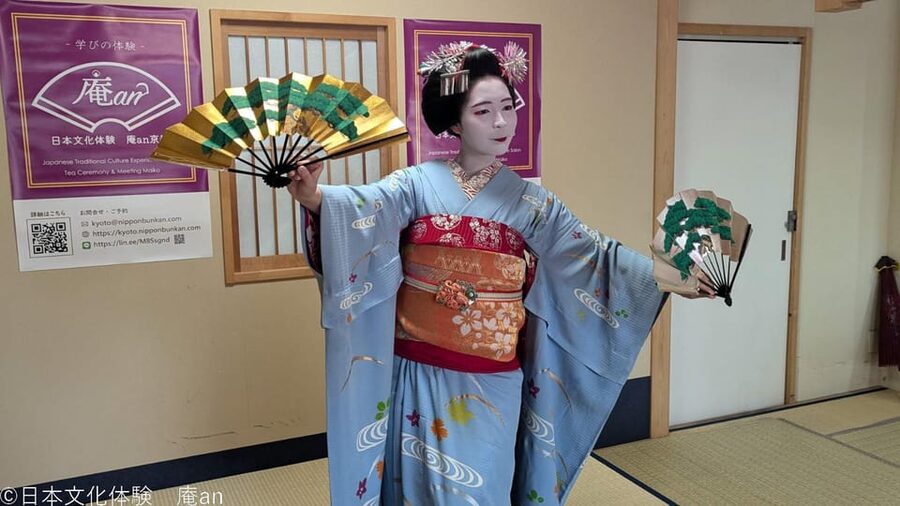
The Maiko performs two traditional dances. Their subjects can relate to the seasons, love stories, or everyday life, and the movements express Japanese ideas of grace and restraint.
Do not expect a long stage production. The appeal is in the details: the controlled posture, the movement of the kimono sleeves, the measured steps, and the careful use of a fan or other dance elements when included. The small room places you close to the performance, so you can notice gestures that might disappear in a large theater.
The dances have been the emotional high point for many people. Some described getting goosebumps, while others praised the beauty and elegance of the performance. That response makes sense because the dance is the clearest display of the years of practice behind the Maiko’s public role.
The room does affect the presentation. It is not a traditional theater or refined tea house, and the backdrop may include large advertisements, a company name, or a QR code. If you care about photography, the background can be distracting. The performance itself remains the strongest visual part of the program, but the surroundings do not always match the mood.
A playful game breaks the formal mood
After the dances, the Maiko leads a simple traditional game. Volunteers can take part, while everyone else can clap, watch, and encourage the players.
This section helps prevent the experience from becoming overly solemn. The Maiko’s formal appearance contrasts nicely with the lighthearted competition, and children often enjoy this part as much as the adults. You might find yourself laughing and cheering even if you arrived expecting a quiet cultural demonstration.
The game also shows another side of Maiko hospitality. The role is not only about performing dance. It includes conversation, social skill, timing, and the ability to make a group feel comfortable.
If you prefer a completely quiet and formal ceremony, the game may feel less serious than expected. For most people, though, it adds warmth and gives you a chance to interact rather than sit still for the entire program.
Photos and the Senjyafuda keepsake
You receive an opportunity to take a commemorative photo directly beside the Maiko. Depending on the flow of the session, photos and videos may also be possible during the presentation, but follow the host’s instructions so the program continues smoothly.
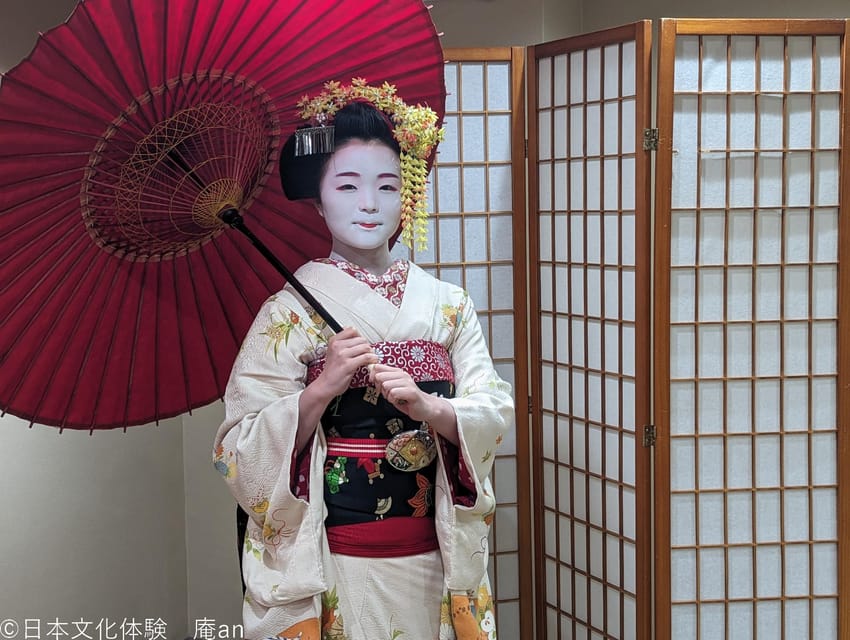
This close photo opportunity is one of the clearest reasons to choose the Premium option. You are not limited to watching from a distance. You can preserve a direct memory of the meeting, often with the Maiko in her full kimono and traditional hairstyle.
The photo backdrop is the weak point. Several people wished for a more Japanese-looking screen, artwork, or room behind the Maiko. Company advertising appears in some images, which can make your souvenir photo feel more like an event photograph than a portrait from old Kyoto.
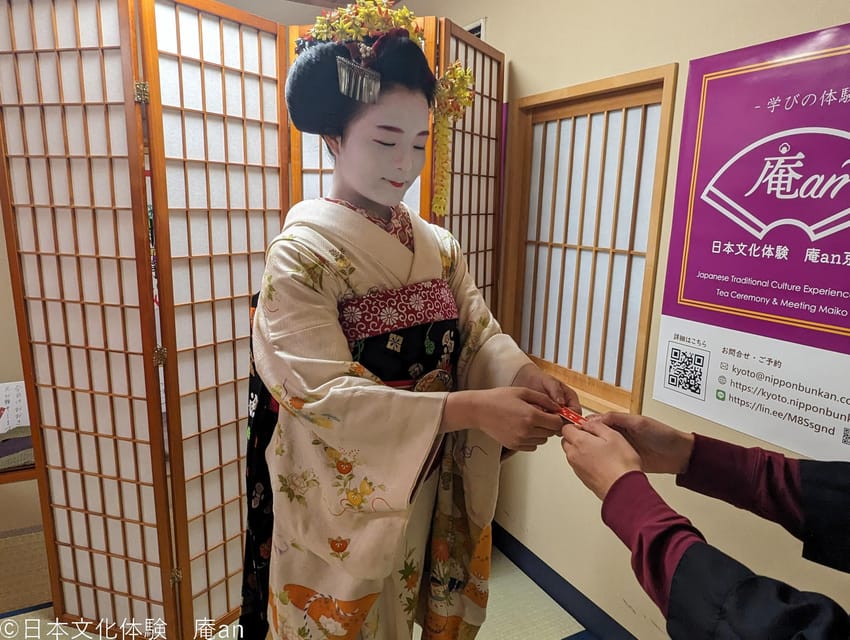
At the end, the Maiko presents a Senjyafuda. This is a small lucky charm and a thoughtful physical reminder of the experience. It is not a major material gift, but it adds a personal touch to a program that might otherwise end with only digital photos.
The modern room is the main compromise
It is important to set your expectations before booking. This is not an ochaya, or traditional Japanese tea house, and it is not held in a historic home with tatami mats and an intimate garden.
The venue is in a building with a relaxed atmosphere, friendly staff, tables, and stools. The Maiko sits behind a small table on a stool rather than kneeling in a formal tatami room. The setting feels practical and organized, but not especially atmospheric.
That trade-off explains the reasonable price. A traditional private setting would likely involve more expense, stricter etiquette, and less access for a broad international audience. Here, you get a structured cultural program within 90 minutes, close to public transport, at a cost of $50 per person.
Noise can also affect the mood. The program may be held alongside people having lunch or dinner, and the room is shared rather than fully private. One participant found that noisy people reduced the enjoyment. If you want silence and ceremony, this is not the best match.
I would treat the room as a classroom and performance space, not as the attraction itself. The Maiko’s conversation, dance, and interaction carry the experience. The building simply provides a convenient place for them to happen.
Is the $50 Premium price good value?
At $50, the experience is good value if you want several cultural activities in one compact sitting. You receive matcha, two sweets, a talk, a Q&A, two dances, a game, a photo opportunity, and a Senjyafuda.
The Premium label matters. The dance and game are among the most praised elements, so I would choose the fuller option if your schedule and budget allow. Extra seating charges apply if you want a better position:
- SS seat, first row: 3,300 yen
- S2 seat, second row: 2,200 yen
- S3 seat, third row: 1,100 yen
The standard price may be enough if you mainly want to hear the Maiko and take part in the tea activity. A closer seat could help with photos and dance viewing, but it is not essential to understand the program.
For families, the value is even clearer because the game and short activity changes keep young people involved. Children under two who sit on a parent’s lap are free, but a seat or meal requires the regular fee.
Who will enjoy this Kyoto experience most?
I would recommend it to you if you want a first introduction to Maiko culture without committing to a formal or expensive evening. It also suits visitors with only a short time in Kyoto, since the location is easy to reach and the program combines several elements.
Families can expect a friendly format. Children aged four and ten were reported to enjoy the activity as much as the adults, and the game gives younger participants something active to anticipate.
It is also a good choice for photographers who care more about a close portrait than a historic setting. You can take photos beside the Maiko, but you should accept that the background may include advertising.
I would be cautious about booking it if your main dream is a traditional tea ceremony in a tatami room. You may leave disappointed by the tables, stools, plain walls, and modern building. The tea-making lesson is basic, and English interpretation may not be equally strong in every session.
Practical details for a smoother visit
Reservations can be canceled for a full refund up to eight days in advance. After that point, cancellation fees apply, and changing the date or time after a fee has been incurred can bring another specified charge.
The operating hours are 10:00 to 17:00, and reservations received after 17:00 are processed the next day. Check the available start times when booking because the 90-minute duration alone does not tell you when the session runs.
Arrive early, especially if you want time to find the entrance and climb the stairs. The activity cannot be held for late arrivals, and people who are not participating cannot enter the room.
Dress does not require special preparation. You can come as you are, but respectful behavior helps protect the calm atmosphere. Keep your questions concise, follow instructions about photography, and remember that the Maiko is presenting a living tradition rather than a costume character.
Should you book the Kyoto Maiko Premium experience?
Book it if you want a friendly, accessible meeting with a Maiko, plus matcha, two dances, a game, questions, photos, and a small keepsake. The strongest parts are the direct conversation and the graceful performance, and the $50 price is fair for the amount packed into 90 minutes.
Skip it if the room itself matters as much as the performer. This is not a historic tea house, and the advertising backdrop can spoil an otherwise lovely photo. For most first-time visitors, though, the chance to speak with a Maiko and see her perform at close range makes the compromise worthwhile.
FAQ
Where is the Maiko tea ceremony held?
It is held one minute from Exit 1 of Gojo Station on Kyoto’s Subway Karasuma Line. The entrance faces Gojo-dori, the main street.
How long does the experience last?
The listed duration is 90 minutes. The main program is scheduled to finish around 75 minutes, followed by chatting time before room departure at approximately 90 minutes.
What is included in the Premium program?
The program includes the Maiko tea ceremony, matcha, two dried Japanese sweets, the Q&A session, a photo opportunity, a Senjyafuda lucky charm, two traditional dances, and an interactive game. Free snacks and a drink are also listed as included.
Is this held in a traditional tea house?
No. The venue is in a modern building rather than an ochaya or traditional Japanese house. The room has tables and stools, and the building does not have an elevator.
Will a Maiko always appear?
The program may sometimes feature a Geiko instead of a Maiko. The provider makes that change depending on the situation.
Is English available?
The official language is Japanese. English translation is provided as much as possible, and you can contact the provider if you would like to request English support.
Are children allowed to participate?
Yes. Children under two can join free if they sit on a parent’s lap. If a separate seat or meal is required, the regular fee applies.
Can I cancel for a full refund?
You can cancel up to eight days in advance for a full refund. Cancellation fees apply after that point, according to the applicable cancellation policy.
Just added in Kyoto
- The “Golden Route” and Ancient Japan by DIAMIR Erlebnisreisen – 14-Day Tour★ 2.0 · 2 reviews
- Japan: Castles & Cuisine by G Adventures – 6-Day Kyoto to Osaka Tour★ 4.5 · 4 reviews
- Cycle Japan by Explore! – 13-Day Kyoto to Tokyo Tour★ 4.7 · 12 reviews
- Cycle Japan by Intrepid Travel – 11-Day Kyoto to Tokyo Tour★ 4.8 · 2 reviews
- Classic Japan by Intrepid Travel – 11-Day Kyoto to Tokyo Tour★ 4.4 · 14 reviews
- Ancient & Modern Japan 14-Day Tour by Exodus Adventure Travels★ 4.4 · 40 reviews
- 5 Day Cultural Adventure of Kyoto, Nara & Osaka by Tourist Journey★ 2.5 · 2 reviews
- 12 Days Kinosaki Onsen Escape: A Journey Through Japan’s Timeless Towns by UME Travel★ 4.8 · 5 reviews
Tea Ceremonies, compared.
Tea Ceremony in a Traditional Tea House in Kiyomizu
Read our review →
World Heritage Kyoto & Nara Uji Authentic Matcha Experience
Read our review →
Browse the lists this tour appears in