
Reviewed · TEA CEREMONIES
Kyoto: Tea Ceremony with Maiko
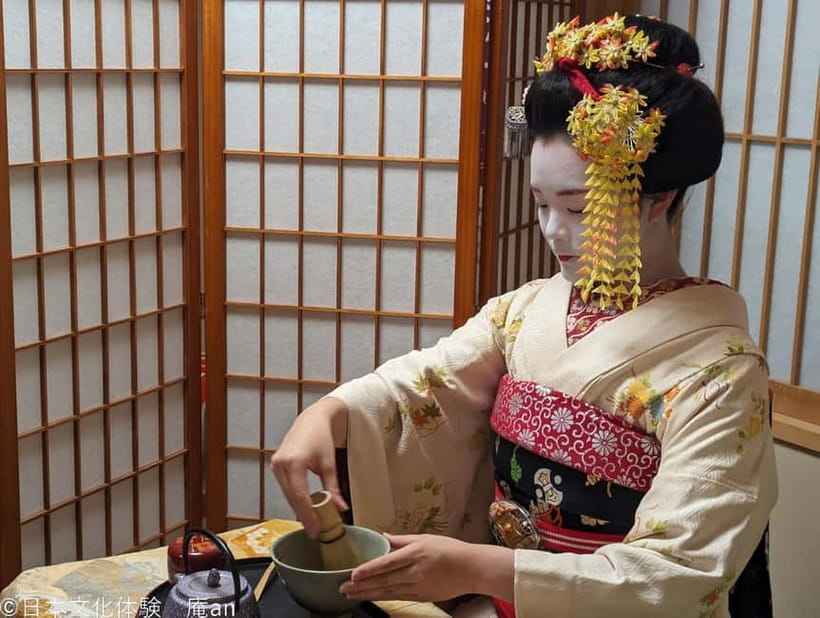
Kyoto’s geisha world comes with a whisk. I like the close-up meeting with a maiko, which gives you a respectful way to learn about her life without chasing her through the streets. I also like the hands-on matcha lesson, two delicate ohigashi sweets, personal questions, photos, and the small Senjafuda charm included for $28.
The main tradeoff is the setting. This is not an ochaya or an old Japanese house, but a relaxed room in a building. English help is offered as much as possible, yet the instructor speaks Japanese, so the quality of translation can shape how much you get from the question session.
In This Review
- Key points to know before booking
- Why this short Kyoto experience works
- Finding the room near Gojo Station
- The opening greeting with a maiko
- Making matcha instead of only watching
- The question session is the real payoff
- The photo, charm, and final minutes
- How authentic is the setting?
- Is $28 a good value?
- Who should book this?
- Booking details worth keeping in mind
- FAQ
- How long does the tea ceremony with a maiko last?
- What is included in the $28 price?
- Where is the meeting point?
- Is English interpretation available?
- Will the host always be a maiko?
- Is the venue wheelchair accessible?
- Should you book this Kyoto tea experience?
Key points to know before booking
- A real maiko leads the tea lesson: Watch the demonstration, then whisk your own matcha.
- Questions are part of the program: You can ask about a maiko’s daily life, training, and path toward becoming a geiko.
- The meeting is close to Kyoto Station: Gojo Station is one minute away, making this useful on a tight schedule.
- Your $28 includes the main extras: Matcha, two dried Japanese sweets, a photo opportunity, and a Senjafuda lucky charm.
- The room is in a modern building: Expect stairs and a simple venue rather than a traditional tea house.
- The host may be a geiko instead: The performer depends on the date, so check the booking details before you go.
Why this short Kyoto experience works
Kyoto has plenty of polished cultural activities, but many ask for half a day, formal clothing, or a long trip outside the city center. This one takes about 45 minutes, with the main program finished at roughly the 30-minute mark and a little extra time for photos and departure.
That short format is the first reason I see value here. You can fit it between sightseeing stops, before a meal, or during a brief visit to Kyoto. At $28 per person, the price is modest for a live cultural presentation, a guided activity, sweets, tea, and a personal photo.
The second reason is access. You are not simply watching a performer from across a room. You sit close enough to see the tea-making movements and ask direct questions. That makes the meeting feel more human and less like a stage show.
Still, you should set your expectations properly. The program offers an introduction to the maiko world, not a full traditional tea ceremony lesson or an evening at an ochaya. The room is in a building, and the event can sometimes take place while other people are having lunch or dinner. If you want an old Kyoto setting with formal architecture, this will feel plain.
More Kimono Experiences in Kyoto
- [Kyoto & Nara Day Tour] Sagano Scenic Railway & Nara Park & Fushimi Inari Taisha Thousand Torii Gates & Togetsukyo Bridge & Bamboo Grove & Kimono Forest (Departing from Osaka)
★ 4.9 · 10,942 reviews - Kyoto Geisha Walking Tour: Gion District & Hidden Gems
★ 4.7 · 3,273 reviews - Kyoto: Gion Magical Night Walking Tour with Geisha Trivia
★ 4.9 · 2,393 reviews
Finding the room near Gojo Station
The meeting point is one minute from Exit 1 of Gojo Station on the Subway Karasuma Line. The entrance faces Gojo-dori, the main street, so you do not need to search through a maze of side lanes once you reach the right block.
A useful arrival tip is to leave through Exit 1, walk straight, cross a very small street, and continue until you reach the venue above the supermarket Carnival. The entrance can be easy to miss if you are looking for a wooden tea house, since the event is held in a building.
Give yourself extra time. The program cannot wait for late arrivals, and latecomers do not receive a refund. The building has no elevator, so you need to use the stairs to reach the room. That matters for anyone carrying luggage, using a wheelchair, or avoiding stairs.
The operation hours are 10:00 AM to 5:00 PM. Reservations received after 5:00 PM are processed the next day. You should also check the exact starting time when booking, since the available sessions can change.
The opening greeting with a maiko
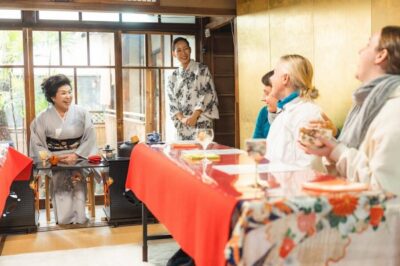
The program begins with a greeting from the maiko. This is a brief introduction, but it sets the tone for the rest of the meeting. The point is not only to admire the elaborate hairstyle and kimono. You get a chance to meet the person behind the appearance.
The maiko may be identified by her professional name. One particularly praised host was Maiko Masaya-san, who demonstrated the tea ritual with confidence and answered questions through an interpreter. The performer can change, though, and some dates are hosted by a geiko instead of a maiko.
That distinction is worth understanding. A maiko is an apprentice geiko, while a geiko is a more senior traditional entertainer. Both are connected with Kyoto’s traditional arts, but the details of the conversation may differ depending on who appears that day.
The meeting is arranged, respectful, and close. It does not ask you to follow a maiko in the Gion streets or interrupt her private time. For many visitors, that makes this a more considerate way to learn about the tradition.
Making matcha instead of only watching
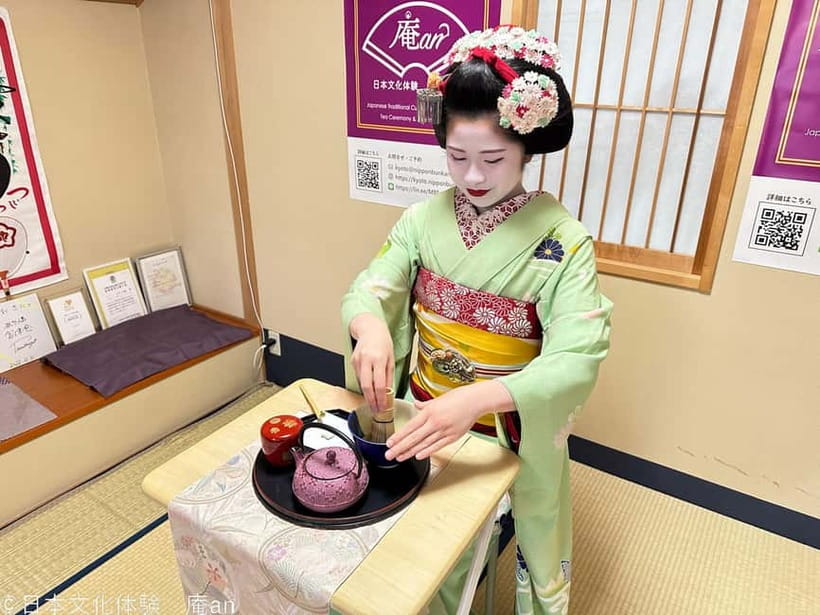
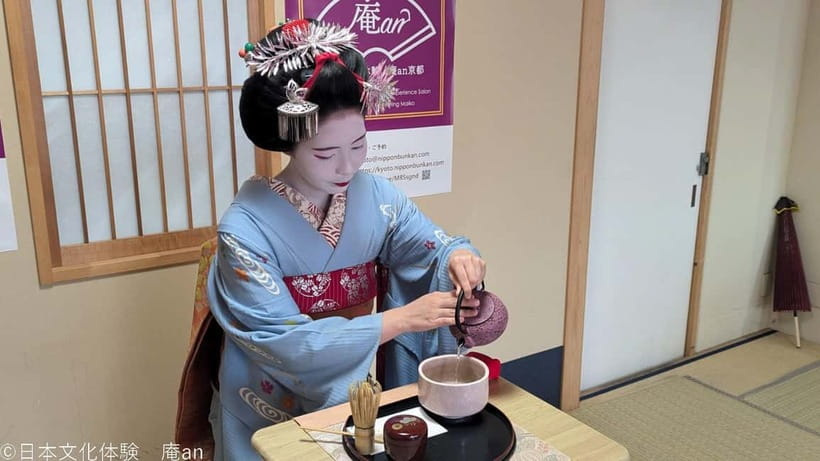
The tea portion is the heart of the activity. First, the maiko shows you how to prepare matcha and explains what to do. Then you make your own bowl.
That hands-on step matters. Watching a ceremony can be beautiful, but it can also leave you wondering what each movement means or how to repeat it. Here, you hold the tools, whisk the powder, and taste the result yourself.
You do not need previous experience. The lesson is designed to be easy to follow, and several people singled out the clear demonstration. The pace is short, so do not expect a detailed study of every tea school or a long lecture on utensils. Think of it as a friendly introduction with enough structure to give you a feel for the practice.
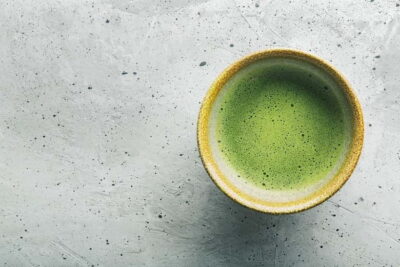
The matcha comes with two dried-style Japanese sweets called ohigashi. These are small, refined sweets made to accompany tea. Their restrained sweetness helps balance the strong, grassy taste of matcha.
The sweets are not just a snack added to the ticket. They show an important part of the tea experience, where taste, appearance, timing, and manners work together. You get a small example rather than a full meal, so plan to eat before or after if you need something substantial.
More Tea Ceremonies in Kyoto
- Kyoto: Tea Ceremony in a Traditional Tea House in Kiyomizu
★ 4.9 · 3,519 reviews - Kyoto: Tea Ceremony Ju-An at Jotokuji Temple
★ 4.9 · 3,207 reviews - Kyoto: 45-Minute Tea Ceremony Lesson Experience
★ 4.3 · 2,378 reviews - Kyoto: Table-Style Tea Ceremony at a Kyo-Machiya
★ 4.9 · 1,211 reviews
The question session is the real payoff
After the tea demonstration and preparation, the session moves into questions. This is where the activity becomes more than a photo opportunity.
You can ask about the maiko’s lifestyle, training, and progression toward becoming a geiko. The questions can turn a mysterious public image into a clearer picture of work, discipline, and daily routines. That personal exchange is one of the strongest reasons to choose this program over a simple performance.
The language point needs care. The instructor is Japanese, and English translation is provided as much as possible if requested. A staff member helped explain the ceremony and translate for English speakers during one especially well-received session, allowing the maiko to answer in Japanese while the group followed along.
That arrangement worked well, but translation is not described as guaranteed at the same level for every session. If English support is important to you, contact the provider in advance and ask to add it. Prepare a few concise questions rather than a long list. With only about 30 minutes before the photo portion, short questions give you more room for useful answers.
Good questions focus on the maiko’s training, what a normal working day involves, how she became a maiko, and what changes when she becomes a geiko. Avoid treating the session like a chance to demand private information. The best exchange is curious and polite.
The photo, charm, and final minutes
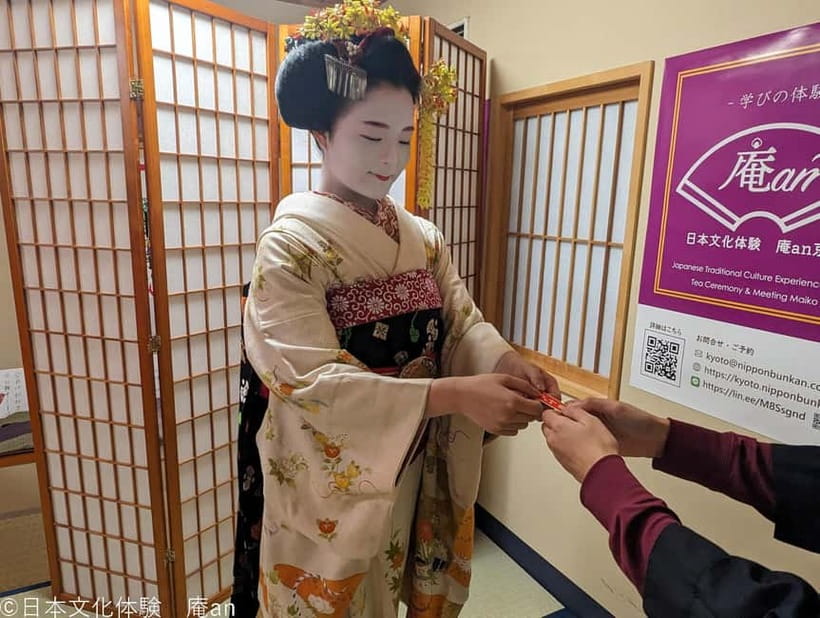
Around the 30-minute point, the formal program ends and the photo opportunity begins. You can take a commemorative picture beside the maiko, close enough to capture the detail of her costume and makeup.
This is a practical benefit for families and couples. You do not have to rely on a distant stage shot or ask a stranger to take a hurried picture in a crowded street. The arrangement is simple and personal.
The maiko then gives you a Senjafuda, a small lucky charm associated with her name. It is an appealing souvenir because it connects directly to the person you met, rather than being a generic Kyoto purchase.
The final departure time is about 45 minutes after the start. The extra quarter hour allows for photographs, the gift, and the maiko leaving the room. Keep your schedule loose enough to account for the full 45 minutes, even though the main activity ends sooner.
Do not assume that every session includes additional entertainment. One particularly enthusiastic account described a program with a dance performance and a game, but the core information for this booking promises the tea ceremony, questions, photos, sweets, matcha, and Senjafuda. Treat any extra activity as a possible variation, not a guaranteed feature.
How authentic is the setting?
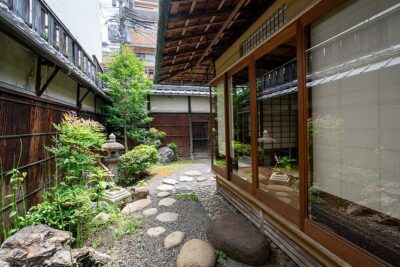
The cultural contact is the strongest part of the program, while the physical setting is modest. The room is not an ochaya, and it is not presented as a preserved Japanese home. You will be in a building with a relaxed atmosphere and friendly staff.
I see that as both a weakness and a benefit. The room may lack the atmosphere you picture when you imagine old Kyoto. On the other hand, the central location, simple access from the subway, and informal setting make the program less intimidating for first-time visitors.
You also may share the room with people eating lunch or dinner, depending on the situation. That could reduce the quiet, ceremonial feeling. It does not remove the value of meeting the maiko, but it reinforces the point that this is an accessible cultural program rather than a private traditional-house visit.
The activity is best understood as a short introduction to Kyoto’s maiko tradition. It gives you a face-to-face meeting, a basic tea skill, and a chance to ask questions. It does not claim to recreate every part of a formal tea gathering.
Is $28 a good value?
At $28, I consider this a strong value for a visitor who wants a compact cultural activity. You receive a live presentation, hands-on matcha preparation, two sweets, a photo opportunity, and a personal charm. The Gojo location also saves time and transportation costs compared with an activity farther from central Kyoto.
The value is especially good if you have only a morning or afternoon in the city. You can pair it with other central sights without giving up half a day. It also works well for anyone who wants more than a museum display but less than a formal, expensive dinner event.
The price is less compelling if your main goal is an elaborate traditional setting. You are paying for access to a maiko, instruction, and conversation, not luxury surroundings or a full meal. The possibility of a geiko rather than a maiko may also matter if you booked specifically to meet an apprentice.
Children who need their own seat pay the same price as one person. Children under two who sit on a parent’s lap are free. That makes the rule clear, though families should think about the short Japanese-style cultural format and the required stairs before booking.
Who should book this?
I would point this toward first-time visitors who want a clear, friendly introduction to Kyoto’s traditional arts. It suits couples, families with older children, solo visitors, and anyone curious about the maiko world but unsure about booking a more formal evening event.
It is also a good choice if you enjoy asking questions. The personal exchange can be more memorable than the tea itself, especially when the interpreter helps you understand the answers.
The program may be less suitable for you if you need guaranteed English interpretation, cannot use stairs, or want complete silence and an old Japanese house. It may also disappoint if you expect a long ceremony, a full meal, or a large stage performance.
Book with an open mind. The maiko is the main attraction, but the quality of the experience comes from the mix of demonstration, participation, questions, and respectful contact.
Booking details worth keeping in mind
Free cancellation is available up to eight days in advance for a full refund. Changes to the date or time within seven days of booking incur a fee, and cancellation charges can apply depending on the policy.
You should arrive early enough to find the entrance and climb the stairs. The program will not be held for delays, and the provider does not compensate you for travel expenses if the booking is canceled.
If you do not take part in the experience, you cannot enter the room. English help should be requested ahead of time, since the listed language is Japanese and translation is offered as much as possible.
FAQ
How long does the tea ceremony with a maiko last?
The full experience lasts 45 minutes. The main program reaches its end at about 30 minutes, followed by photos, the Senjafuda gift, and departure.
What is included in the $28 price?
The price includes the tea ceremony with a maiko, matcha, two dried-style Japanese sweets called ohigashi, a photo opportunity, and a Senjafuda lucky charm.
Where is the meeting point?
The venue is a one-minute walk from Exit 1 of Gojo Station on the Subway Karasuma Line. The entrance faces Gojo-dori.
Is English interpretation available?
The instructor speaks Japanese. English translation is provided as much as possible if requested, and you should contact the provider in advance if you would like to add it.
Will the host always be a maiko?
No. Depending on the date, the experience may be hosted by a maiko or a geiko.
Is the venue wheelchair accessible?
The building has no elevator, and you need to use stairs to reach the venue. The available information does not confirm wheelchair accessibility.
Should you book this Kyoto tea experience?
Book it if you want a short, affordable meeting with a maiko, especially near the start or end of a busy Kyoto day. The personal questions, easy matcha lesson, close photo, and Senjafuda make the $28 fee sensible.
Skip it if the setting matters more to you than the person you meet. This is not an old tea house or a fully formal ceremony. But if you value direct contact, simple instruction, and a respectful look at a Kyoto tradition that is difficult to encounter casually, it offers a lot in 45 minutes.
Just added in Kyoto
- The “Golden Route” and Ancient Japan by DIAMIR Erlebnisreisen – 14-Day Tour★ 2.0 · 2 reviews
- Japan: Castles & Cuisine by G Adventures – 6-Day Kyoto to Osaka Tour★ 4.5 · 4 reviews
- Cycle Japan by Explore! – 13-Day Kyoto to Tokyo Tour★ 4.7 · 12 reviews
- Cycle Japan by Intrepid Travel – 11-Day Kyoto to Tokyo Tour★ 4.8 · 2 reviews
- Classic Japan by Intrepid Travel – 11-Day Kyoto to Tokyo Tour★ 4.4 · 14 reviews
- Ancient & Modern Japan 14-Day Tour by Exodus Adventure Travels★ 4.4 · 40 reviews
- 5 Day Cultural Adventure of Kyoto, Nara & Osaka by Tourist Journey★ 2.5 · 2 reviews
- 12 Days Kinosaki Onsen Escape: A Journey Through Japan’s Timeless Towns by UME Travel★ 4.8 · 5 reviews
Tea Ceremonies, compared.
Tea Ceremony in a Traditional Tea House in Kiyomizu
Read our review →
World Heritage Kyoto & Nara Uji Authentic Matcha Experience
Read our review →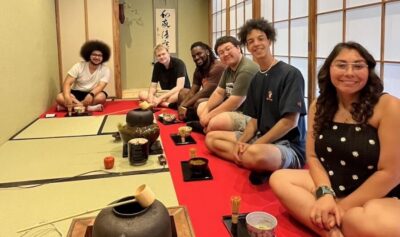
Browse the lists this tour appears in