
Reviewed · WORKSHOPS
Tokyo Manga Drawing Workshop Guided by Active Pro Manga Artist
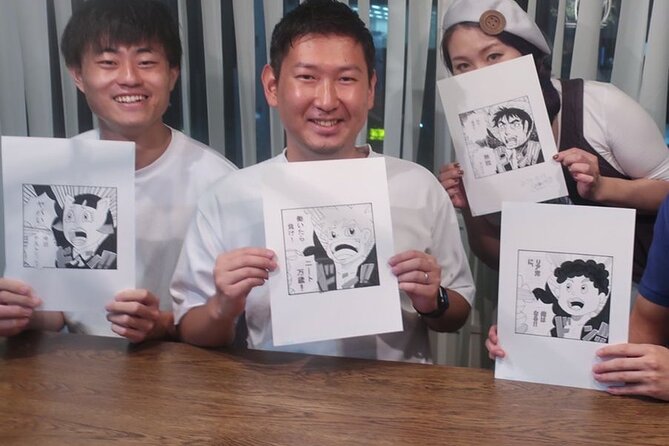
Manga comes alive at the drawing table. This small-group Tokyo workshop gives you direct instruction from an active professional manga artist, taking you from a rough idea to a finished illustration using traditional tools and techniques. You do not need drawing experience, and you leave with your own artwork rather than just a few photographs.
I especially like the step-by-step teaching, which works for both confident artists and people who can barely draw a stick figure. I also like the personal touch: you choose the character or subject, and the finished piece can become a memorable souvenir. The main point to consider is the price, $132.10 per person, plus the need to find the correct studio address carefully before class.
In This Review
- Key points to know before booking
- What this Tokyo manga class actually offers
- Meeting the artist and getting started
- Choosing a subject you can finish
- From first sketch to final manga artwork
- Why the professional instruction matters
- Is the class suitable for beginners and families?
- What the $132.10 price includes
- Timing, group size, and the studio setting
- A few limitations to keep in mind
- Who should book this manga workshop?
- Should you book it?
- FAQ
- How long does the manga drawing workshop last?
- Where does the class begin and end?
- Do I need previous drawing experience?
- What materials are included?
- How many people can join the class?
- Can I cancel for a refund?
Key points to know before booking
- Learn from an active manga professional: The class is taught by working artists, including instructors with professional industry experience.
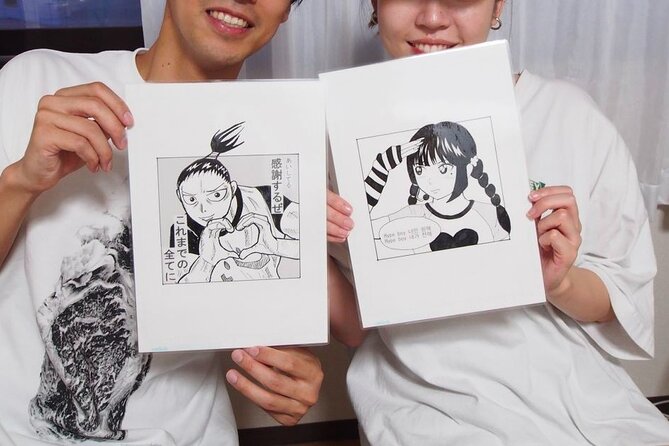
- Bring your own idea: You can draw a favorite character, create an original figure, or turn a family or pet photo into manga-style art.
- No art background is required: The teachers can provide guidance, sketches, and composition help for beginners.
- Use real manga tools: The class includes drawing materials and screen tone, a traditional manga technique used to add texture and shading.
- Small classes mean personal help: The maximum group size is eight, with instructors able to assist each person.
- Plan your arrival carefully: The studio is near Ebisu Station, but the address can be confusing, and some class locations have changed.
What this Tokyo manga class actually offers
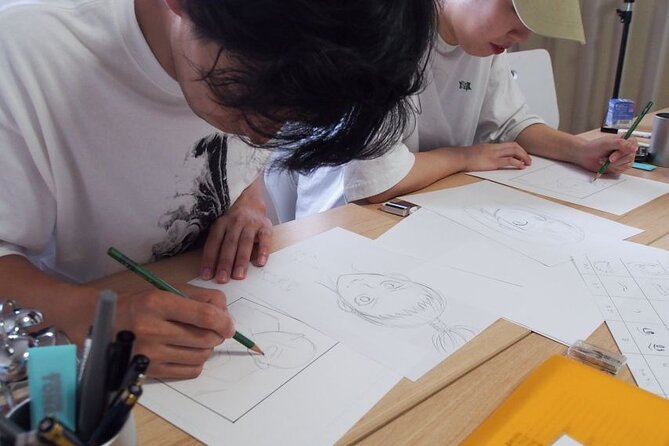
This is not a lecture about Japanese comics. You sit down and make one.
The basic flow takes you through the working stages of manga creation. You begin with an idea, sketch the subject, develop the outline, add color and manga effects, and finish the illustration with the help of the instructor. The class description gives an approximate duration of two hours and 30 minutes, while the teaching description refers to a two-hour session. Allow at least the full advertised time, especially if you want to ask questions or take care with your final piece.
The experience is built around personal choice. You can select a character from a favorite series such as One Piece, Naruto, or My Hero Academia. You can also work from a personal subject. One family used a photograph as the basis for a manga-style portrait, while another participant drew pets.
That freedom matters. A paint-by-numbers activity gives everyone the same result. Here, your finished drawing can reflect your own interests and skill level. You can follow the teacher closely, or adjust the sketch to suit your taste.
A few more options to weigh up in Tokyo
- Tokyo Disney Resort – Tokyo Disneyland & Tokyo DisneySea Park Tickets
★ 4.8 · 99,488 reviews - SHIBUYA SKY Ticket
★ 4.7 · 46,509 reviews - JR Whole Japan Rail Pass
★ 4.8 · 29,150 reviews
Meeting the artist and getting started
The class begins at the studio at Ishikawa 3-chome 8-11, Shibuya, Tokyo 150-0002. You make your own way there, and the activity ends at the same location.
The studio is described as being close to Ebisu Station and near public transportation. That makes it a manageable addition to a day in Ebisu or Shibuya. Still, I would not leave navigation until the last minute. The address has caused confusion for some participants, including a situation where the directions led people to an office in Ebisu while the actual class was in Shibuya. In that case, the instructor redirected the group by email, but the change caused a late arrival.
My practical advice is simple: check the final address shortly before leaving, compare it with your confirmation, and allow extra time for finding the building. If the location has changed, you want to discover that before you are standing outside the wrong office.
Once everyone is seated, the artist and translator explain the process. English support is available through the assistant or translator, and one French-speaking participant also praised the translator’s English and Spanish. The artist may speak some English, but the translator helps keep the instructions clear and makes it easier to ask about manga tools, techniques, and the Japanese comic industry.
Choosing a subject you can finish
You will get better results if you arrive with a clear idea.
You do not need to prepare a full composition. A simple character, pet, family portrait, or favorite anime figure is enough. The instructors can suggest ideas, help with the scene, and guide you through the drawing. Still, deciding what you want to make before class saves valuable time.
For beginners, a familiar subject is helpful because you already know what you want the final image to look like. You can concentrate on learning the techniques instead of trying to invent a character from nothing.
More experienced artists can use the workshop differently. You might bring a rough concept and ask the instructor to help refine it. One participant with previous drawing experience received a brief sketch, then adapted it to personal preferences. A complete beginner in the same class traced a guided version. That is a good example of how the class can serve people at different levels without forcing everyone into the same exercise.
The instructors also help with composition and layout. This is useful because manga drawing is not only about making a face look appealing. The placement of the character, the pose, the background, and the visual effects all affect how the image reads.
From first sketch to final manga artwork
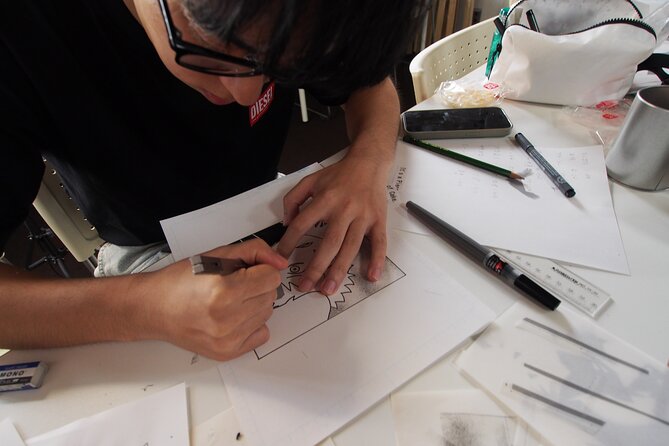
The early sketch is where the teacher can make the biggest difference. You may begin with a simple idea or a rough outline, then receive help developing proportions, pose, and the main shapes.
The teacher may draw a sample or provide a basic sketch for you to follow. That does not remove the creative part. You can change the expression, clothing, details, or overall style to make the image your own.
Next comes the clean outline. This stage requires patience, especially for younger children. A nine-year-old can participate, but the techniques call for care and concentration. Families with children aged 13 and 17 had a good time, and teenagers appear especially well suited to the format because they can work independently while still asking for help.
Color and manga effects follow. The tools include screen tone, sometimes described by participants as a sticker-like background material. Screen tone adds shading, texture, patterns, and atmosphere without requiring you to paint every detail by hand. The instructor can help you apply it properly and finish areas that feel difficult.
This is one of the most interesting parts for anyone curious about professional manga production. You are not merely copying an image. You are handling materials associated with the traditional graphic process and seeing how small choices change the finished page.
At the end, your artwork is prepared as a keepsake. One participant described having the illustration laminated, which makes it easier to carry home in a suitcase. The exact finishing method may vary, but the important point is that you leave with a physical piece of your own work.
A completely different kind of day out:
- Mt Fuji and Hakone 1-Day Bus Tour Return by Bullet Train
★ 5.0 · 26,383 reviews - TOKYO SKYTREE® Ticket
★ 4.7 · 25,136 reviews - teamLab Borderless Tickets: MORI Building DIGITAL ART MUSEUM
★ 4.7 · 24,126 reviews - teamLab Planets TOKYO Ticket
★ 4.7 · 21,663 reviews
Why the professional instruction matters
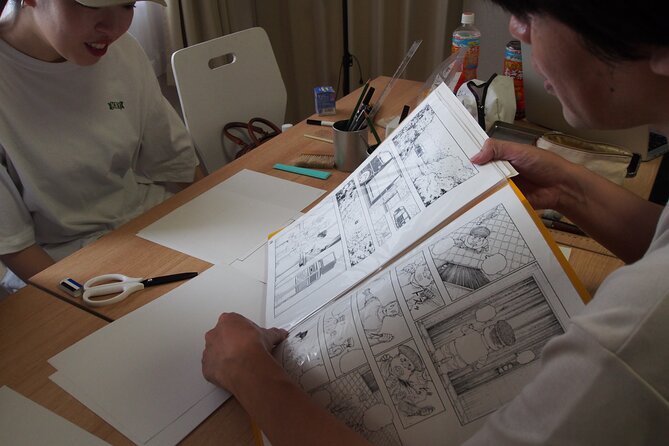
The best feature here is not simply access to art supplies. It is the chance to watch a manga artist make decisions in real time.
The instructors can show how to simplify a face, suggest movement, add a background, or create a stronger visual effect. They can also correct a problem before you spend too much time on it. That kind of immediate feedback is difficult to get from a book or online video.
Masa and Chie Sensei are among the names associated with the teaching team. Participants also praised the artists for being patient, friendly, encouraging, and willing to answer questions. One instructor had worked on Hunter x Hunter, adding useful professional context for fans who want to know how manga production works beyond the finished television or printed series.
The class also leaves room for conversation. You can ask about the tools, the manga-making process, and the industry. For fans of Japanese pop culture, this may be more valuable than a standard craft workshop because you are learning directly from people connected to the field.
The tone sounds relaxed rather than formal. The teachers keep the session light and enjoyable while still explaining genuine methods. That balance is important. You get a real lesson, but you are not expected to perform like a professional artist.
Is the class suitable for beginners and families?
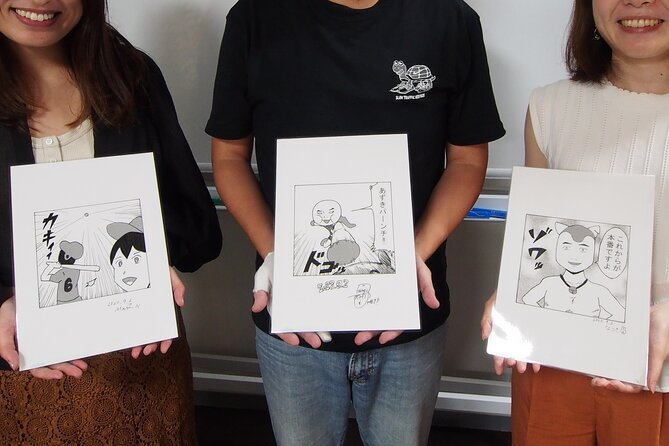
Yes, provided you are willing to spend time drawing.
Several participants with little or no artistic ability were pleased with their finished work. The instructors offer enough support to help a beginner produce something recognizable and attractive. If you are nervous, remember that the goal is not to create a publishable manga page. The goal is to learn a process and make a personal souvenir.
Families are a strong match. Parents and children can choose separate subjects and work at different levels. A child might draw a favorite anime character while an adult creates a manga portrait of the family. The class has also worked for groups where only some members were interested in manga. Even people with limited interest in Japanese comics found the practical activity enjoyable.
For children, I would use about age nine as a rough lower limit based on the experience of families who attended. That is not a formal age rule, but the drawing and screen-tone work require patience. Younger children may need more help than the class can comfortably provide.
Teenagers and adults with existing art skills should not assume the session will be too basic. You can ask for advice on your own sketch, explore professional tools, and adapt the exercise to your level.
What the $132.10 price includes
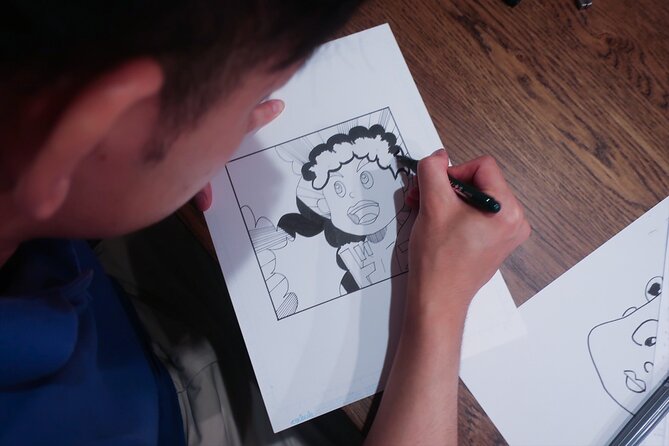
At $132.10 per person, this is not a cheap drop-in activity. The value depends on what you want from your Tokyo sightseeing.
The fee includes the manga drawing tools, including screen tone, instruction from professional artists, and your finished artwork to take home. You are paying for a small class rather than a large demonstration. With a maximum of eight participants, the instructor can spend time with each person.
The minimum participation requirement is two people, and the fee for attending alone is the same as the fee for two participants. That is important if you are traveling solo. You may want to book with another person, join a small group, or confirm the arrangement before paying.
For a manga fan, the price can be reasonable because it combines a lesson, access to specialist tools, personal instruction, and a souvenir. It is also a good choice if you value an activity you cannot easily reproduce at home.
For a casual visitor who only wants a quick craft project, the cost may feel high. You are paying for the artist’s time and guidance, not just paper and pencils. Bottled water and snacks are not included, so bring your own if needed.
Timing, group size, and the studio setting
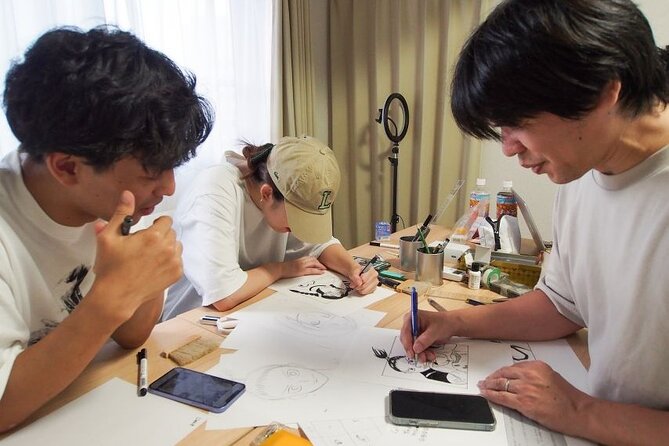
The class lasts approximately two hours and 30 minutes, making it short enough to fit into a busy Tokyo schedule. You could place it between other plans in Ebisu or Shibuya, but I would avoid booking a major attraction immediately afterward. Finding the studio, settling in, and finishing your drawing may take more time than expected.
A maximum of eight participants is a useful limit. It keeps the session personal without making it feel like a private lesson. If the class is full, you should still receive individual support, but the amount of time available for each person will depend on everyone’s needs.
You do not need to bring supplies. All materials are provided, so you can arrive with empty hands and leave with an artwork. That makes the activity easy to add during a longer Japan trip, when carrying extra art equipment would be inconvenient.
The class is near public transportation, but no pickup is provided. You are responsible for reaching the meeting point and returning there after the session.
A few limitations to keep in mind
The address issue is the clearest practical weakness. Double-check the location and watch for any update from the provider. A wrong turn or changed office can cost you part of a short class.
The minimum of two participants also matters. If you are alone, the same fee applies as for two people. This can make the activity less attractive for solo visitors unless the chance to learn from a working artist is especially important to you.
Finally, the finished image depends partly on your own patience. The instructors can guide, sketch, and correct, but they cannot do every stage for you. If you want a completely polished professional illustration with little personal effort, this is the wrong format. If you want to learn by doing, the hands-on work is the point.
Free cancellation is available if you cancel at least 24 hours before the start time. Changes or cancellations inside that window are not accepted for a refund, and the cut-off uses Tokyo local time.
Who should book this manga workshop?
I would recommend it most strongly to:
- Anime and manga fans who want to understand how the artwork is made
- Families with children around nine and older
- Teenagers looking for a creative Tokyo activity
- Adults who enjoy drawing, illustration, or Japanese pop culture
- Beginners who want patient help rather than a self-guided art class
- Experienced artists curious about traditional manga tools and screen tone
I would hesitate if you dislike drawing, have a very tight schedule, or are unwilling to spend time finding the studio. The activity is not a sightseeing tour, and there is no hotel pickup. You need to make your own way there and take part actively.
Should you book it?
Book this if you want a personal souvenir and a real lesson in manga technique. The strongest reasons are the small group, the professional artists, the freedom to choose your subject, and the amount of help available to beginners.
Before paying, confirm the meeting address and remember the two-person minimum. If those details work for you, this is one of the more personal ways to connect with Japanese pop culture. You sit at the table, handle the tools, ask questions, and take home something you made yourself. That is a much better memory than another item bought from a shop.
FAQ
How long does the manga drawing workshop last?
The experience lasts approximately two hours and 30 minutes. The class description also refers to a two-hour session, so you should allow the full advertised time.
Where does the class begin and end?
The meeting point is Ishikawa 3-chome 8-11, Shibuya, Tokyo 150-0002, Japan. The activity ends back at the meeting point.
Do I need previous drawing experience?
No. Beginners can participate, and the instructors guide you through the process step by step. People with previous drawing experience can also adapt the sketches and techniques to their own style.
What materials are included?
Manga drawing tools are included, including screen tone. You do not need to bring your own supplies.
How many people can join the class?
The maximum group size is eight participants. At least two people are required, and the fee for attending alone is the same as the fee for two people.
Can I cancel for a refund?
You can receive a full refund if you cancel at least 24 hours before the scheduled start time. Cancellations or changes made less than 24 hours before the start are not accepted for a refund.
Just added in Tokyo
- Very popular in Harajuku♡Animal petting zoo★ 4.6 · 39 reviews
- Yokohama Port: Private Customizable Tour with Transfer★ 5.0 · 19 reviews
- Wagyu & Sake 8 Course Tasting Dinner in Shinjuku★ 4.9 · 20 reviews
- Warner Bros. Studio Tour Tokyo – The Making of Harry Potter★ 4.8 · 181 reviews
- Yanaka District: Historical Walking Tour in Tokyo’s Old Town★ 4.8 · 117 reviews
- Tokyo: Classic Tsukiji Food Tour★ 4.9 · 78 reviews
- Tokyo: Tsukiji Fish Market Tour with 6 Stops & Seafood Lunch★ 4.5 · 165 reviews
- Tokyo Wagyu & Sake Pairing Tasting Experience with Local Flavors★ 5.0 · 108 reviews
Workshops, compared.

Sushi Making Tokyo Roll and Authentic Japanese Sushi Class
Read our review →
Gion Make Your Own Chopsticks with Engraving Option
Read our review →
Roll and Authentic Sushi Making Class in Asakusa
Read our review →
Ramen Cooking Class at Ramen Factory in Kyoto
Read our review →
Tokyo Asakusa Chopsticks Workshop: Make Your Own Pair
Read our review →
Ring Making Workshop : Vintage Japanese Coin Ring
Read our review →Browse the lists this tour appears in