
Reviewed · KIMONO AND CULTURAL DRESS
1 Hour Geisha Show in Kyoto
Kyoto’s rarest stage may be a small tea house. This experience gives you direct access to a real maiko, one of only about 40 still working in Kyoto today, with two traditional dances, a translated Q&A, photos, and a Japanese game. I especially like the close setting and the chance to speak with the performer rather than simply watch from a distance.
I also like the choice between an authentic Kyo-Machiya tea house and a dedicated Gion theater. The main caution is value: at $79.59 per person, the dancing lasts only about 10 minutes, so you are paying for the personal exchange and cultural explanation as much as the performance itself.
In This Review
- Key points to know before booking
- What this Kyoto maiko experience really offers
- Arriving in Kamishichiken
- Two dances, about ten minutes total
- The Q&A is the heart of the visit
- Photos and the traditional game
- Tea, snacks, and what is not included
- Tea house or Gion theater?
- Is $79.59 a fair price?
- Who will enjoy this most?
- Practical tips for a smoother visit
- Should you book the 1-Hour Geisha Show?
- FAQ
- How long does the geisha experience last?
- Is the performance given by a real maiko?
- What is included in the price?
- Are food and additional drinks included?
- Where does the experience take place?
- Can I take photos with the maiko?
- What happens if I need to cancel?
Key points to know before booking
- Two short dances: The maiko performs for about 10 minutes in total, by design, rather than filling the entire hour with dancing.
- Real interaction: You can ask questions, take photos, and join a traditional Japanese game with the maiko.
- Two possible venues: Choose carefully between the tea house in a Kyo-Machiya and the Gion theater, since the mood and setting differ.
- Translation included: A professional guide and translator help explain the performance and answer questions.
- Small-group format: The maximum group size is 25 people, though some sessions feel especially intimate.
- Kimono option available: If you add kimono rental and hair styling, you must visit Kyoto Kimono Rental Mimosa before the show.
What this Kyoto maiko experience really offers
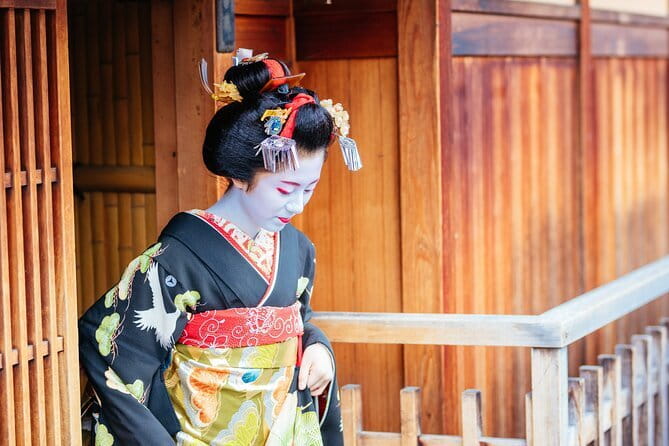
A geisha show can mean many things in Kyoto. Some are stage performances with a large audience. This one aims for something more personal: you meet a maiko, watch her dance, hear about her training and daily life, and speak with her through a translator.
A maiko is a geiko, or geisha, in training. Her elaborate hairstyle, colorful kimono, white makeup, and restrained movements are part of a demanding artistic tradition. The show gives you a useful introduction without pretending that one hour can explain everything about the geisha world.
The most important point is to set your expectations correctly. The maiko will not dance continuously for an hour. The two dances take about 10 minutes altogether. The rest of the session is used for conversation, questions, pictures, and a game.
That balance works well if you want cultural contact instead of a standard theater performance. If you mainly want a long dance recital, you may find the price hard to justify.
More Kimono Experiences in Kyoto
- [Kyoto & Nara Day Tour] Sagano Scenic Railway & Nara Park & Fushimi Inari Taisha Thousand Torii Gates & Togetsukyo Bridge & Bamboo Grove & Kimono Forest (Departing from Osaka)
★ 4.9 · 10,942 reviews - Kyoto Geisha Walking Tour: Gion District & Hidden Gems
★ 4.7 · 3,273 reviews - Kyoto: Gion Magical Night Walking Tour with Geisha Trivia
★ 4.9 · 2,393 reviews
Arriving in Kamishichiken
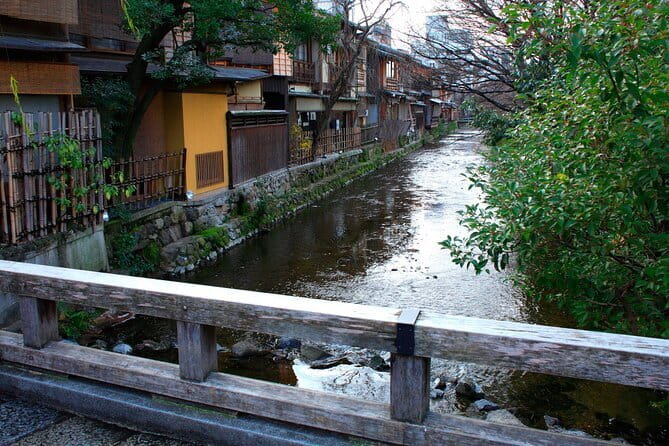
The listed meeting area is Kamishichiken Street, one of Kyoto’s historic entertainment districts. Your guide leads the session and explains how to behave in the setting, which is useful if this is your first encounter with a maiko or a traditional tea house.
The exact venue depends on the option you choose. The tea house version takes place inside an authentic Kyo-Machiya, a traditional Kyoto townhouse. This setting gives the experience a quiet, domestic feel. You are not simply watching a performer under bright stage lights. You are entering a preserved style of Kyoto architecture where the room itself helps explain the culture.
The Gion option takes place in a dedicated showhouse. This may suit you better if you prefer a purpose-built venue and a more straightforward performance setup. Check the photographs carefully before booking so you know which setting you are selecting.
One practical issue is timing. The start time can change, so check your messages close to the date of the experience. You are told to arrive 10 minutes early, and the instructions warn that late entry may not be allowed once the show begins. Build in extra time for finding the meeting point.
Two dances, about ten minutes total
The dances are the artistic center of the hour. They are short, precise, and formal, with the maiko’s movements shaped by traditional choreography, music, costume, and gesture.
A short performance is not necessarily a lesser performance. Maiko dances require concentration, and the program explains that performances are intentionally limited to preserve the art. The aim is to present a focused example rather than turn the maiko into an all-evening entertainer.
Still, this is where your expectations matter most. You might imagine an hour-long geisha recital from the title, but the dancing occupies only a small part of the program. I would think of the event as a one-hour cultural meeting that includes a brief dance presentation.
The room layout can affect your view. Seating is arranged around a tea table, and a seat in the middle may give you a poor angle during the dance. If you have a choice, try to sit where you can face the performance area directly. The group size can reach 25 people, so not every seat will provide the same view.
The Q&A is the heart of the visit
After the dances, the format becomes more relaxed. The maiko answers questions with help from the guide and translator. This is where you can learn about her training, lifestyle, performance work, and the customs surrounding maiko culture.
The quality of this section depends partly on the guide. Several guide names have been praised for warmth, clear English, and good timing, including Soichiro, Ai, Genki, and Chihiro. Their role is more than simple translation. A good guide helps you ask respectful questions, explains context, and keeps the group involved.
Chihiro, for example, was noted for explaining how to conduct yourself in the tea house and making the setting feel comfortable. Soichiro was appreciated for his humor and calm translations. Ai was praised for her friendly manner and ability to keep the exchange flowing.
You should come with a few questions ready. Ask about the years of training, the meaning of the dance, the kimono, the hairstyle, or the difference between a maiko and a geiko. The supplied information confirms that the session welcomes questions, but it does not promise a fixed list of topics, so the conversation may vary from one date to another.
A completely different kind of day out:
- PERFECT KYOTO 1-Day Bus Tour
★ 5.0 · 13,518 reviews - Kyoto: Fushimi Inari, Kinkakuji, Bamboo Grove 1 Day Bus Tour
★ 4.8 · 4,316 reviews - Kyoto: Tea Ceremony in a Traditional Tea House in Kiyomizu
★ 4.9 · 3,519 reviews - Kyoto: Gion Make Your Own Chopsticks with Engraving Option
★ 5.0 · 3,465 reviews
Photos and the traditional game
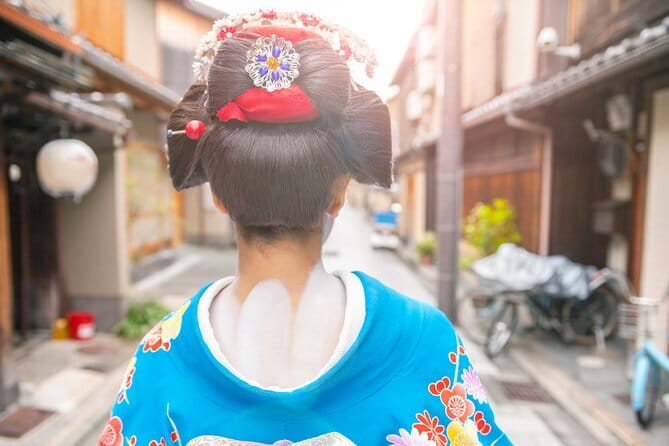
The photo session adds a personal touch. You have the opportunity to take pictures of the maiko and photos with her. This is one of the strongest reasons to choose this experience over a distant public performance.
The atmosphere is described as friendly rather than stiff. The maiko may ask you questions too, and the interaction can feel more personal than a standard stage show. Families may especially enjoy this portion because it gives children something active to do after the dancing.
The traditional Japanese game follows the conversation or appears near the end of the program. It is a simple way to show a different side of the culture. You are not just looking at a costume and taking pictures. You are sharing a small social activity with the maiko.
The game is also a useful reminder that geisha culture includes entertainment and conversation, not only formal dance. The experience presents those parts in a compact, accessible way.
Tea, snacks, and what is not included
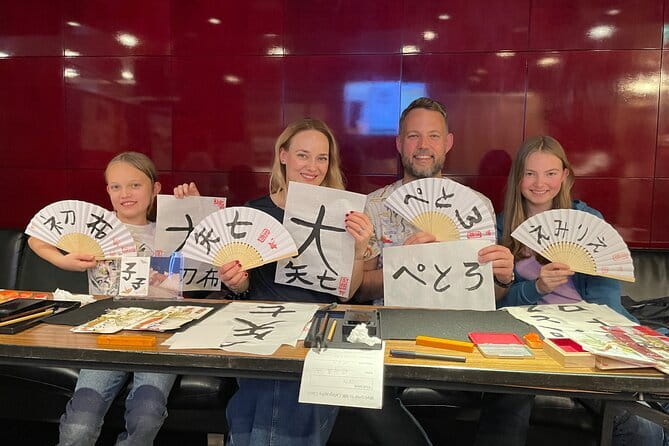
Traditional Japanese green tea is included. It fits naturally with the tea house setting and gives the program a calm pause between the performance and conversation.
Additional drinks and food are not included. Some sessions may provide a small snack, and children have enjoyed that detail, but you should not book this as a meal or tea ceremony with a full food service.
If you select the kimono rental and hair set option, the arrangement is handled separately before the show. You must go to Kyoto Kimono Rental Mimosa at 362-2 Masuyacho, Higashiyama Ward, before the performance. The shop is open daily from 8:00 to 18:00.
Tell the staff that you are with GuideMe Japan and give your name. No payment is required there because the rental and hair set are already included in that selected option. You are responsible for getting to the rental shop on your own, then making your way to the show.
Tea house or Gion theater?
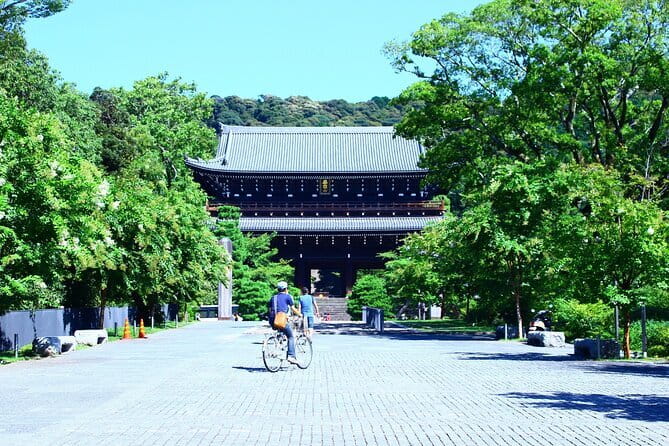
The two venue choices can change the tone of your visit.
The tea house in an authentic Kyo-Machiya is the better pick if you want atmosphere and a traditional residential setting. The old-style room, tea, and close interaction create a quieter experience. It may feel more intimate and personal, though the seating layout can be less predictable.
The Gion theater is more suitable if you prefer a dedicated show venue. It should make the performance purpose clearer, but it may not have the same household character as the Kyo-Machiya.
Do not assume the two options are interchangeable. Look at the photos before booking and confirm the venue name on your confirmation. If the setting matters to you, this choice may be as important as the maiko performance itself.
Is $79.59 a fair price?
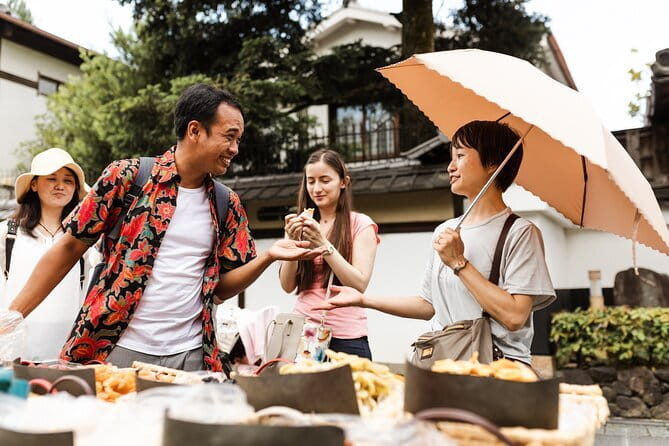
At $79.59, this is not a cheap one-hour activity. The dance portion is brief, and food beyond the included green tea is not provided. A family of four will feel the cost quickly.
The price makes more sense if you value access. You are paying for a real maiko, a private or semi-private cultural setting, professional translation, direct questions, photos, and a traditional game. Those elements are difficult to arrange independently, especially if you do not speak Japanese or know how Kyoto’s traditional entertainment districts work.
I would call it fair for someone who wants a focused cultural experience and accepts that the maiko’s time is limited. I would call it expensive if you mainly want a long performance or a full meal.
The group limit of 25 helps keep the program manageable, but a full group may reduce your view and limit personal conversation. Smaller sessions can feel especially worthwhile because the Q&A and photo time become easier to enjoy.
Who will enjoy this most?
This experience suits you if you want to understand the tradition rather than simply photograph a woman in a kimono. The guide’s explanations, translated questions, and discussion of maiko training give the program substance.
It is also a good choice for families. The dances are short enough for children, the game adds participation, and a small snack may be provided during some sessions. Parents should still explain that the event is respectful and structured, not a casual meet-and-greet.
First-time visitors to Kyoto may find this an easy introduction to the world of maiko and geiko. It provides cultural background without requiring a full evening at a formal performance.
You may want to skip it if you dislike group seating, need a guaranteed front-row view, or expect a complete hour of dance. You should also think twice if the price is a major concern and you are not interested in the Q&A.
Practical tips for a smoother visit
- Check the selected venue carefully. The tea house and Gion theater offer different surroundings.
- Arrive at least 10 minutes early, and allow extra time to find the meeting point.
- Recheck the start time before leaving. A time change has occurred for some bookings.
- Prepare questions in advance. The Q&A is one of the most valuable parts of the hour.
- Ask for a clear view of the performance area when seating begins.
- Bring a camera or phone for the photo session, but follow the guide’s instructions.
- If you book kimono rental and hair styling, visit Mimosa before the show and identify yourself as a GuideMe Japan customer.
- Remember that green tea is included, but additional food and drinks cost extra.
Free cancellation is available if you cancel at least 24 hours before the local start time. Cancellations or changes made within 24 hours are not accepted for a refund.
Should you book the 1-Hour Geisha Show?
Book it if you want a rare, respectful meeting with a real maiko and value conversation as much as performance. The strongest parts are the intimate setting, the thoughtful guides, the translated Q&A, and the chance to join a game and take photos.
Do not book it expecting a full-length dance show. The dancing lasts only about 10 minutes, and the $79.59 price depends on how much you value access to the performer and the cultural setting.
For my money, this is a worthwhile Kyoto choice for curious visitors who want context and personal contact. Pick the venue carefully, arrive early, and treat the short dance as one part of a broader introduction to a living tradition.
FAQ
How long does the geisha experience last?
The experience lasts approximately one hour to one hour and 30 minutes. The two dances together take about 10 minutes, with the remaining time used for explanations, Q&A, photos, and a traditional game.
Is the performance given by a real maiko?
Yes. The experience includes a meeting with a real maiko, a geiko in training. The program notes that only about 40 maiko remain in Kyoto today.
What is included in the price?
The price includes the one-hour maiko meeting and experience, traditional Japanese green tea, and a professional tour guide and translator.
Are food and additional drinks included?
No. Additional drinks and food are not included. Traditional green tea is included, and a small snack may be provided during some sessions.
Where does the experience take place?
The experience may take place in an authentic Kyo-Machiya tea house or in a dedicated Gion theater. Check the photos and selected option before booking.
Can I take photos with the maiko?
Yes. The program includes a photo session, with opportunities to photograph the maiko and take photos together.
What happens if I need to cancel?
You can receive a full refund if you cancel at least 24 hours before the experience start time. Changes or cancellations made less than 24 hours before the start time are not accepted for a refund.
More Show in Kyoto
- Kyoto Sumo Show with Experience & Photo, 2 Drinks Included
★ 5.0 · 941 reviews - Kyoto: Sumo Experience (with Live Show & Audience Challenge)
★ 5.0 · 519 reviews - Kyoto Gion Cultural Walk & Geisha Show with Dining Options
★ 5.0 · 518 reviews - Kyoto Gion Cultural Walk & Geisha Show with Dining Options
★ 5.0 · 483 reviews
Just added in Kyoto
- The “Golden Route” and Ancient Japan by DIAMIR Erlebnisreisen – 14-Day Tour★ 2.0 · 2 reviews
- Japan: Castles & Cuisine by G Adventures – 6-Day Kyoto to Osaka Tour★ 4.5 · 4 reviews
- Cycle Japan by Explore! – 13-Day Kyoto to Tokyo Tour★ 4.7 · 12 reviews
- Cycle Japan by Intrepid Travel – 11-Day Kyoto to Tokyo Tour★ 4.8 · 2 reviews
- Classic Japan by Intrepid Travel – 11-Day Kyoto to Tokyo Tour★ 4.4 · 14 reviews
- Ancient & Modern Japan 14-Day Tour by Exodus Adventure Travels★ 4.4 · 40 reviews
- 5 Day Cultural Adventure of Kyoto, Nara & Osaka by Tourist Journey★ 2.5 · 2 reviews
- 12 Days Kinosaki Onsen Escape: A Journey Through Japan’s Timeless Towns by UME Travel★ 4.8 · 5 reviews
Kimono and Cultural Dress, compared.
![[Kyoto & Nara Day Tour] Sagano Scenic Railway & Nara Park & Fushimi Inari Taisha Thousand Torii Gates & Togetsukyo Bridge & Bamboo Grove & Kimono Forest (Departing from Osaka)](https://media.japanvisits.com/wp-content/uploads/kyoto-nara-day-tour-sagano-scenic-railway-nara-park-fushimi-inari-taisha-thousand-torii-gates-togetsukyo-bridge-bamboo-grove-kimono-forest-departing-from-osaka-k110001-400x257.jpg)

Tokyo Asakusa Kimono&Yukata Rental at Kimono Miyabi Asakusa Station
Read our review →
Kyoto Geisha Walking Tour: Gion District & Hidden Gems
Read our review →
Gion Magical Night Walking Tour with Geisha Trivia
Read our review →
Gion Geisha District Walking Tour – Stories of Geisha
Read our review →
Best of Kyoto: Gion, Geisha, Pagodas & Cobblestones
Read our review →
Kyoto Kimono Rental Experience (Optional Exquisite Hair Styling/Japanese Makeup/Photography) (Ookini Kiyomizu-dera Main Store)
Read our review →Browse the lists this tour appears in