
Reviewed · WALKING TOURS
Arashiyama Hidden Gems: Walking Tour escaping crowds
Crowds fade quickly in Arashiyama. This small-group walking tour trades the usual rush for quiet temple grounds, old imperial spaces, and a calm pond reached on foot. I like the personal guidance from Kyoto guide Yusuke Tanaka, and I like that he keeps the group to six people. The main consideration is the walking: you cover about 3 kilometers, and the full outing can take close to four hours.
I also like the literary angle. Most stops, apart from the bamboo forest, connect with The Tale of Genji, and Yusuke can add that background if you choose the special option. Still, this is not a quick sightseeing loop. Warm weather, temple floors, and a route that ends away from the busiest restaurant area may test your energy.
In This Review
- Key points to know before you book
- Why this Arashiyama walk feels different
- Starting at Randen Arashiyama Station
- Nonomiya Shrine and its black torii
- Fifteen minutes in the Arashiyama bamboo forest
- Seiryoji Temple and an old Buddhist image
- Daikakuji, the former Saga Gosho
- Osawa-no-ike Pond and a calm finish
- How much time and effort the route takes
- The value of the $89 price
- Who will enjoy this walk most
- My practical advice for making the most of it
- Should you book the Arashiyama Hidden Gems walk?
- FAQ
- How long does the Arashiyama Hidden Gems walking tour take?
- How far do you walk?
- What is the group size?
- Are temple admission fees included?
- Do I need to remove my shoes?
- Can I return to the starting point after the tour?
Key points to know before you book
- A quieter route through Arashiyama: The tour moves beyond the famous bamboo grove to Seiryoji, Daikakuji, and Osawa-no-ike Pond.
- A guide who leads the tour himself: Yusuke Tanaka has guided more than 3,000 people and offers historical, cultural, and literary context.
- A maximum of six people: The small group makes it easier to ask questions, move at a comfortable pace, and get help with photos.
- The bamboo forest is only one short stop: You spend about 15 minutes there, rather than building the entire outing around it.
- Extra temple costs apply: Admission is not included for Seiryoji or Daikakuji and Osawa-no-ike Pond.
- The walk ends at Daikakuji: If you want to return to the starting point, Yusuke offers a free walking return.
Why this Arashiyama walk feels different
Arashiyama is famous for a narrow bamboo path and the river scenery around central Tenryuji. Those places are worth seeing, but they can also become a slow shuffle of cameras and umbrellas. This tour gives the bamboo forest a place on the route without letting it dominate the day.
I appreciate that balance. You get the classic photo stop, then move toward quieter religious sites where the pace slows. The route also gives you a better sense of western Kyoto as a place of imperial retreats, old worship, gardens, and seasonal scenery, not just a backdrop for one famous photograph.
Yusuke designed and guides the experience himself. That matters because the tour has a clear personal point of view. You are not simply being led from gate to gate. You can ask about shrine customs, Buddhist images, Japanese architecture, and the links between place and literature.
The The Tale of Genji option adds another layer. The locations visited, other than the bamboo forest, appear in the novel. If you have read the book, the stories can give the route extra meaning. If you have not, the regular tour still covers the same places, so you are not missing the physical experience.
More Walking Tours in Kyoto
- Kyoto Geisha Walking Tour: Gion District & Hidden Gems
★ 4.7 · 3,273 reviews - Kyoto: Gion Magical Night Walking Tour with Geisha Trivia
★ 4.9 · 2,393 reviews - Kyoto: Gion Geisha District Walking Tour – Stories of Geisha
★ 4.7 · 2,187 reviews
Starting at Randen Arashiyama Station
The meeting point is Randen-yaJapan, inside the Arashiyama Station Hannari Hokkori Square at 202 Sagatenryuji Tsukurimichi-cho. This is a practical start near public transportation, but give yourself time to locate the exact meeting spot within the station complex.
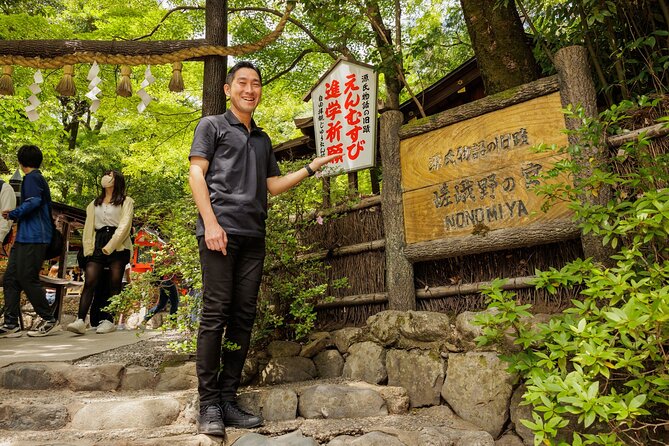
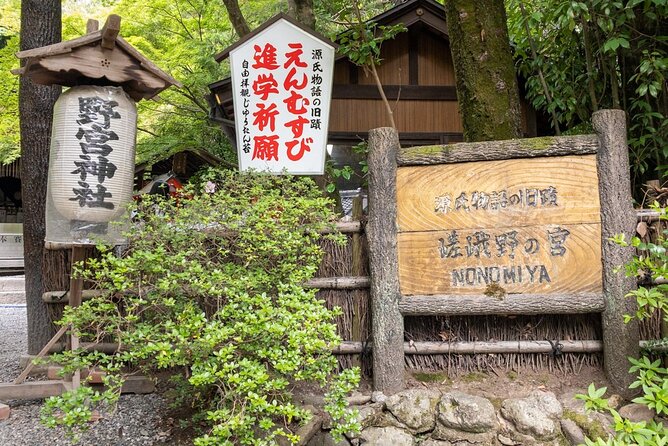
The first part of the route focuses on Nonomiya Shrine. From here, the outing quickly shifts away from simply taking pictures and toward understanding how Japanese sacred places work.
Nonomiya Shrine and its black torii
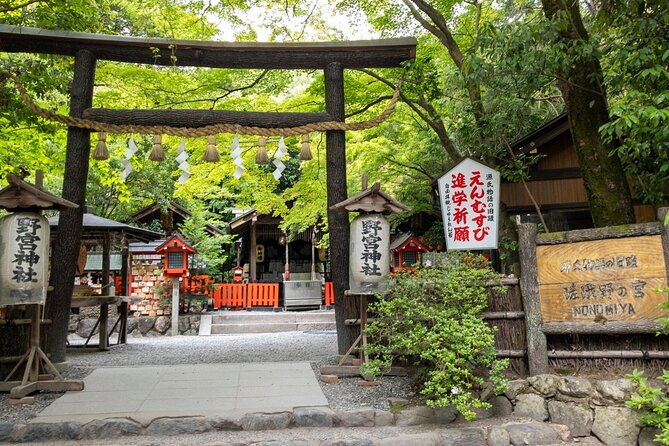
Nonomiya Shrine is a compact but striking beginning. Its black wooden torii gate is one of the details that makes the stop memorable. The tour explains that only two shrines in Japan have black torii gates, giving you a small piece of visual context that is easy to miss on your own.
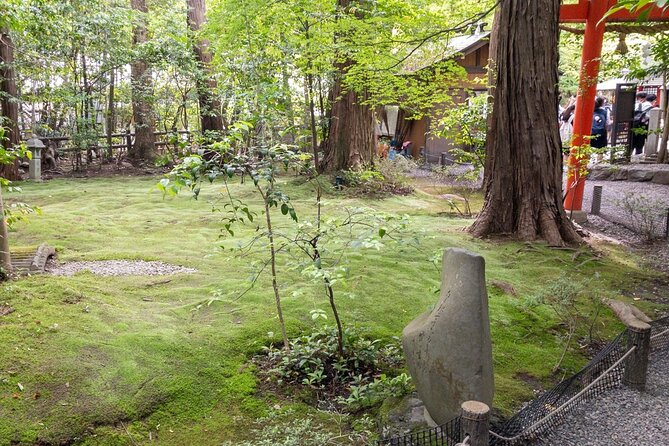
The shrine also has a beautiful moss garden. It is a modest setting, but that is part of its appeal. The moss, wood, and subdued colors create a quieter mood than the bright commercial streets near the station.
Yusuke explains how to visit a shrine and pray, as well as the difference between a shrine and a temple. These customs can feel confusing when you first arrive in Japan. A short explanation here helps you approach later stops with more confidence and respect.
Plan on about 30 minutes at Nonomiya Shrine. That is enough time for the guide’s explanation, a look at the garden, and photographs without turning the stop into a rushed pass-by.
Fifteen minutes in the Arashiyama bamboo forest
The bamboo forest is the most recognizable part of Arashiyama, and this tour does include it. The stop lasts about 15 minutes, with time to enjoy the tall bamboo, listen to the sound of the stalks, and take photographs.
That short visit is both a strength and a limitation. You get the famous setting without spending half your morning in a crowded corridor. On the other hand, if your main goal is a long, unhurried bamboo photo session, this schedule may feel brief.
Yusuke helps take photographs, and photography is one of his hobbies. That is useful for solo visitors, couples, or anyone tired of asking strangers to take a picture. You should think of the photo help as a welcome extra, not a formal professional photography session.
The bamboo grove can be especially busy, so keep your expectations sensible. The tour is designed to help you experience it as one part of Arashiyama, then move on to places with more room to breathe.
A completely different kind of day out:
- PERFECT KYOTO 1-Day Bus Tour
★ 5.0 · 13,518 reviews - [Kyoto & Nara Day Tour] Sagano Scenic Railway & Nara Park & Fushimi Inari Taisha Thousand Torii Gates & Togetsukyo Bridge & Bamboo Grove & Kimono Forest (Departing from Osaka)
★ 4.9 · 10,942 reviews - Kyoto: Fushimi Inari, Kinkakuji, Bamboo Grove 1 Day Bus Tour
★ 4.8 · 4,316 reviews - Kyoto: Tea Ceremony in a Traditional Tea House in Kiyomizu
★ 4.9 · 3,519 reviews
Seiryoji Temple and an old Buddhist image
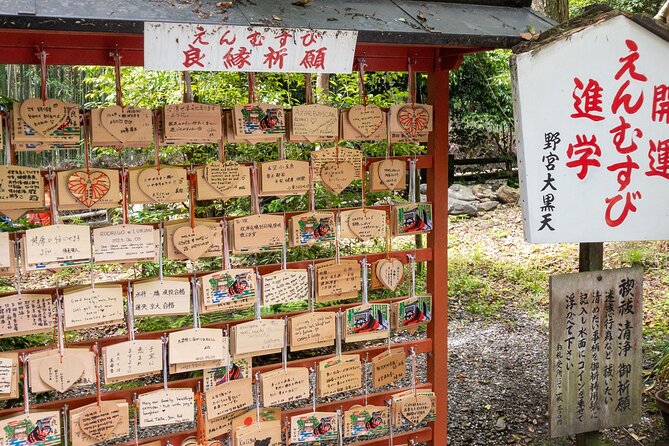
Seiryoji receives about 55 minutes, making it one of the more substantial stops. The temple was originally built about 1,200 years ago, while the present buildings date from roughly 300 years ago. That long timeline gives the site a useful sense of continuity, even if you are not an expert in Japanese religious history.
One of the major sights is the Shaka Nyorai Buddhist statue, identified as a Japanese national treasure. The guide’s explanation helps you look beyond the general atmosphere of the temple and notice why particular objects matter.
You need to remove your shoes before entering the interior at Seiryoji. Wear socks you are comfortable walking in, and avoid footwear that is difficult to take off and put back on. This is a small practical point, but it can make the indoor visits smoother.
Admission is not included. The stated cost is ¥500 for Seiryoji. Bring Japanese yen for the extra tickets, since the tour price covers guiding rather than every entrance fee.
Daikakuji, the former Saga Gosho
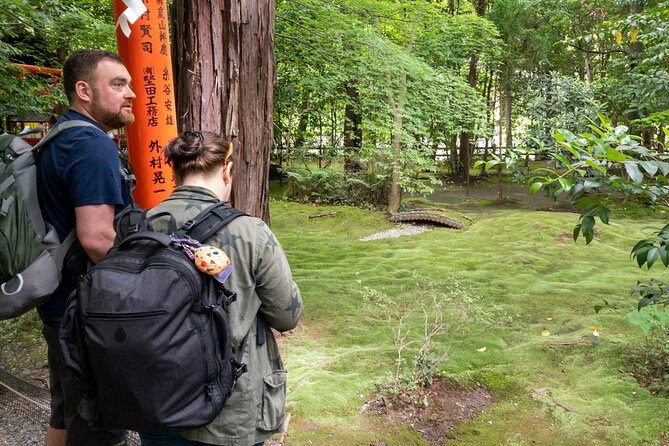
Daikakuji is the tour’s major quieter stop. It began as a former imperial palace called Saga Gosho, built about 1,200 years ago. The buildings and grounds offer a chance to see an older imperial setting without the same level of attention drawn by Arashiyama’s central sights.
You receive about 50 minutes here. That is enough time to take in the architecture and listen to Yusuke explain the place, rather than merely entering, taking one photograph, and leaving.
Daikakuji is also another shoe-free interior visit. The repeated change between outdoor walking and indoor temple spaces means you should dress for both. Comfortable walking shoes are important, but easy-to-remove shoes are even better for this route.
The tour ends at Daikakuji, which is useful if you want to continue exploring the area on your own. It is less useful if you expect to finish back in central Arashiyama for lunch without planning your return.
Yusuke offers a free walking return tour if you prefer to go back to the starting point. That is a generous option, though it adds more time and distance. Ask yourself how much energy you have left before choosing it.
Osawa-no-ike Pond and a calm finish
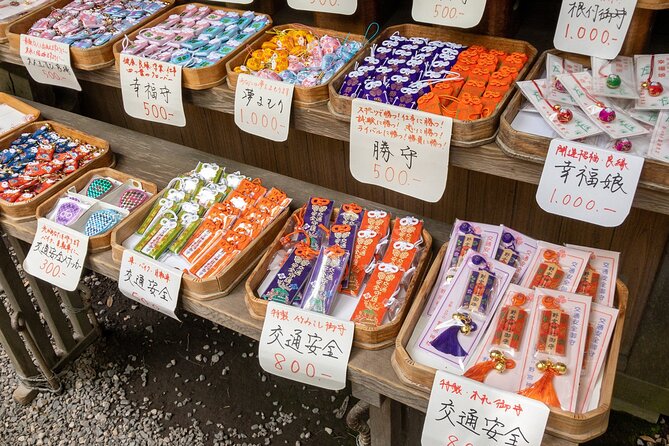
Osawa-no-ike is described as Japan’s oldest artificial pond. The stop takes about 20 minutes and includes scenery that changes with the seasons, along with a quiet bamboo area.
This ending works well because it is slower and more open in feeling than the famous grove. You can pause, take in the water and surrounding scenery, and finish the route without being pushed toward a crowded photo point.
The stated admission information needs a little care. The tour details list ¥300 for Osawa-no-ike Pond, while the additional-cost section lists ¥800 per person for Daikakuji and Osawa-no-ike together. Seiryoji is listed separately at ¥500. I would budget for the quoted extra amounts and confirm the current breakdown with Yusuke before the tour.
There are not many restaurants around the ending point. Bring a snack if you tend to get hungry, especially because the walk can take around four hours. Optional Japanese snacks are estimated at about ¥500, but they are not included.
How much time and effort the route takes
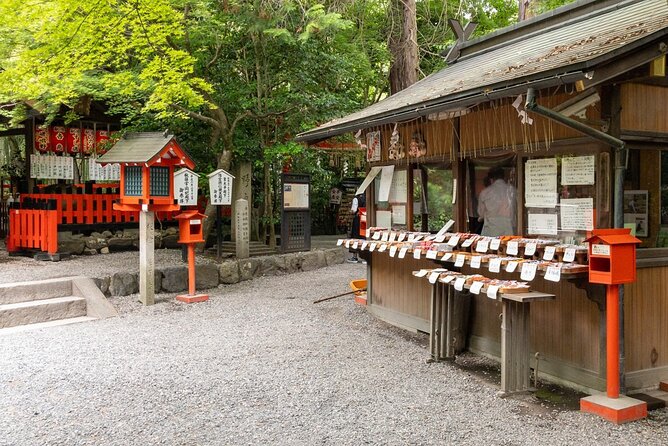
The advertised duration is about three to four hours, while the practical guidance says to expect about four hours. Walking and travel time are included in that total. You walk roughly 3 kilometers, with about 55 minutes identified as walking time, plus the temple visits, explanations, photographs, and pauses.
That makes the tour manageable for many people, but it is not a seated sightseeing experience. One person who took the route at age 68 found the walk tiring on a warm day, particularly toward the later stops. I would take that seriously if you have limited stamina or are visiting during Kyoto’s hot months.
The route is likely to feel comfortable if you enjoy walking at a relaxed pace and want a full morning or afternoon devoted to one district. It may feel too long if you have only a short time in Arashiyama or want to combine this with several other major attractions.
The small group helps. With no more than six people, the guide can pay attention to the group’s pace and answer questions without addressing a large crowd. Yusuke has also made a point of helping people stay comfortable, which is important on a warm day and during the longer temple visits.
The value of the $89 price
At $89 per person, this is not the cheapest way to see Arashiyama. You also pay the temple and pond admission fees, and food is extra. The price makes more sense if you place a high value on a small group, local explanations, photo help, and a route that avoids spending the whole outing in the busiest section.
The original booklet is included. It is about 15 pages, so you have something tangible to keep and use after the walk. That adds modest value, particularly if you like to review names, places, and cultural details later.
The The Tale of Genji option may be worth the added attention if you have read the novel or have a strong interest in Japanese literature. Both options visit the same locations, so the choice is about the style and depth of the storytelling, not access to different sights.
I would compare the tour with your alternative. If you are happy to walk alone, pay temple admission, and read signs or guidebooks, you can spend less. If you want someone to explain shrine etiquette, connect the sites to literature, and help you take good photos while leading you away from the most obvious route, the price is easier to justify.
The fact that the experience is often booked about 25 days ahead also suggests that you should not leave it until the last minute if your schedule is fixed. Confirmation arrives at booking, and the mobile ticket is convenient for a day when you are already moving between several Kyoto sights.
Who will enjoy this walk most
I would choose this tour if you want more than a quick bamboo forest photograph. It suits people who enjoy temples, old buildings, Japanese customs, seasonal scenery, and stories tied to place.
It is especially appealing for:
- First-time visitors who want a guide to explain how shrines and temples differ
- Readers of The Tale of Genji
- Solo visitors who would appreciate help with photographs
- Couples or families who prefer a small group
- People who have already seen central Arashiyama and want a quieter route
- Anyone who likes a measured walk rather than a checklist of sights
I would hesitate if you dislike removing shoes, have difficulty walking for several hours, or need a restaurant close to the final stop. I would also think twice if the bamboo grove is your only priority, since the visit there is short.
The tour requires good weather. If poor weather causes cancellation, you are offered a different date or a full refund. Otherwise, you can cancel for a full refund up to 24 hours before the start time. Changes or cancellations inside that window are not accepted.
My practical advice for making the most of it
Wear comfortable shoes that come off easily. You will remove them inside both Seiryoji and Daikakuji, and you will be walking on streets and temple grounds for much of the day.
Bring water and a snack. The route ends at Daikakuji, where restaurant choices are limited according to the tour details. An optional Japanese snack may be available for about ¥500, but I would not depend on it if you need food at a particular time.
Carry yen for admission. The stated extra costs include ¥500 for Seiryoji and a combined ¥800 for Daikakuji and Osawa-no-ike, while the pond is also separately described as ¥300. Confirm the exact current amount before setting out.
If you want the literary version, select The Tale of Genji when booking. The standard route still includes the same places, but the extra storytelling can change how you see the temples, pond, and old imperial setting.
Finally, protect enough time for the full route. Do not schedule a train, restaurant reservation, or second tour immediately afterward. A relaxed pace is one of the best reasons to choose this experience, and rushing away at the end would defeat the point.
Should you book the Arashiyama Hidden Gems walk?
I would book it if you want a thoughtful half-day in Arashiyama rather than a quick visit to the bamboo forest. Yusuke’s personal guiding, the six-person limit, the photo help, and the stops at Seiryoji, Daikakuji, and Osawa-no-ike give the tour a clear purpose.
I would skip it if your legs, schedule, or budget are tight. The $89 fee does not include temple admissions or food, and the walk can be tiring in warm weather. For the right person, though, this is a good way to see the quieter side of Arashiyama and understand why the district has mattered to Kyoto’s religious, imperial, and literary life for so long.
FAQ
How long does the Arashiyama Hidden Gems walking tour take?
The tour lasts about three to four hours, with practical guidance indicating that you should expect close to four hours. Walking and travel time are included.
How far do you walk?
You walk about 3 kilometers during the tour. Around 55 minutes is identified as walking time, with the rest spent visiting sites, listening to explanations, and taking photographs.
What is the group size?
The tour has a maximum of six travelers, making it a small-group experience.
Are temple admission fees included?
No. Seiryoji admission is listed at ¥500 per person. Daikakuji and Osawa-no-ike are listed together at ¥800 per person, while Osawa-no-ike is also separately described as costing ¥300. Confirm the current fee breakdown with the guide.
Do I need to remove my shoes?
Yes. You must remove your shoes to enter the interiors at Seiryoji Temple and Daikakuji Temple.
Can I return to the starting point after the tour?
Yes. The tour normally ends at Daikakuji Temple, but Yusuke offers a free walking return tour if you prefer to go back to the starting point.
Just added in Kyoto
- The “Golden Route” and Ancient Japan by DIAMIR Erlebnisreisen – 14-Day Tour★ 2.0 · 2 reviews
- Japan: Castles & Cuisine by G Adventures – 6-Day Kyoto to Osaka Tour★ 4.5 · 4 reviews
- Cycle Japan by Explore! – 13-Day Kyoto to Tokyo Tour★ 4.7 · 12 reviews
- Cycle Japan by Intrepid Travel – 11-Day Kyoto to Tokyo Tour★ 4.8 · 2 reviews
- Classic Japan by Intrepid Travel – 11-Day Kyoto to Tokyo Tour★ 4.4 · 14 reviews
- Ancient & Modern Japan 14-Day Tour by Exodus Adventure Travels★ 4.4 · 40 reviews
- 5 Day Cultural Adventure of Kyoto, Nara & Osaka by Tourist Journey★ 2.5 · 2 reviews
- 12 Days Kinosaki Onsen Escape: A Journey Through Japan’s Timeless Towns by UME Travel★ 4.8 · 5 reviews
Walking Tours, compared.
Kyoto Geisha Walking Tour: Gion District & Hidden Gems
Read our review →
Tokyo Tsukiji Fish Market Food and Culture Walking Tour
Read our review →
Gion Magical Night Walking Tour with Geisha Trivia
Read our review →
Imperial Palace and Shogun Historical Walking Tour
Read our review →
Gion Geisha District Walking Tour – Stories of Geisha
Read our review →
Shinjuku Local Bar and Izakaya Guided Walking Tour
Read our review →
Browse the lists this tour appears in