
Reviewed · CASTLES AND HISTORIC SITES
Crowd-Free Kyoto: Fushimi Inari, Nijo Castle & Kinkaku-ji
Arrive early, see Kyoto at its best. This private five-hour tour links three of Kyoto’s most famous sights, with a guide handling the route and adding the cultural details that are easy to miss on your own. I like the early approach to Fushimi Inari, before its torii-lined paths become packed, and I like the private format, which lets your group move at a more comfortable pace.
The route is efficient without feeling like a checklist. Guides such as Tom, Ryu, Kazuya, and Maki have been praised for friendly service, local insight, and clear explanations. The main tradeoff is cost: at $91.96 per person, you still pay separately for Nijo Castle and Kinkaku-ji, and five hours leaves little room for lingering.
In This Review
- Key points at a glance
- Why this Kyoto route works well
- Fushimi Inari: red torii before the rush
- Nijo Castle: samurai power in a very different setting
- Kinkaku-ji: the golden finish
- What the private guide adds
- Timing, meeting point, and route
- Is $91.96 per person good value?
- Who should book this experience?
- Booking details worth knowing
- Should you book Crowd-Free Kyoto?
- FAQ
- How long does the Kyoto tour last?
- Which attractions are included?
- Is the tour private?
- What is included in the price?
- Are entrance tickets included?
- Where does the tour begin?
- Where does the tour end?
- Is food included?
- Is the tour available by mobile ticket?
- What happens if bad weather cancels the tour?
Key points at a glance
- Fushimi Inari before the crowds: The tour is planned around an early start, giving you a better chance to enjoy the famous red torii with less congestion.
- Three major Kyoto sights in five hours: You visit Fushimi Inari-taisha Shrine, Nijo Castle, and Kinkaku-ji in one compact route.
- Private guide for your group: No strangers join you, so the pace and questions can stay focused on your interests.
- Strong guide-led experience: Tom, Ryu, Kazuya, and Maki are praised for history, local details, kindness, and an entertaining manner.
- Useful final stop: The tour ends at Kinkaku-ji, making it easy to continue sightseeing from one of Kyoto’s best-known temples.
- Admissions are partly extra: Fushimi Inari is free, but entrance to Nijo Castle and Kinkaku-ji is not included.
Why this Kyoto route works well
Kyoto can be tricky to plan. Its major sights are spread across the city, and the order of your stops matters. Fushimi Inari is far more pleasant early in the day, while Kinkaku-ji can become crowded as sightseeing groups arrive. Nijo Castle adds a very different experience between the two religious sites.
This tour gives you a simple answer to that planning problem. You meet your guide at the South Square in the Kyoto Station Building, visit the three headline attractions, and finish at Kinkaku-ji. The plan is especially useful if you have limited time in Kyoto or want your first day to cover the best-known landmarks without spending hours working out train routes and opening times.
I also like the change of mood between stops. Fushimi Inari offers sacred paths and mountain scenery. Nijo Castle brings you into the world of the Tokugawa shoguns. Kinkaku-ji provides the famous final photograph, with the gold-covered pavilion reflected in its pond when conditions are right.
The route is not designed for slow, specialized sightseeing. You get about an hour at each stop, which is enough for an introduction but not enough to inspect every corner. If you want long photography sessions, extended temple study, or a full walk through Fushimi Inari’s upper trails, you will need extra time elsewhere in your Kyoto plans.
More Castles and Historic Sites in Kyoto
- Kyoto Samurai Experience
★ 5.0 · 1,294 reviews - Kyoto: Nijo-jo Castle and Ninomaru Palace Guided Tour
★ 4.7 · 1,020 reviews - Kyoto: Kendo and Samurai Experience with Uniform and Gear
★ 4.9 · 815 reviews
Fushimi Inari: red torii before the rush
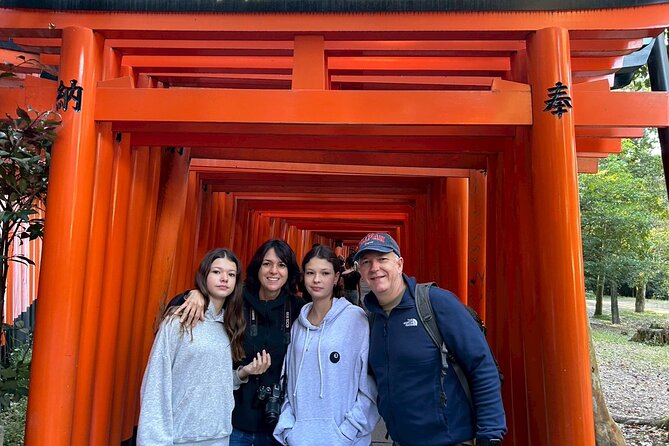
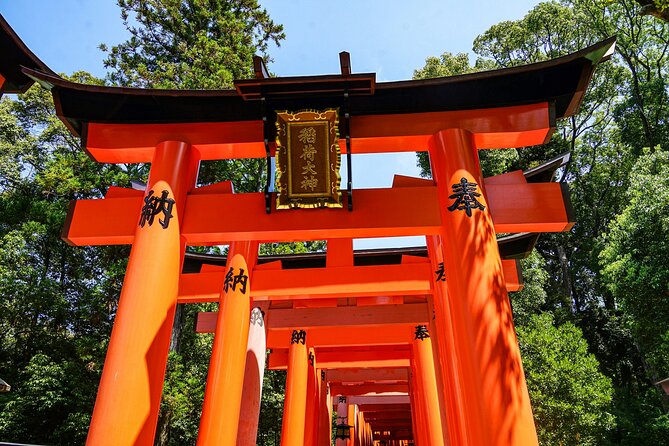
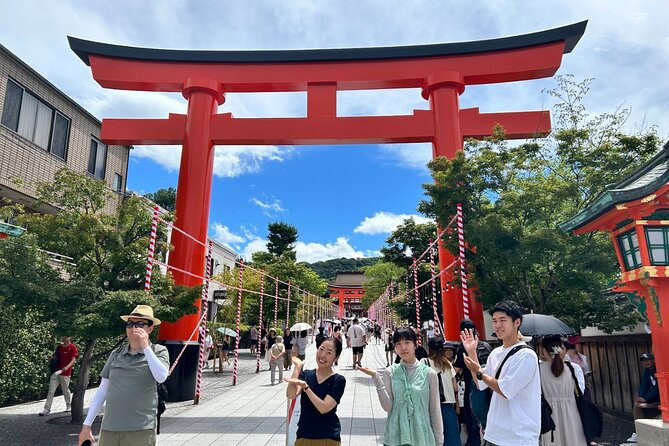
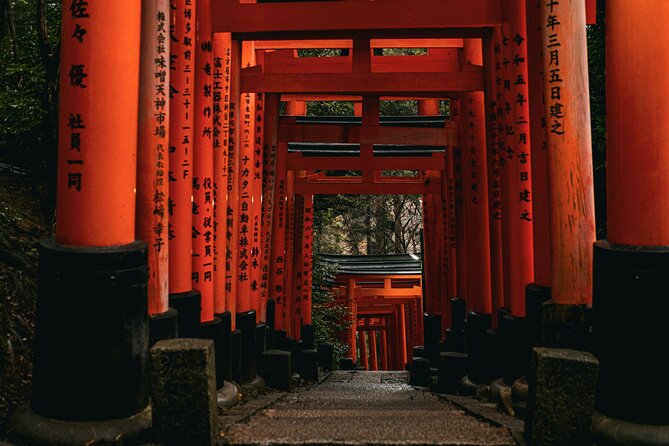
The tour begins at Fushimi Inari-taisha Shrine, one of Kyoto’s most recognizable sights. Its famous Senbon Torii consists of thousands of red-orange gates that line the paths leading up Mount Inari. The gates create a tunnel-like walk that changes as you climb, with glimpses of trees, stone markers, and shrine details along the way.
The early timing is one of the best reasons to book this experience. Fushimi Inari is free to enter, so it attracts a steady stream of people throughout the day. An early visit gives you a better chance to see the lower torii with breathing room and to take photographs without stopping every few steps for a passing group.
You are scheduled to spend about one hour here. That is enough to experience the main torii route and hear the guide explain the shrine’s role, but it is not enough to walk every path on the mountain. One particularly energetic tour participant made it all the way to the top, describing the climb as a real accomplishment and joking about paying 300 yen for water afterward. Take that as a useful warning: the upper route is a climb, and you should not treat the hour as a full mountain visit.
I would stay near the guide’s planned section unless you already know the shrine well. The best part of a private tour is not simply covering more ground. It is understanding what you are seeing, from the meaning of the gates to the traditions connected with the shrine. Several of the strongest comments about this tour focus on the guide’s cultural explanations, not just the scenery.
Wear comfortable shoes and keep your pace sensible. The path can be easy at first, but the uphill walk becomes more demanding. If someone in your group prefers not to climb, the lower section still offers the signature experience.
Nijo Castle: samurai power in a very different setting
Nijo Castle changes the tone completely. Instead of a shrine path and mountain approach, you enter a formal castle complex connected with the Tokugawa shoguns. The key stop is Ninomaru Palace, the former residence of the shogun, where lavish interiors and carefully planned spaces tell a story about authority and ceremony.
This is the stop that may surprise you. Fushimi Inari and Kinkaku-ji are instantly recognizable from photographs, but Nijo Castle gives you a stronger sense of how political power worked in historic Kyoto. The palace was not simply a home. It was a setting for official meetings, rank, protocol, and controlled movement.
You have about an hour here. That makes a guide especially useful. Without context, you might admire the architecture and move on. With a good explanation, details inside the palace become clues about social order and security. The guide can help you understand why the rooms differ, how visitors were received, and why the building carries such weight in Kyoto’s story.
Maki has received particular praise for making Nijo Castle the highlight of the tour. That fits the site’s character. Kinkaku-ji gives you visual drama, while Nijo Castle rewards attention to structure and history.
Admission is not included, so allow for that extra expense. The tour price covers the private guide, not all entrance fees. This is important when you compare the experience with a cheaper shared walk or a self-guided day. You are paying for route planning, personal attention, and explanations, then adding the ticket costs separately.
Kinkaku-ji: the golden finish
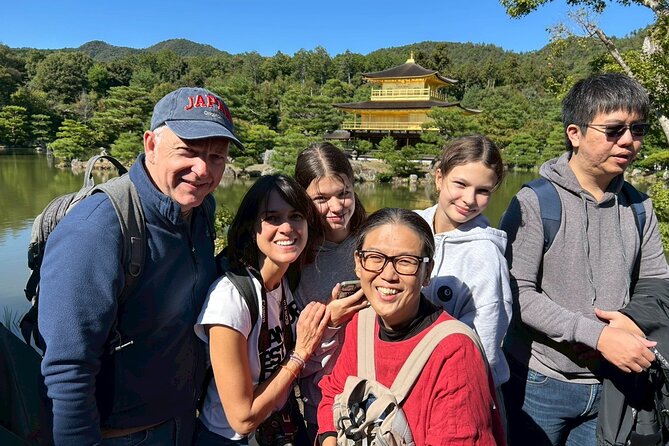
The last stop is Kinkaku-ji, better known as the Golden Pavilion. The upper levels of the temple are covered in gold leaf, and the building sits beside a pond designed to frame its reflection. Weather and light matter here. On a clear day, the pavilion can look almost unreal, which explains why it is often the visual high point of a first Kyoto visit.
The tour allows about an hour at the temple. That is generally enough to follow the visitor route, view the pavilion from the main angles, and listen to the guide explain its place in Japanese religious and architectural culture. The path is organized rather than open-ended, so you are not wandering through every part of the grounds.
One guest joined mainly to see Kinkaku-ji and considered it the highlight, praising Tom for answering questions and explaining the site. If the Golden Pavilion is your priority, tell your guide early. The private format gives you a better chance to shape the conversation around what you most want to understand.
The temple entrance is also not included. This matters because the tour is priced per person, and the final total will be higher once you add admission for both Nijo Castle and Kinkaku-ji, along with any food or drinks. Still, finishing here is practical. You do not have to return to Kyoto Station with the group, and the stated end point is Kinkaku-ji at 1 Kinkakujicho in Kyoto’s Kita Ward.
More Temples and Shrines in Kyoto
- [Kyoto & Nara Day Tour] Sagano Scenic Railway & Nara Park & Fushimi Inari Taisha Thousand Torii Gates & Togetsukyo Bridge & Bamboo Grove & Kimono Forest (Departing from Osaka)
★ 4.9 · 10,942 reviews - Kyoto: Fushimi Inari, Kinkakuji, Bamboo Grove 1 Day Bus Tour
★ 4.8 · 4,316 reviews - Kyoto: Tea Ceremony in a Traditional Tea House in Kiyomizu
★ 4.9 · 3,519 reviews - Kyoto Nara Day Trip │ Kiyomizu-dera Temple + Fushimi Inari-taisha Shrine + Nara Park (Departing from Osaka/Kyoto)
★ 4.7 · 3,408 reviews
What the private guide adds
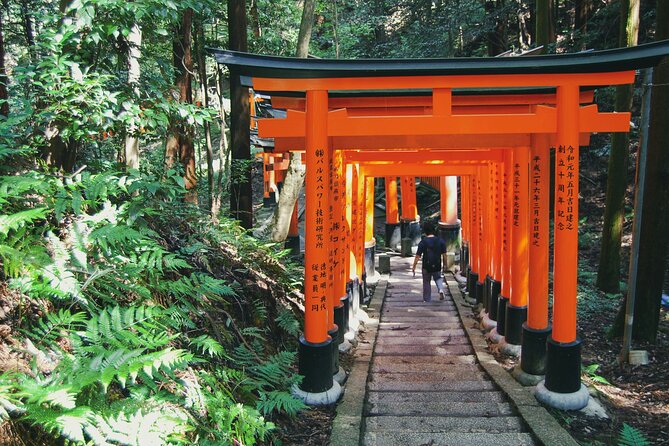
A private guide is the heart of this experience. The route itself is easy to copy from a guidebook. The value comes from having someone explain why each place matters and help you use your limited time well.
Tom is praised for strong knowledge of Kyoto and for making the cultural background easy to follow. Ryu is described as friendly and entertaining. Kazuya made one private tour feel unusually personal, with a kind manner and close attention to detail. Maki is credited with bringing Nijo Castle to life.
Those personal connections are not guaranteed, of course. Guide assignments can vary, and every guide has a different style. But the pattern is clear: this is meant to be more than transportation between famous buildings. You should expect questions to be welcome and explanations to go beyond basic dates and names.
The private setting also helps if your group has different interests. One person may care about architecture, another about samurai history, and another about photography. On a shared tour, the guide must keep moving for everyone. Here, you can ask for more detail or keep the pace brisk when needed.
Timing, meeting point, and route
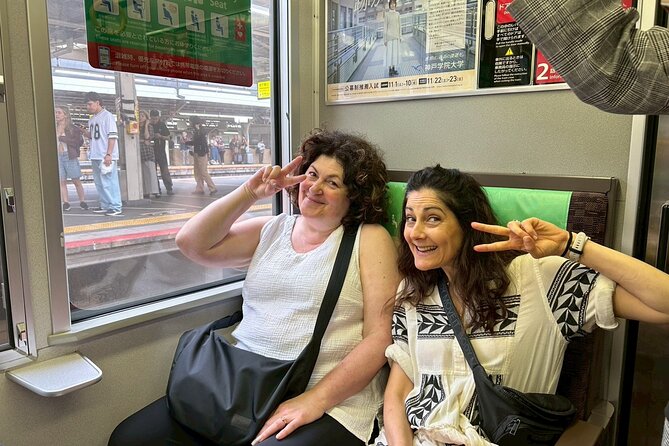
The meeting point is the South Square in the Kyoto Station Building, in Higashishiokojicho, Shimogyo Ward. That is a central starting place, but you should confirm the exact meeting instructions when booking so you know where to wait inside the station complex.
The tour lasts approximately five hours. Since the listed visits total about three hours, the remaining time is used for movement between sights and the practical transitions that come with a city tour. Do not expect a leisurely half-day at each temple. Expect a focused route with limited free time.
The tour ends at Kinkaku-ji rather than returning to Kyoto Station. That is helpful if you plan to continue sightseeing in northern Kyoto. It also means you should think ahead about your next stop, especially if you need to collect luggage or make a fixed reservation elsewhere.
The experience is near public transportation, and most people can take part. No meal is provided, so eat before the start or plan food after the tour. Food and drinks are not included.
Is $91.96 per person good value?
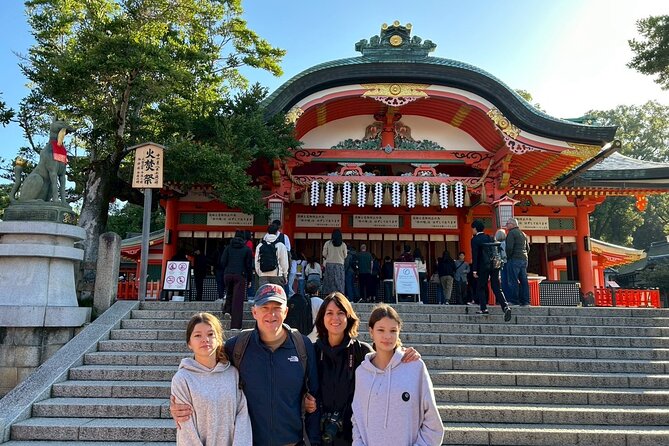
At $91.96 per person, this is not the cheapest way to see Kyoto’s major sights. You also pay admission for Nijo Castle and Kinkaku-ji, while food and drinks are extra. If you are comfortable navigating Kyoto, reading background material, and adjusting your own timing, independent sightseeing will cost less.
The price makes more sense for a small group that wants a private guide. You are buying convenience and interpretation, not just entry to three places. The guide removes much of the planning work, puts Fushimi Inari at the best point in the day, and helps you understand what you are looking at once you arrive.
Group discounts may improve the value for larger parties. Since only your group participates, the per-person cost can feel more reasonable when shared by family or friends. A solo visitor pays more for the same private structure, though the personal attention may still be worthwhile.
I would see this as a time-saving purchase. It suits you if Kyoto is part of a short Japan trip, if you are visiting for the first time, or if you want a strong introduction before exploring on your own. It is less suitable if your main goal is the lowest possible cost or a slow, independent day.
Who should book this experience?
This tour is a good fit for first-time Kyoto visitors who want to cover the essential sights without building a detailed transport plan. It also works well for families and friends who prefer to stay together rather than join a larger group.
You should consider it if stories and context matter to you. The strongest praise centers on explanations of Kyoto’s culture, history, and local details. If you enjoy asking questions, the private format gives you room to do that.
It is also useful for people who want to make Fushimi Inari a priority. The early plan is designed to avoid the busiest period, though no tour can promise an empty shrine. You still need to be ready for walking and some uphill ground.
I would hesitate if you want a full exploration of each site. One hour per stop is a sensible introduction, but it is not enough for a long climb at Fushimi Inari, a detailed study of every section of Nijo Castle, and an unhurried visit to Kinkaku-ji.
Booking details worth knowing
You receive confirmation at booking, and mobile tickets are available. The activity requires good weather. If poor weather causes cancellation, you are offered another date or a full refund.
Free cancellation is available up to 24 hours before the start time. A cancellation made less than 24 hours ahead is not refundable, and changes inside that window are not accepted. Keep the local Kyoto time in mind when making changes.
Should you book Crowd-Free Kyoto?
Book it if you want three major Kyoto sights in one efficient morning or half-day, with a private guide and an early start at Fushimi Inari. The best reasons are the personal service, the guide’s local explanations, and the chance to see the torii gates before the heaviest crowds.
Skip it if admission costs and private-tour pricing are likely to bother you, or if you want to spend a full day at one or two sites. For everyone else, this is a well-shaped introduction to Kyoto. Just wear good shoes, budget for two entrance fees, and tell your guide which of the three stops matters most to you.
FAQ
How long does the Kyoto tour last?
The tour lasts approximately five hours.
Which attractions are included?
The route includes Fushimi Inari-taisha Shrine, Nijo Castle, and Kinkaku-ji Temple.
Is the tour private?
Yes. Only your group participates in the private tour or activity.
What is included in the price?
A local guide is included.
Are entrance tickets included?
Admission to Fushimi Inari-taisha Shrine is free. Tickets for Nijo Castle and Kinkaku-ji are not included.
Where does the tour begin?
The tour begins at South Square in the Kyoto Station Building, Higashishiokojicho, Shimogyo Ward, Kyoto, 600-8216, Japan.
Where does the tour end?
The tour ends at Kinkaku-ji, 1 Kinkakujicho, Kita Ward, Kyoto, 603-8361, Japan.
Is food included?
No. Food and drinks are not included.
Is the tour available by mobile ticket?
Yes. Mobile tickets are available.
What happens if bad weather cancels the tour?
If poor weather causes cancellation, you are offered a different date or a full refund.
Just added in Kyoto
- The “Golden Route” and Ancient Japan by DIAMIR Erlebnisreisen – 14-Day Tour★ 2.0 · 2 reviews
- Japan: Castles & Cuisine by G Adventures – 6-Day Kyoto to Osaka Tour★ 4.5 · 4 reviews
- Cycle Japan by Explore! – 13-Day Kyoto to Tokyo Tour★ 4.7 · 12 reviews
- Cycle Japan by Intrepid Travel – 11-Day Kyoto to Tokyo Tour★ 4.8 · 2 reviews
- Classic Japan by Intrepid Travel – 11-Day Kyoto to Tokyo Tour★ 4.4 · 14 reviews
- Ancient & Modern Japan 14-Day Tour by Exodus Adventure Travels★ 4.4 · 40 reviews
- 5 Day Cultural Adventure of Kyoto, Nara & Osaka by Tourist Journey★ 2.5 · 2 reviews
- 12 Days Kinosaki Onsen Escape: A Journey Through Japan’s Timeless Towns by UME Travel★ 4.8 · 5 reviews
Castles and Historic Sites, compared.

Imperial Palace and Shogun Historical Walking Tour
Read our review →
Tokyo Castle & Imperial PalaceーShogun Walking Tour
Read our review →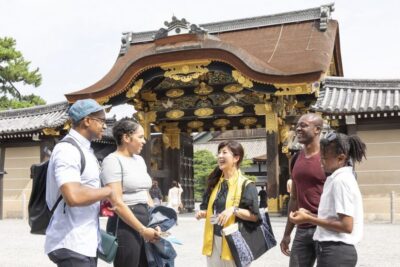
Nijo-jo Castle and Ninomaru Palace Guided Tour
Read our review →
Samurai Ninja Museum Guided tour and Experience
Read our review →Browse the lists this tour appears in