
Reviewed · CASTLES AND HISTORIC SITES
Embrace the Samurai Way: Iaido Swordsmanship Experience in Tokyo
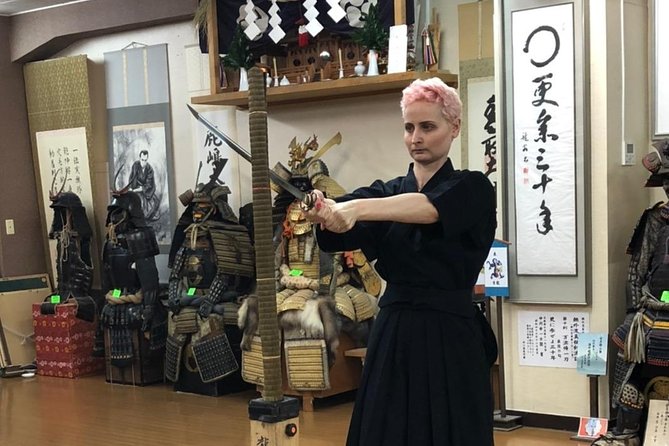
Stand where samurai once trained. This 90-minute Tokyo lesson gives you hands-on practice in Iaido, the Japanese art of drawing and handling a sword, rather than a quick photo stop with a plastic blade. You wear a traditional Iaido uniform, learn basic movements, hear about samurai values, and may cut tatami targets with a real Japanese sword under close supervision.
I like the personal instruction, which can be adjusted to your ability, and I like the English support from attendants such as Masa and Masahiro. The session also includes a participation certificate. The main caution is that this is a real physical activity involving a sword, so it is not suitable for pregnant women, people with heart conditions, or anyone needing wheelchair access.
In This Review
- Key points to know before you book
- What this Tokyo Iaido lesson is really about
- Meeting at Starbucks near Kudanshita
- Changing into the Iaido uniform
- Learning the basics from a master
- From replica practice to a real blade
- Samurai stories, blade customs, and cultural context
- Why the private format matters
- Price, timing, and overall value
- Who should book this experience?
- What impressed me most
- Should you book the Tokyo Samurai Iaido Experience?
- FAQ
- How long does the Iaido experience last?
- Where does the experience begin and end?
- How early should I arrive?
- Is English support included?
- Do I wear a traditional Iaido uniform?
- Can I use a real Japanese sword?
- Is this activity private?
- What is the cancellation policy?
Key points to know before you book
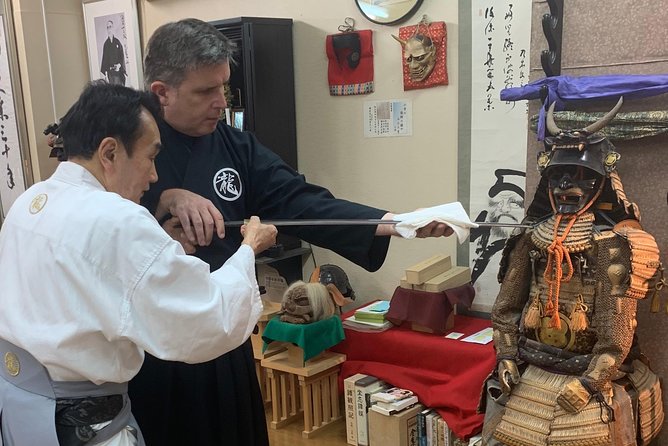
- Real sword practice: The session can include supervised tatami cutting with a live Japanese sword, not only practice with a replica.
- Traditional clothing: You put on an Iaido jacket and related items, which makes the lesson feel like training rather than a staged costume visit.
- Private instruction: Your group has the activity to itself, allowing the teacher to adjust the pace and answer questions.
- English assistance: An English-speaking attendant helps explain technique, customs, and the meaning behind the movements.
- Meeting point in Kudanshita: You meet at Starbucks Coffee near Kudanshita Station and return there after the lesson.
- Good value for enthusiasts: At $154.37 per person, the price makes more sense for people who want instruction and real practice, not just a samurai-themed photograph.
What this Tokyo Iaido lesson is really about
Iaido is often described as the art of drawing the sword, but the lesson is about more than pulling a blade from its scabbard. You learn how posture, hand position, timing, focus, and controlled movement work together.
That matters because the samurai image is often reduced to armor, swords, and dramatic movie battles. This class presents a quieter idea of the samurai way. Discipline, respect, precision, and self-control are part of the lesson, and the instructor connects physical technique with the values behind it.
I appreciate that balance. You are not simply handed a sword and told to swing. The basic movements come first, and the teacher explains why each action needs care. That makes the activity more useful for a first-time visitor who wants cultural context along with a memorable afternoon.
The lesson lasts about 1 hour and 30 minutes. That is long enough to learn a sequence of movements and attempt a supervised cut, but short enough to fit into a busy Tokyo sightseeing day. You should still expect the time to pass quickly, especially if your group has many questions.
More Castles and Historic Sites in Tokyo
- Tokyo: Imperial Palace and Shogun Historical Walking Tour
★ 5.0 · 2,251 reviews - Tokyo Castle & Imperial PalaceーShogun Walking Tour
★ 4.7 · 1,068 reviews - Tokyo: Samurai Ninja Museum Guided tour and Experience
★ 4.6 · 1,010 reviews
Meeting at Starbucks near Kudanshita
The starting point is Starbucks Coffee at the Kudankita 1-chome building, close to Kudanshita in Chiyoda City. The full address provided is 1-chome 2-1 Kudankita, Chiyoda City, Tokyo 102-0073.
You should arrive at least 10 minutes early. That small buffer matters in Tokyo, where a wrong station exit or a few minutes spent checking a map can create unnecessary stress. The activity ends back at the same meeting point, so you do not need to work out a separate return journey.
The location is near public transportation, which makes it practical to pair with other parts of central Tokyo. Still, give yourself time to find the correct Starbucks and confirm you are at the designated meeting place. Messages with location information may be sent through WhatsApp, and this can be useful if you need help finding the spot.
Private transportation is not included. You make your own way to the meeting point, then return there after the lesson. For most people, that is a reasonable arrangement because the activity is near transit and the class itself is the main event.
Changing into the Iaido uniform
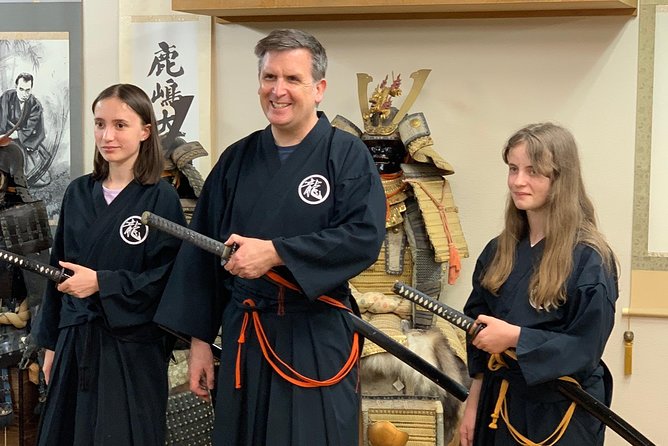
One of the first touches that makes this feel different from a standard sightseeing stop is changing into a traditional Iaido jacket and related clothing items. The uniform is not just for photographs. It helps put you in the right frame of mind and allows you to practice the movements in appropriate clothing.
You should wear comfortable clothes underneath. Avoid anything that restricts your movement, though you do not need special sports equipment. Since the activity involves standing, stepping, turning, and handling a sword, comfort is more important than dressing for a formal dinner afterward.
The uniform also helps separate this lesson from the many samurai attractions that focus on appearance alone. Here, the clothing is part of the practice. You are learning how the body should be positioned and how the sword is handled, not simply posing beside one.
Learning the basics from a master
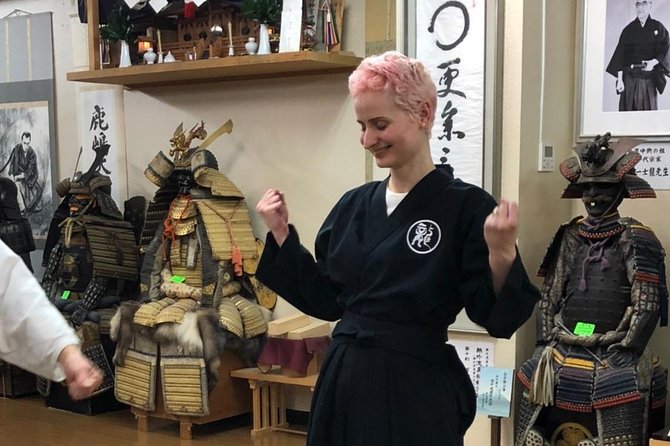
The instructor begins with an explanation of Iaido concepts and basic sword handling. The pace is meant to work for beginners, so you do not need previous martial arts experience.
Expect close attention to fundamentals. A teacher may correct how you stand, how you hold the sword, how you move your arms, and how you finish a technique. These details can feel slow at first, but they are the reason a private class is more useful than a large demonstration.
The instructor also explains aspects of samurai culture, including the rules and licensing connected with Japanese blades. That is a particularly interesting part of the session because it places the sword in its legal and cultural setting. A Japanese sword is not simply a souvenir or a prop. It is an object handled with serious care.
English interpretation is included. The attendant helps translate the teacher’s explanations and can clarify points for you and your family. In one particularly successful family session, the translator helped a parent and son understand the technical details and the small points of etiquette. That kind of support is important because a lesson about posture and precision loses much of its value if you only understand half of the instructions.
Masa and Masahiro are names associated with the English-language support and welcome. Their role appears to include meeting the group, helping with communication, and supporting photographs. The friendly tone of the staff is a plus, especially if you are nervous about handling a sword for the first time.
A completely different kind of day out:
- Tokyo Disney Resort – Tokyo Disneyland & Tokyo DisneySea Park Tickets
★ 4.8 · 99,488 reviews - SHIBUYA SKY Ticket
★ 4.7 · 46,509 reviews - JR Whole Japan Rail Pass
★ 4.8 · 29,150 reviews - Mt Fuji and Hakone 1-Day Bus Tour Return by Bullet Train
★ 5.0 · 26,383 reviews
From replica practice to a real blade
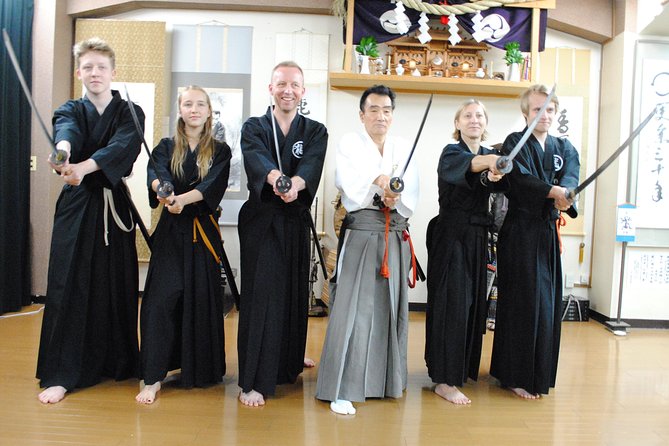
The class may begin with a mock sword as you learn the safest way to draw, hold, and move. This is sensible. It lets you focus on body position before adding the weight and sharpness of a real blade.
Later, you may use a real Japanese sword to cut tatami targets under supervision. This is the feature that gives the activity much of its appeal, but it is also the part that demands the most attention. You should listen closely, follow the instructions exactly, and resist the temptation to treat the sword like a theatrical prop.
Cutting tatami is not simply a matter of strength. The technique, angle, timing, and follow-through all matter. A successful cut can be deeply satisfying because you see an immediate result from the movements you have just practiced. A parent and son were able to cut through tatami together, making the session especially memorable as a family activity.
Not every participant will find the real-sword section easy. That is part of the honest appeal. You are attempting a demanding traditional skill in a short class, not becoming a trained swordsman in one afternoon. The instructor’s supervision is essential, and you should view the attempt as practice rather than a test of toughness.
The provider describes this as one of the few Iaido workshops where you can use and cut with a real sword. That detail helps explain the price, but it also means you should choose the activity only if you are comfortable with a serious, controlled physical exercise.
Samurai stories, blade customs, and cultural context
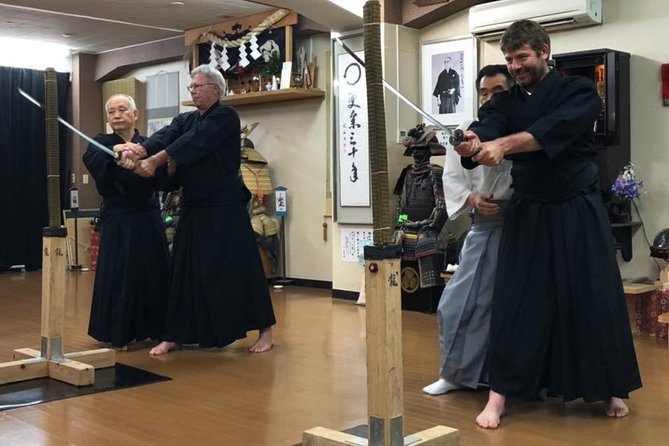
The storytelling adds weight to the practical instruction. The dojo master explains samurai history and talks about the licensing of blades, giving you a better sense of why swordsmanship developed such strict customs.
This is where the class can become meaningful even for someone who is less interested in martial arts. You learn about how a weapon can also be a symbol of rank, duty, discipline, and tradition. The best parts are not necessarily the fastest movements. Often, the explanation before or after an exercise gives the activity its lasting value.
The English translation helps bridge a difficult subject. Samurai concepts do not always fit neatly into a short English explanation, so having an attendant who can clarify the lesson is a real benefit. You can also ask questions about the sword, the techniques, and the traditions rather than simply watching a performance.
Antique swords may also be shown during the visit, based on the experience details shared by the operator. If this is part of your session, handle the opportunity with the same care as the training itself. The point is not to rush from one object to the next, but to understand why Japanese sword culture values craft, care, and proper handling.
Why the private format matters
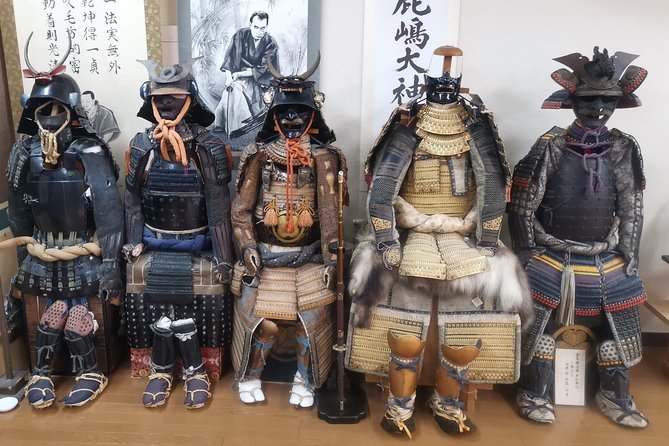
This is a private activity, meaning only your group participates. That is a major advantage for families, couples, and small groups of friends who want to ask questions without holding up strangers.
Private instruction also reduces the embarrassment factor. Beginners can look awkward during the first few movements. In a group of strangers, you might worry about keeping up. With your own group, the teacher can slow down, repeat a movement, or give extra attention to the person who needs it.
The format is especially good for a parent and child, as long as both can follow safety instructions and take part physically. It also suits martial arts students who want a first look at Iaido, history enthusiasts who want something more active than a museum, and visitors marking a special occasion.
The trade-off is that the experience may feel more intense than a casual cultural show. You are expected to pay attention and participate. If you only want to watch a sword demonstration, this may not be the best match.
Price, timing, and overall value
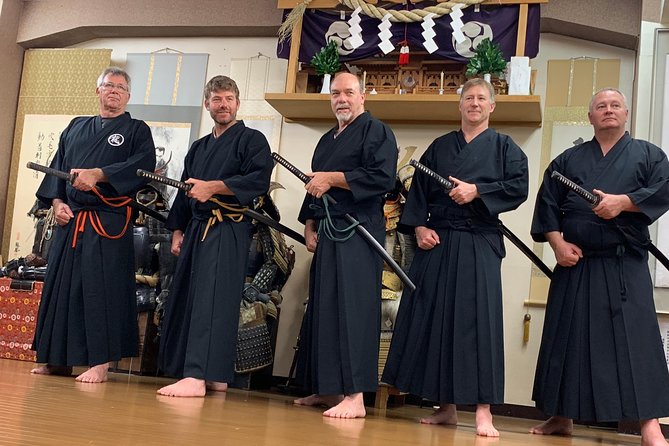
The listed price is $154.37 per person. That is not a small add-on for a Tokyo afternoon, especially when the session lasts roughly 90 minutes. I would not choose it simply because it looks unusual in a sightseeing search.
The value becomes clearer when you consider what is included: traditional Iaido clothing, private instruction, an English-speaking attendant, practical training, the possibility of real-sword tatami cutting, and a participation certificate. You are paying for access to a specialist lesson rather than admission to a general attraction.
For someone already interested in Japanese martial arts, the price is easier to justify. The real blade practice and direct contact with a master are the parts that make this more than a costume experience. For a family, group discounts may improve the cost, though the exact savings are not provided.
You should also consider the opportunity cost. Tokyo offers countless inexpensive cultural activities, but few involve supervised sword practice. If this is a once-in-a-lifetime interest for you, the focused format can be worth more than several passive attractions.
The experience is booked an average of 58 days ahead, so I would not leave it until the final days of your trip if your schedule is fixed. Confirmation is sent within 48 hours of booking, subject to availability. Free cancellation is available up to 24 hours before the start time. Late cancellations and changes are not accepted for a refund.
The activity requires good weather and a minimum number of participants. If the operator cancels for either reason, you are offered another date or a refund. That policy is useful, but you should avoid placing the session on the only open afternoon of a tightly packed itinerary.
Who should book this experience?
I would recommend it most strongly to:
- First-time visitors who want an active introduction to Japanese culture
- People with a serious interest in Iaido, samurai customs, or Japanese blades
- Families with older children who can follow careful instructions
- Couples or friends seeking a shared activity with a clear sense of place
- Martial arts students curious about a different Japanese discipline
- Visitors who value personal instruction over a large staged show
You should think twice if you dislike physical activities, have a heart condition, are pregnant, or require wheelchair accessibility. Comfortable clothing is required, and the activity involves standing and handling a sword.
It may also disappoint you if you expect a long museum visit or a full-day historical tour. The class gives you a compact introduction, not an exhaustive study of samurai culture. Its strength is direct participation.
What impressed me most
The strongest part is the combination of explanation and action. You hear about samurai values, learn the mechanics with a practice sword, and then apply those lessons under supervision. That progression gives the class a clear purpose.
I also like the staff support. The English attendant is not an afterthought. Good translation helps you understand why the instructor is asking for a particular stance or movement. It also makes the session more comfortable for families with different ages and levels of English.
The personal welcome from Masa and the energy associated with Masahiro add warmth to what could otherwise be a very formal lesson. Help with photographs is another small but useful touch. You can concentrate on the activity while someone else helps record the moment.
The high overall rating of 4.8 from 16 ratings and a 94 percent recommendation rate indicate strong satisfaction, but the sample is not large. There is also one serious report of a missed pickup and unanswered messages. The operator apologized and attributed it to a web and app setup problem after a restart. I would confirm the meeting details shortly before the activity and keep the operator’s contact information handy.
Should you book the Tokyo Samurai Iaido Experience?
Book it if you want to handle a real sword, learn from a master, and take part in a focused cultural lesson rather than watch a polished performance. The private format, English support, traditional uniform, and possible tatami cutting make this a strong choice for curious families and martial arts enthusiasts.
Skip it if you want something passive, inexpensive, or fully accessible. At $154.37, it needs to match a real interest in Iaido to feel worthwhile. Arrive early, wear comfortable clothing, confirm the meeting point, and treat every instruction seriously.
For the right person, this is a memorable way to connect with Japan through discipline and practice. You leave with more than a photograph and a certificate. You leave with a better sense of why swordsmanship demands patience, control, and respect.
FAQ
How long does the Iaido experience last?
The activity lasts approximately 1 hour and 30 minutes.
Where does the experience begin and end?
It begins at Starbucks Coffee near Kudanshita in Chiyoda City, Tokyo, and ends back at the same meeting point.
How early should I arrive?
You should arrive at the designated meeting point 10 minutes before the scheduled start time.
Is English support included?
Yes. An English-speaking attendant is included to help explain the lesson and translate the instructor’s guidance.
Do I wear a traditional Iaido uniform?
Yes. An Iaido jacket and related items are included for the activity. You should wear comfortable clothing underneath.
Can I use a real Japanese sword?
The experience includes supervised real-sword practice with tatami cutting, according to the activity information. The lesson also includes basic practice and sword handling instruction.
Is this activity private?
Yes. Only your group participates in the private tour or activity.
What is the cancellation policy?
You can cancel up to 24 hours before the start time for a full refund. Cancellations or changes made less than 24 hours in advance are not accepted for a refund. If the operator cancels because of weather or insufficient participation, you are offered another date or a full refund.
Just added in Tokyo
- A One-of-a-Kind Sushi Experience in a Special Place of Japan★ 5.0 · 15 reviews
- Tokyo Cute Bento Cooking Class – Make a Kawaii Character Lunchbox★ 5.0 · 126 reviews
- Japanese Home Cooking Class & Walk in Todoroki Temple Tokyo★ 5.0 · 88 reviews
- Japan Tokyo Tower Observatory Deck E-Ticket★ 4.0 · 34 reviews
- Catch a Baseball Game in Tokyo with a Local – Tickets Included★ 5.0 · 24 reviews
- JDM Experience with Fast&Furious RX-7 (English speaking Driver)★ 5.0 · 57 reviews
- Tokyo Private Day Tour by Car with English speaking Driver Guide★ 4.0 · 29 reviews
- Japan Classic 10 Day – One Life Adventures★ 5.0 · 129 reviews
Castles and Historic Sites, compared.



Imperial Palace and Shogun Historical Walking Tour
Read our review →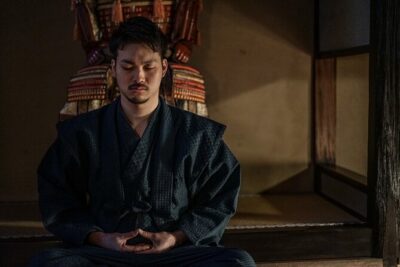
Tokyo Castle & Imperial PalaceーShogun Walking Tour
Read our review →
Nijo-jo Castle and Ninomaru Palace Guided Tour
Read our review →
Samurai Ninja Museum Guided tour and Experience
Read our review →Browse the lists this tour appears in