
Reviewed · WORKSHOPS
Japanese Calligraphy – Shodo – Lesson (near Kyoto Station)
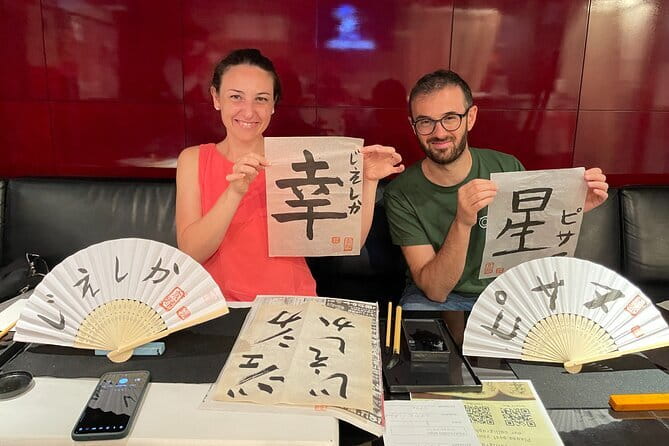
Brushes, ink, and a little patience make memorable souvenirs. This one-hour Japanese calligraphy lesson near Kyoto Station gives you a hands-on introduction to shodo, with help using the brush, applying ink, and writing simple kanji. I like the small group size, capped at 10, and I like that your finished work goes home with you rather than ending up in a classroom bin. The main drawback is finding the meeting point, which is at the MK Taxi VIP Station and can be easy to miss around the station.
The class is friendly and family-ready, with activities suited to children as well as adults. I also like the personal touch of creating an approximate Japanese version of your name and learning what the selected kanji mean. At $50.40 per person, the price is not bargain-level for an hour, but the included materials, instruction, and take-home pieces make it a reasonable choice when you want an activity rather than another sightseeing stop.
In This Review
- Key Details Before You Book
- What This Kyoto Shodo Class Actually Teaches
- The First Ten Minutes: Brush, Ink, and Washi Paper
- Practicing Kanji and Creating a Scroll
- Turning Your Name Into Kanji
- A Small Group Makes the Lesson More Useful
- Finding the MK Taxi VIP Station at Kyoto Station
- Is $50.40 Good Value for One Hour?
- Who Will Enjoy This Activity Most?
- Practical Booking and Cancellation Notes
- Should You Book the Kyoto Shodo Lesson?
- FAQ
- How long does the Japanese calligraphy lesson last?
- Where does the class meet?
- Where does the activity end?
- What materials are included?
- How many people can join the class?
- Can children take part?
- Will I learn to write my name in Japanese?
- Can I cancel for a full refund?
Key Details Before You Book
- Your meeting point is the MK Taxi stand: Look for the MK Taxi VIP Station at the Hachijo Exit, in or by the Kyoto sightseeing reception area near ibis Styles Kyoto Station.
- The class is limited to 10 people: That keeps the lesson more personal and gives you a better chance to receive brush and kanji help.
- You practice several useful characters: The lesson includes kanji for one, A, forever, and Kyoto, followed by a personal name written approximately in kanji.
- You take home your creations: Washi paper, brushes, and ink are supplied, and your writing can be made into a scroll.
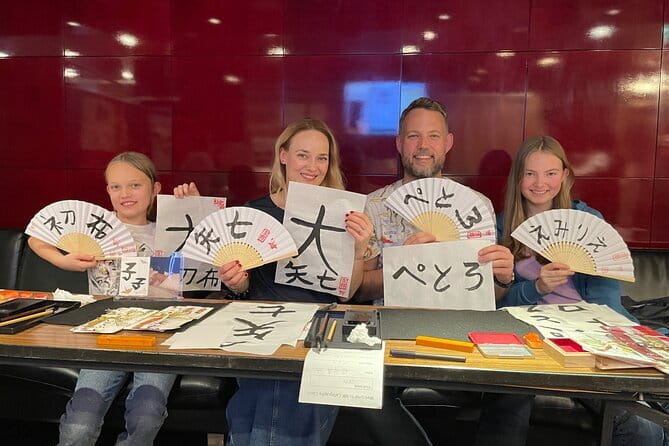
- Children can take part: The activity has family-friendly exercises, and one 9-year-old participant particularly enjoyed the practice and decorating.
- The lesson lasts about one hour: It fits neatly into a Kyoto Station day, especially before a train, after arrival, or on a rainy afternoon.
What This Kyoto Shodo Class Actually Teaches
This is a beginner lesson, not a formal course in Japanese calligraphy. That is good news if you want a clear introduction without needing to read Japanese or bring any experience with brushwork.
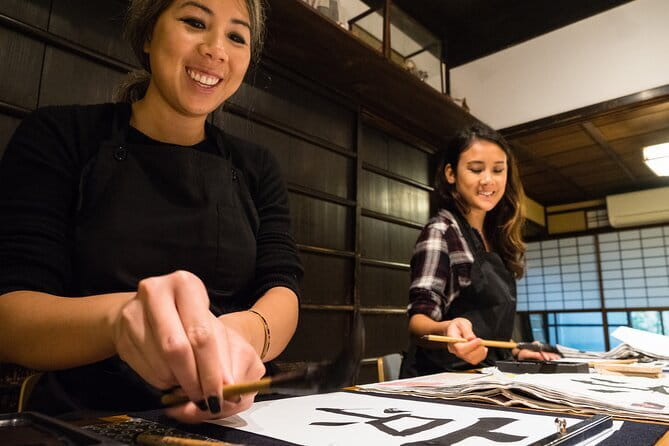
The class begins with the basics: how to hold and use a brush, how to apply ink, and how to control the marks on the paper. Those simple instructions matter. A calligraphy brush does not behave like a pencil, and the amount of ink, pressure, and speed all affect the final stroke. An instructor can show you these small adjustments much faster than a book or a video.
You then practice basic characters. The listed examples include kanji for one, A, forever, and Kyoto. The exact character choices give the activity a nice Kyoto connection while keeping the first exercises manageable. You are not expected to produce museum-quality work. The point is to learn the shape and movement of each character, then make something attractive enough to keep.
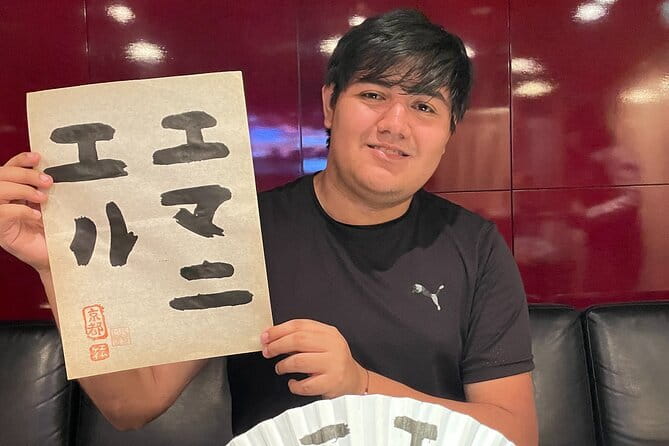
The instructor also helps you write your name in approximate kanji. This is one of the most personal parts of the class, but it needs a little explanation. Japanese kanji are not simply a direct alphabetic translation of an English name. The staff choose characters that can suggest the sounds of your name and carry meanings of their own.
For example, the name Brian may be represented with characters connected to martial courage, courtesy, and peace. Liz may receive characters linked with a pear and painting. These choices are playful interpretations, not official Japanese spellings. You should treat them as a creative souvenir and a chance to learn about character meanings.
That distinction makes the activity more interesting. You are not just copying symbols. You are hearing why particular characters might fit your name and seeing how written Japanese can carry meaning as well as sound.
A few more options to weigh up in Kyoto
- PERFECT KYOTO 1-Day Bus Tour
★ 5.0 · 13,518 reviews - [Kyoto & Nara Day Tour] Sagano Scenic Railway & Nara Park & Fushimi Inari Taisha Thousand Torii Gates & Togetsukyo Bridge & Bamboo Grove & Kimono Forest (Departing from Osaka)
★ 4.9 · 10,942 reviews - Kyoto: Fushimi Inari, Kinkakuji, Bamboo Grove 1 Day Bus Tour
★ 4.8 · 4,316 reviews
The First Ten Minutes: Brush, Ink, and Washi Paper
All the necessary materials are supplied, including brushes, ink, and washi paper. That keeps the session simple. You do not need to shop for supplies in Kyoto, pack delicate paper, or worry about bringing ink through the rest of your trip.
Washi paper is especially suitable for this kind of keepsake. It gives the finished characters a distinctly Japanese look and feels more special than ordinary printer paper. You will work with the brush and ink under the instructor’s direction, then use the paper for your practice and final pieces.
The teaching style is practical. Staff explain how to handle the brush and how to place ink rather than giving you a long lecture on calligraphy theory. That suits the one-hour format. You get enough context to understand what you are doing, then spend most of your time making marks yourself.
Haruko has been singled out for being kind, patient, and easy to follow. English support is available, which is important for a lesson built around small movements and word meanings. You can ask for help with a stroke, a character, or the sense behind your proposed name.
Do not expect a silent, formal studio atmosphere. The staff are described as friendly and chatty, which can make the class comfortable for first-time participants. If you prefer a strict traditional lesson with little conversation, this may feel more casual than expected.
Practicing Kanji and Creating a Scroll
Once you understand the brush, the class moves into basic characters. This is where the session becomes more than a photo opportunity. You get repeated chances to practice, correct your grip, adjust your ink, and try again.
The characters include simple concepts such as one and forever, along with Kyoto. They offer different levels of difficulty and let you see how a few strokes can create a complete idea. Writing Kyoto is also a useful way to tie the souvenir to the place where you learned.
The practice stage is important for children. A child may not want a long explanation about Japanese writing, but repeated strokes, colorful materials, and a final object to take home give the lesson a clear purpose. The activity has been enjoyed by children as young as 9, and the staff can guide younger participants through the process.
At the end, your chosen kanji can be arranged into a scroll. This gives your work a finished form and makes it easier to protect in your luggage. You are not leaving with just a few loose sheets of practice paper. You have a souvenir connected to something you personally did.
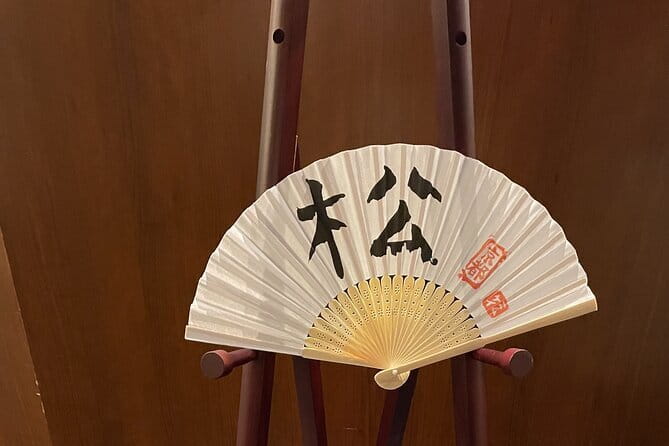
Some sessions also include decorated items such as fans and a photo frame, based on the activities described by participants. Since the exact items may vary, I would treat the scroll and your calligraphy sheets as the reliable core of the experience, with other decorative pieces as possible extras.
Turning Your Name Into Kanji
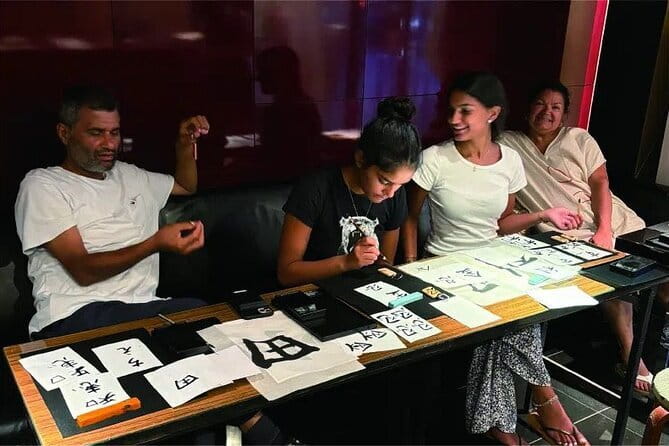
The name exercise is the most distinctive part of the lesson. Many short cultural activities let you copy a standard word, but this class adds a personal layer by working with your own name.
The instructor helps suggest possible kanji characters and explains their meanings. This can lead to unusual and amusing combinations. The sound of your name may be represented with characters whose literal meanings are quite different from the original name. That is normal for this activity and part of its charm.
I would approach this section with an open mind. You may not receive a single perfect answer, because names from English and other languages do not always fit neatly into Japanese writing systems. The goal is to find an attractive, meaningful approximation and understand the characters selected.
This is also a good moment to ask questions. You can learn why one character suggests peace, another suggests courtesy, or another refers to a familiar object. The explanation helps turn a decorative souvenir into a small lesson about how Japanese writing works.
If you are attending with family or friends, comparing everyone’s character choices can be fun. Each person leaves with something different, and the results are more personal than buying the same souvenir from a shop.
A completely different kind of day out:
- Kyoto: Tea Ceremony in a Traditional Tea House in Kiyomizu
★ 4.9 · 3,519 reviews - Kyoto: Gion Make Your Own Chopsticks with Engraving Option
★ 5.0 · 3,465 reviews - Kyoto Nara Day Trip │ Kiyomizu-dera Temple + Fushimi Inari-taisha Shrine + Nara Park (Departing from Osaka/Kyoto)
★ 4.7 · 3,408 reviews - Kyoto Geisha Walking Tour: Gion District & Hidden Gems
★ 4.7 · 3,273 reviews
A Small Group Makes the Lesson More Useful
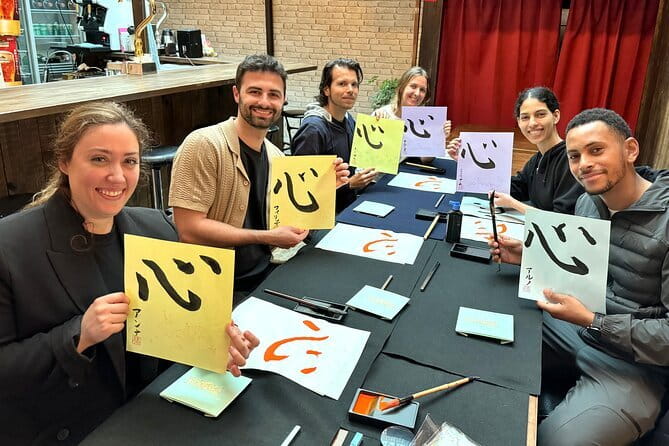
The class accepts a maximum of 10 people. That is small enough for the instructor to notice how you are holding the brush and to help when a character goes wrong.
This matters because calligraphy is a hands-on skill. If the instructor were speaking to a large room, you might spend too much time waiting or copying without knowing what to correct. In a group of 10 or fewer, you have a better chance of getting practical help.
The compact format also suits families. Adults can work at their own pace while children receive assistance with the brush and paper. The class is not described as a private lesson, so you should expect to share the room, but the group limit keeps it from becoming impersonal.
A one-hour session also prevents the activity from becoming tiring. Brush practice demands concentration, especially for children. You get enough time to make several attempts and finish a souvenir without giving up half a day of your Kyoto schedule.
The tradeoff is that the lesson cannot cover every form of Japanese calligraphy in depth. You will learn the foundations and create a keepsake, but you will not leave as an advanced shodo student. For a first encounter, that is a fair exchange.
Finding the MK Taxi VIP Station at Kyoto Station
The meeting point deserves careful attention. It is the MK Taxi VIP Station at the Hachijo Exit of Kyoto Station, listed with the taxi stand and Kyoto sightseeing reception at ibis Styles Kyoto Station, 47 Higashikujo Kamitonodacho, Minami Ward, Kyoto 601-8002.
The practical tip is simple: look for the MK Taxi stand. The building can be confusing to spot from the station, and the meeting point is not presented as a large calligraphy studio that is obvious from every direction.
One useful orientation tip is to look for the MK building diagonally across the street after coming out of the station exit. Another description places it about two blocks from nearby accommodation. Give yourself extra time, especially if you are carrying luggage or navigating Kyoto Station for the first time.
The location is otherwise convenient. It is near public transportation and close to the station, so you can combine the lesson with arrival or departure plans. The activity ends back at the same meeting point, which simplifies the next step in your day.
Because the class is only about an hour, the location is one of its strongest practical features. You do not need to spend another hour crossing Kyoto to reach a remote workshop. Just build in enough time to identify the MK Taxi area before the start.
Is $50.40 Good Value for One Hour?
At $50.40 per person, this is not the cheapest way to spend an hour in Kyoto. You are paying for instruction, a small group, supplied brushes and ink, washi paper, help with name kanji, and finished items you can take home.
The value depends on what you want. If you only want to write one character quickly, the cost may feel high. If you want a guided cultural activity with a personal souvenir and no need to buy materials, the price is easier to justify.
I think the included equipment makes a real difference. Calligraphy supplies are not difficult to find in Japan, but shopping takes time and you may not know which brush or paper to choose. Here, everything is ready when you arrive, and the instructor shows you how to use it.
The small group limit adds value too. A cheaper, crowded activity may give you less individual attention. In this class, help with your name and brush technique is part of what you are paying for.
The strong 4.9 rating from 37 ratings and a 100 percent recommendation rate suggest that the class is delivering what it promises. I would still judge the price against your schedule. For a family or a couple seeking a shared activity, it can be worthwhile. For a solo visitor on a very tight budget, a temple visit or free station-area sightseeing may offer more time for less money.
Who Will Enjoy This Activity Most?
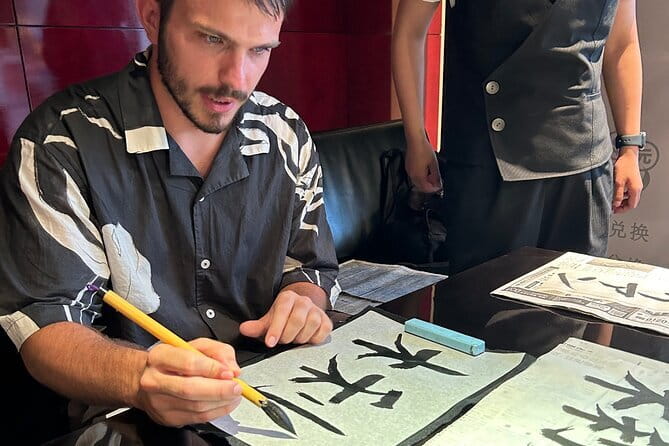
This lesson suits first-time visitors to Kyoto who want to make something rather than simply look at something. It is also a good option for anyone curious about Japanese writing but unsure where to begin.
Families are well matched to the class. The activities are suitable for children, and the combination of practice, decorating, names, and take-home souvenirs gives younger participants several ways to stay interested.
Couples and friends can also enjoy the personal aspect. Each person can choose a favorite word and create a different set of characters. The completed pieces make better souvenirs than a generic keychain because you had a hand in making them.
The lesson also works well on a short Kyoto itinerary. Since it lasts about an hour and begins and ends near Kyoto Station, it can fit between transport connections or alongside other station-area plans.
I would be less likely to recommend it to an experienced calligrapher seeking advanced instruction. The class is built for beginners, and the short duration means the focus is on basic technique and fun results rather than formal mastery.
Practical Booking and Cancellation Notes
Confirmation is provided when you book, and mobile tickets are supported. The activity has free cancellation if you cancel at least 24 hours before the local start time.
Cancellations or changes made less than 24 hours before the start are not accepted for a refund. Keep that deadline in mind if your Kyoto schedule may shift.
Most people can participate, and the class is near public transportation. The maximum group size is 10, which is worth checking when you want a quieter lesson with more instructor attention.
The provider is Kyoto MK. The lesson ends where it begins, at the MK Taxi VIP Station near Kyoto Station.
Should You Book the Kyoto Shodo Lesson?
Book this class if you want a short, friendly introduction to Japanese calligraphy with a souvenir that feels personal. The strongest reasons are the small group, patient English-speaking help, family-friendly format, and the chance to turn your name into approximate kanji.
I would book it especially for a first or last day in Kyoto. Its station location makes it easy to pair with transport, while the finished scroll, paper, fan, or decorated item can become a tangible reminder of Japan.
Skip it if you want a long, serious study of shodo or if $50.40 feels too much for a one-hour activity. For most beginners, though, the hands-on practice and personal name exercise give the session more substance than a quick souvenir-making stop.
FAQ
How long does the Japanese calligraphy lesson last?
The activity lasts approximately one hour.
Where does the class meet?
It meets at the MK Taxi VIP Station at the Kyoto Station Hachijo Exit, near the taxi stand and Kyoto sightseeing reception at ibis Styles Kyoto Station.
Where does the activity end?
The activity ends back at the meeting point.
What materials are included?
Brushes, ink, and washi paper are included.
How many people can join the class?
The maximum group size is 10 participants.
Can children take part?
Yes. The experience is family-friendly and includes activities available for children.
Will I learn to write my name in Japanese?
You will receive help creating an approximate version of your name in kanji, along with explanations of possible characters and their meanings.
Can I cancel for a full refund?
Yes, if you cancel at least 24 hours before the experience start time. Cancellations or changes made less than 24 hours before the start are not refundable.
Just added in Kyoto
- The “Golden Route” and Ancient Japan by DIAMIR Erlebnisreisen – 14-Day Tour★ 2.0 · 2 reviews
- Japan: Castles & Cuisine by G Adventures – 6-Day Kyoto to Osaka Tour★ 4.5 · 4 reviews
- Cycle Japan by Explore! – 13-Day Kyoto to Tokyo Tour★ 4.7 · 12 reviews
- Cycle Japan by Intrepid Travel – 11-Day Kyoto to Tokyo Tour★ 4.8 · 2 reviews
- Classic Japan by Intrepid Travel – 11-Day Kyoto to Tokyo Tour★ 4.4 · 14 reviews
- Ancient & Modern Japan 14-Day Tour by Exodus Adventure Travels★ 4.4 · 40 reviews
- 5 Day Cultural Adventure of Kyoto, Nara & Osaka by Tourist Journey★ 2.5 · 2 reviews
- 12 Days Kinosaki Onsen Escape: A Journey Through Japan’s Timeless Towns by UME Travel★ 4.8 · 5 reviews
Workshops, compared.

Sushi Making Tokyo Roll and Authentic Japanese Sushi Class
Read our review →
Gion Make Your Own Chopsticks with Engraving Option
Read our review →
Roll and Authentic Sushi Making Class in Asakusa
Read our review →
Ramen Cooking Class at Ramen Factory in Kyoto
Read our review →
Tokyo Asakusa Chopsticks Workshop: Make Your Own Pair
Read our review →
Ring Making Workshop : Vintage Japanese Coin Ring
Read our review →Browse the lists this tour appears in