
Reviewed · WALKING TOURS
Kyoto Early Riser Platinum One-Day Walking Tour
Kyoto rewards early risers. This private day tour links Fushimi Inari, Arashiyama, Kinkakuji, and Nishiki Market in about eight hours, giving first-time visitors a useful sweep of the city’s best-known sights. You travel with your own guide rather than a large group, so the day can bend around your interests and walking pace.
I like the early start, which gives you a better chance at quieter shrine paths and cooler temperatures. I also like the personal service praised by past participants, including guides Gigi, Fuji-san, Seiya, and Meg, who helped with photos, local details, scenic spots, and even lunch planning. The main drawback is the amount of public transit between distant sights, which can eat into your sightseeing time.
In This Review
- Key points to know before booking
- Why the early start matters in Kyoto
- Fushimi Inari and its thousands of red gates
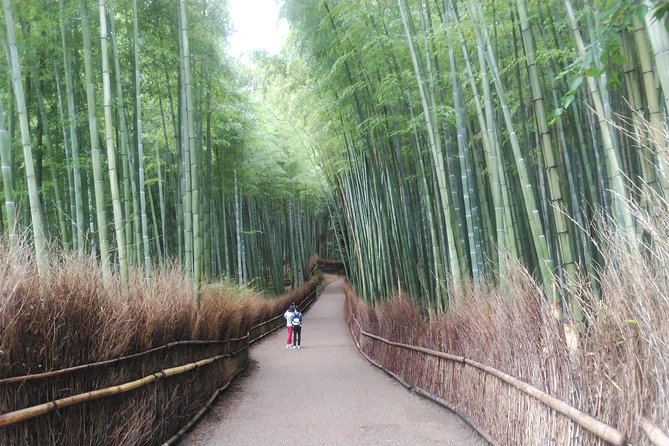
- Arashiyama’s Bamboo Forest Street
- Kinkakuji, Kyoto’s Golden Pavilion
- Kitano Tenmangu and prayers for academic success
- Kamishichiken and Kyoto’s geisha district
- Nishiki Market for food and local shopping
- What the private guide adds
- The public transit tradeoff
- Who should book this Kyoto day tour?
- My final call on the Platinum One-Day Tour
- FAQ
- How long does the Kyoto Early Riser Platinum One-Day Walking Tour last?
- What is the price of the tour?
- Is this a private tour?
- Where does the tour start?
- Where does the tour end?
- Which attractions are included in the route?
- Are entry tickets included?
- Is public transportation included?
- Is the tour suitable for people with limited mobility or eyesight?
- Can I cancel for a full refund?
Key points to know before booking
- Fushimi Inari comes first, when its famous vermilion torii gates are more pleasant to walk through.
- Six major stops fit into one day, including Kyoto’s bamboo forest, Golden Pavilion, a historic shrine, a geisha district, and Nishiki Market.
- Your guide is private to your group, allowing more freedom than a standard coach tour.
- Public transit costs extra, with the listed estimate at ¥1,700 per person, and the connections may feel tedious.
- Kinkakuji admission costs extra, listed at ¥500 per person.
- You will walk a lot, so this suits active visitors more than anyone seeking a relaxed, slow-paced day.
Why the early start matters in Kyoto
Kyoto’s best-known sights can feel very different at the start of the day. Fushimi Inari and the Arashiyama bamboo path are both famous for their photographs, and arriving early gives you a better shot at enjoying their atmosphere before the heaviest crowds and strongest heat.
This is also a practical way to use your first full day in Kyoto. Instead of spending hours working out train, subway, and bus connections, you have a guide handling the broad plan and explaining what you are seeing. That convenience matters in Kyoto, where the main sights sit in different parts of the city and public transit is not always direct.
The tradeoff is clear: this is an ambitious day. You are not lingering for hours at any one temple. You are collecting a strong first look at several major places, with walking and transit filling much of the time.
The tour begins and ends at the Kyoto Station Building, at 901 Higashishiokōjichō in Shimogyo Ward. That central meeting point is useful if you are staying near the station or need a clear place to orient yourself at the start of your Kyoto visit.
More Walking Tours in Kyoto
- Kyoto Geisha Walking Tour: Gion District & Hidden Gems
★ 4.7 · 3,273 reviews - Kyoto: Gion Magical Night Walking Tour with Geisha Trivia
★ 4.9 · 2,393 reviews - Kyoto: Gion Geisha District Walking Tour – Stories of Geisha
★ 4.7 · 2,187 reviews
Fushimi Inari and its thousands of red gates
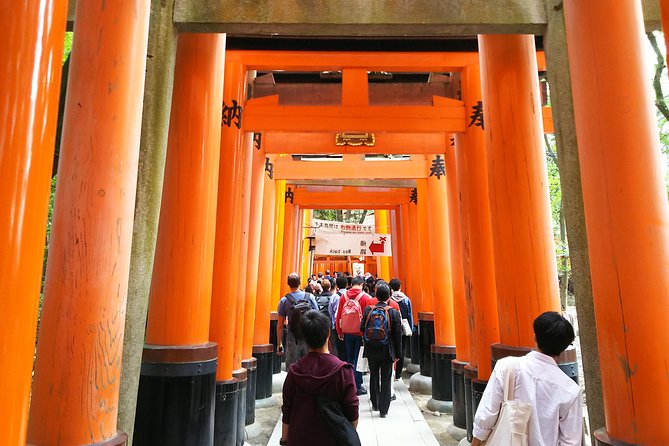
The first stop is Fushimi Inari-taisha Shrine, with about an hour set aside. Its signature sight is the long tunnel of vermilion torii gates, donated by worshippers in thanks for good fortune received from the shrine’s deity.
The gates make this one of Kyoto’s most instantly recognizable places, but the experience is more than a quick photo stop. Walking beneath them gives you a sense of how the shrine changes as you move uphill and away from the entrance. With only an hour here, you should not expect to cover the entire mountain route. The value is getting a taste of the torii-lined paths without spending the whole morning on one site.
Admission is free. The path does involve walking, and the tour’s overall pace means you should wear comfortable shoes and be ready to keep moving. Your guide can add context about the shrine and help you find good photo angles, an especially useful service when you have limited time.
Starting here is one of the smartest choices in the schedule. Fushimi Inari is a popular stop, and an early visit is more likely to feel calm than a late-morning arrival.
Arashiyama’s Bamboo Forest Street
The bamboo forest receives about one hour and ten minutes. Tall bamboo trunks create a narrow green corridor, with light filtering through the leaves and the sound of leaves and trunks moving in the breeze.
This is a beautiful place, but it is also one of the tour’s time pressure points. Arashiyama is not close to Fushimi Inari, so reaching it requires public transportation and part of your day disappears in transit. Once there, you have enough time to walk through the main section and take photographs, but not necessarily enough time to explore the wider Arashiyama area at leisure.
That distinction matters. If the bamboo forest is your top priority, you may want a separate half-day for Arashiyama. If you mainly want to see the famous path as part of a broad Kyoto introduction, the allotted time is sensible.
One participant specifically felt this area deserved more time and suggested splitting the full program over two days. I agree with that caution for anyone who dislikes rushing. The tour works best when you accept that each stop offers a focused visit rather than a complete exploration.
Kinkakuji, Kyoto’s Golden Pavilion
Kinkakuji receives roughly 50 minutes, with admission listed separately at ¥500 per person. The temple’s gilded pavilion beside the pond is one of Kyoto’s classic views and a strong reason to include this tour in a first visit.
The site is famous for good reason. The golden building reflects beautifully in the water, and the surrounding garden gives you several angles for photographs. At the same time, this is a very popular attraction, so you should expect a set route and a steady flow of people.
Fifty minutes is enough to enter, view the pavilion, walk through the grounds, and take pictures. It is not enough for a slow, reflective temple visit. Your guide can help you understand the temple’s connection to Zen and samurai culture, adding meaning to what might otherwise become a quick photo stop.
The extra admission fee is modest, but remember that it is not covered by the tour price. If you are tracking every cost, add the ¥500 entry charge to the advertised $130.79 per-person rate.
A completely different kind of day out:
- PERFECT KYOTO 1-Day Bus Tour
★ 5.0 · 13,518 reviews - [Kyoto & Nara Day Tour] Sagano Scenic Railway & Nara Park & Fushimi Inari Taisha Thousand Torii Gates & Togetsukyo Bridge & Bamboo Grove & Kimono Forest (Departing from Osaka)
★ 4.9 · 10,942 reviews - Kyoto: Fushimi Inari, Kinkakuji, Bamboo Grove 1 Day Bus Tour
★ 4.8 · 4,316 reviews - Kyoto: Tea Ceremony in a Traditional Tea House in Kiyomizu
★ 4.9 · 3,519 reviews
Kitano Tenmangu and prayers for academic success
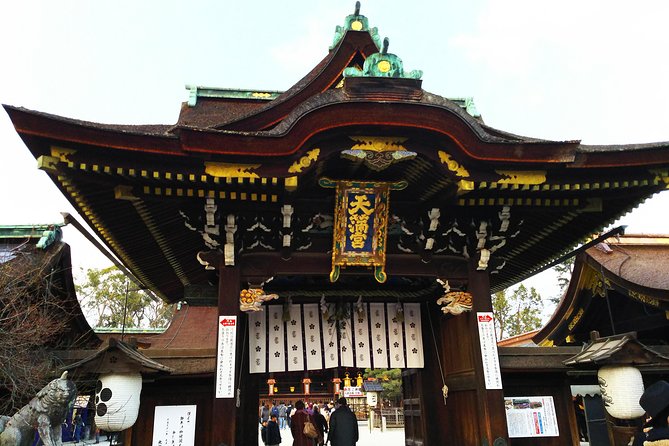
Kitano Tenmangu Shrine receives about 30 minutes. Built in 945, it honors Sugawara no Michizane, a deity associated with academic success. Students come here to pray before important examinations, giving the shrine a living purpose that goes beyond its architecture.
Thirty minutes is a short visit, but it can work well after Kinkakuji. You can see the main shrine area, learn about its role in Kyoto, and notice the connection between religious practice and everyday hopes for education and success.
This is one of the quieter and more culturally useful stops on the route. It may not have the instant visual impact of Fushimi Inari or Kinkakuji, but it gives your guide room to explain a part of Japanese religious life that is easy to miss when you only chase famous buildings.
The stop is free. Its value depends heavily on the guide’s explanation, which is one reason a private format helps here. A rushed independent visit could feel like another shrine on a long list. A good guide can show you why this particular place matters.
Kamishichiken and Kyoto’s geisha district
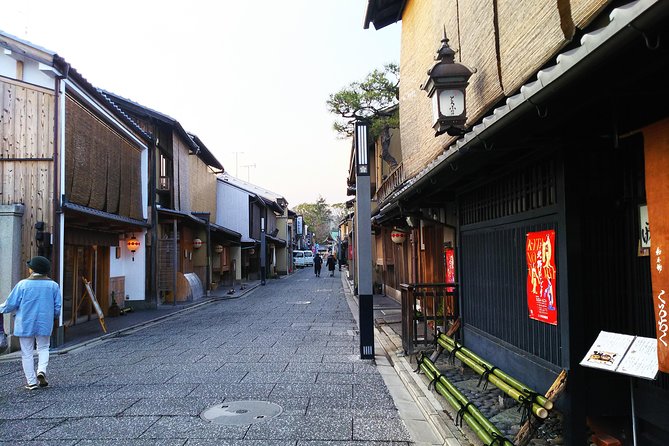
Next door to Kitano Tenmangu is Kamishichiken, one of Kyoto’s five hanamachi, or geisha districts. The schedule allows about 25 minutes at Kamishichiken Kaburenjo Theatre.
This district has fewer geisha houses and fewer geiko and maiko than some of Kyoto’s better-known entertainment quarters. That is not a weakness. It means the area can offer a more restrained look at a traditional neighborhood without turning the visit into a hunt for performers.
You should treat this as a respectful walking stop, not a promise of a geisha sighting or a theatre performance. The available information does not include a performance ticket or theatre entry, and the tour does not promise encounters with geiko or maiko.
The short visit works because the district sits beside the shrine. There is no need to spend a large part of the day reaching it. Your guide can point out the setting and explain the role of the hanamachi within Kyoto’s cultural life.
Nishiki Market for food and local shopping
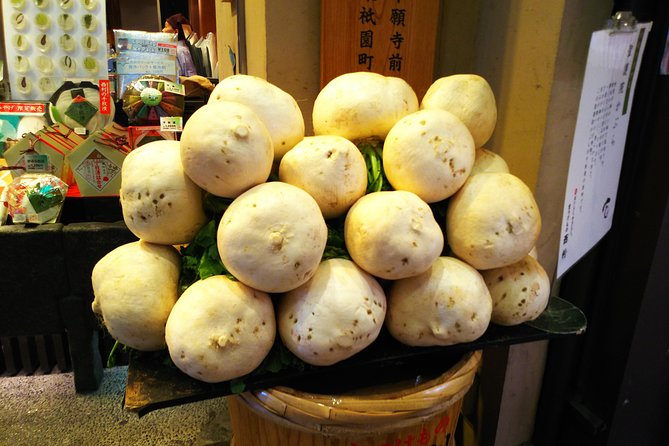
The final listed stop is Nishiki Market, with about 40 minutes for shopping and tasting. The market has served Kyoto residents for about 400 years, with 126 shops along a street roughly 390 meters long.
This is where the day becomes more hands-on. You can look for Kyoto vegetables, pickles, and other local foods, with some opportunities to taste products as you walk. Forty minutes is enough for an introduction, but it is not a long meal break or a full shopping session.
A guide is particularly helpful here because markets can be confusing when you do not know what you are looking at. You can ask about unfamiliar ingredients, local specialties, and what is worth buying. One guide was praised for arranging a very good lunch, while another took the group to a delicious lunch spot. That kind of help may be available, but lunch is not listed as included, so budget separately for food.
Nishiki Market is a good finish because it leaves you in a central part of Kyoto with practical ideas for snacks and souvenirs. Just keep in mind that market stalls may have their own payment and eating rules, and the tour’s 40-minute window will pass quickly.
What the private guide adds
The strongest reason to choose this experience is the private format. Only your group participates, so you can ask questions without waiting for a busload of people and may be able to adjust the emphasis within the fixed route.
The guide quality appears to be a major part of the experience. Gigi was praised for matching the day to personal interests, taking photographs, arranging lunch, and keeping the pace enjoyable. Fuji-san was appreciated for explaining the important details at each place and finding scenic spots. Seiya helped make bus and subway travel part of the experience, using the journeys to show Kyoto neighborhoods rather than treating transit as dead time. Meg was praised for answering questions and even bringing hand warmers on a cold morning.
Those details suggest a useful difference between a basic sightseeing transfer and a good private tour. The guide can help you understand what you are seeing, find better photo locations, and make small comfort adjustments. Still, the tour’s success depends heavily on the individual guide assigned to you.
The public transit tradeoff
The listed public transportation estimate is ¥1,700 per person, separate from the tour price. The route covers far-flung parts of Kyoto, so buses, trains, or subways are necessary to connect the stops.
This has two sides. I like the fact that you see more of ordinary Kyoto while moving through neighborhoods. One participant especially enjoyed using buses and the subway because it added a local element to the day.
But Kyoto transit can be crowded and poorly connected, particularly between major sightseeing areas. One dissatisfied participant found the repeated connections tedious and felt they reduced sightseeing time. That criticism is fair. You should carry a usable transit card, such as a Suica card, if you have one, rather than spending the day counting coins for individual fares.
The extra transit cost also makes the $130.79 price less complete than it first appears. Add ¥1,700 for public transportation and ¥500 for Kinkakuji, then plan for lunch and market purchases. In exchange, you receive an eight-hour private guide, a planned route, and help navigating a difficult city layout.
Who should book this Kyoto day tour?
I would recommend it most strongly to a first-time Kyoto visitor with only one or two full days. You will see several essential sights in one organized day and gain enough context to decide where you want to return later.
It also suits couples, families with older children, and small private groups who value personal attention. The route is useful for anyone who wants a guide to handle the broad plan while still using ordinary public transit.
I would hesitate if your main goal is slow temple visits, long meals, or extended time in Arashiyama. The schedule is packed, and the walking plus transit can be tiring. Anyone with limited mobility should ask careful questions before booking, even though the activity is described as accessible for people with limited mobility and limited eyesight. It is not stroller accessible, and the program involves quite a bit of walking.
The advertised price is $130.79 per person, with group discounts available. That can be fair value for a private full day, especially if you are splitting the cost among a group and want a guide who can adjust the day. It is less attractive if you are comfortable planning transit yourself and prefer spending an entire morning in one district.
My final call on the Platinum One-Day Tour
Book this tour if you want a fast, well-guided introduction to Kyoto’s major cultural sights and accept that transit will be part of the day. The early start, private guide, and wide range of stops are its best features.
Skip it, or ask to split the route across two days, if Arashiyama, Nishiki Market, or temple time matters more to you than checking off several major sights. Before paying, remember the separate ¥500 admission fee, ¥1,700 transit estimate, food costs, and the need for comfortable walking shoes.
The tour has a strong 4.7 rating and a 92 percent recommendation rate, but the mixed experience with transit is worth taking seriously. For the right person, this is an efficient first look at Kyoto, with enough personal guidance to make a very full day feel manageable.
FAQ
How long does the Kyoto Early Riser Platinum One-Day Walking Tour last?
The tour lasts approximately eight hours.
What is the price of the tour?
The listed price is $130.79 per person. Group discounts are available.
Is this a private tour?
Yes. Only your group participates in the activity.
Where does the tour start?
It starts at the Kyoto Station Building, 901 Higashishiokōjichō, Shimogyo Ward, Kyoto, 600-8216, Japan.
Where does the tour end?
The activity ends back at the meeting point at Kyoto Station Building.
Which attractions are included in the route?
The route includes Fushimi Inari-taisha Shrine, Bamboo Forest Street, Kinkakuji Temple, Kitano Tenmangu Shrine, Kamishichiken Kaburenjo Theatre, and Nishiki Market Shopping District.
Are entry tickets included?
No. Kinkakuji admission is listed separately at ¥500 per person. The other listed stops have free admission based on the supplied tour details.
Is public transportation included?
No. Public transportation is listed as an additional cost of ¥1,700 per person.
Is the tour suitable for people with limited mobility or eyesight?
The activity is described as accessible for people with limited mobility and limited eyesight. However, it also involves quite a bit of walking and is not stroller accessible.
Can I cancel for a full refund?
Yes, if you cancel at least 24 hours before the experience start time. Cancellations made less than 24 hours before the start time are not refunded. If poor weather causes the tour to be canceled, you will be offered another date or a full refund.
Just added in Kyoto
- The “Golden Route” and Ancient Japan by DIAMIR Erlebnisreisen – 14-Day Tour★ 2.0 · 2 reviews
- Japan: Castles & Cuisine by G Adventures – 6-Day Kyoto to Osaka Tour★ 4.5 · 4 reviews
- Cycle Japan by Explore! – 13-Day Kyoto to Tokyo Tour★ 4.7 · 12 reviews
- Cycle Japan by Intrepid Travel – 11-Day Kyoto to Tokyo Tour★ 4.8 · 2 reviews
- Classic Japan by Intrepid Travel – 11-Day Kyoto to Tokyo Tour★ 4.4 · 14 reviews
- Ancient & Modern Japan 14-Day Tour by Exodus Adventure Travels★ 4.4 · 40 reviews
- 5 Day Cultural Adventure of Kyoto, Nara & Osaka by Tourist Journey★ 2.5 · 2 reviews
- 12 Days Kinosaki Onsen Escape: A Journey Through Japan’s Timeless Towns by UME Travel★ 4.8 · 5 reviews
Walking Tours, compared.
Kyoto Geisha Walking Tour: Gion District & Hidden Gems
Read our review →
Tokyo Tsukiji Fish Market Food and Culture Walking Tour
Read our review →
Gion Magical Night Walking Tour with Geisha Trivia
Read our review →
Imperial Palace and Shogun Historical Walking Tour
Read our review →
Gion Geisha District Walking Tour – Stories of Geisha
Read our review →

Shinjuku Local Bar and Izakaya Guided Walking Tour
Read our review →
Browse the lists this tour appears in