
Reviewed · WALKING TOURS
Kyoto Fushimi-Inari Night Walking Tour
Fushimi-Inari changes after dark. The famous red torii gates feel calmer as daylight fades, and this small-group walk gives you more than a photo stop. I like the cooler evening air and the chance to hear clear explanations about Shinto customs, fox statues, prayers, and the shrine’s role in daily life. The main thing to consider is that much of the route follows mountain paths in proper darkness, so good walking shoes and a steady pace matter.
At $43.11 per person, the tour offers fair value if you want context, navigation, and company at one of Kyoto’s most confusing sights. Guides such as Jem, Tammy, Caleb, Hiro, Masaki, and Yessi are repeatedly praised for being friendly, organized, and easy to understand. The tradeoff is simple: you will not have the shrine entirely to yourself, and the walk can feel more like a small hike than a casual stroll.
In This Review
- Key points about the Fushimi-Inari night walk
- Why Fushimi-Inari feels different at night
- Meeting the guide at the fox statue
- The lower shrine grounds and first torii gates
- Walking beneath the torii toward Mount Inari
- Small shrines, stone foxes, and the meaning behind the scenery
- The dusk-to-dark timing
- What the $43.11 price buys you
- The main drawbacks to consider
- Who should book this Kyoto night tour?
- Should you book the Fushimi-Inari night walk?
- FAQ
- How much does the Kyoto Fushimi-Inari Night Walking Tour cost?
- How long does the tour last?
- Where does the tour begin?
- Where does the tour end?
- Is admission to Fushimi-Inari included?
- How large is the group?
- Is the tour suitable for most people?
- What should I wear or bring?
- Can I cancel for a refund?
Key points about the Fushimi-Inari night walk
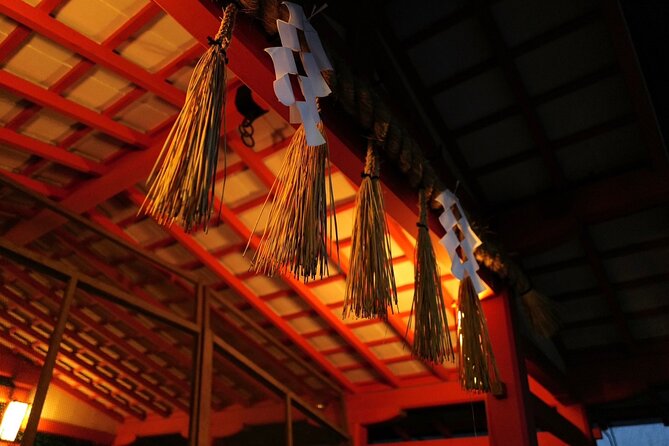
- Red torii gates after sunset: See the shrine in cooler air and softer light, with crowds thinning as evening continues.
- Small groups of up to 12: The limited size makes questions and conversation easier than on a large coach-style outing.
- A 90-minute to two-hour walk: Expect time on sloping paths leading up Mount Inari, not just a quick visit at the entrance.
- Useful cultural instruction: Guides explain how to pray at different sites and point out details you might otherwise pass.
- Meeting point at the entrance fox statue: The tour begins and ends at the fox statue by Fushimi-Inari Taisha.
- Free cancellation up to 24 hours ahead: Cancel at least a full day before the start time for a full refund.
Why Fushimi-Inari feels different at night
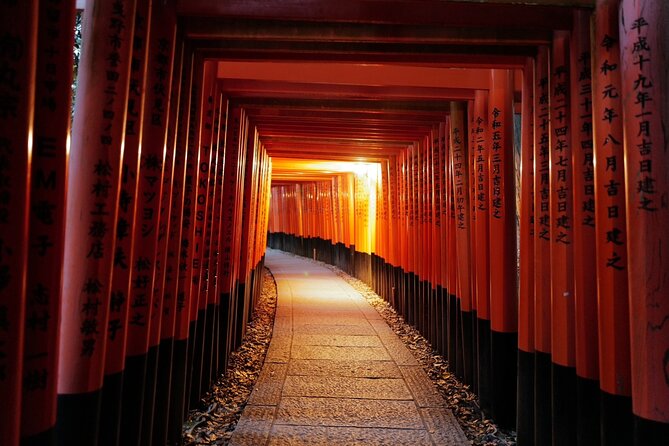
Fushimi-Inari Taisha is best known for its thousands of orange-red torii gates, donated over many years by individuals and businesses seeking success. The gates form long corridors through the wooded slopes of Mount Inari, turning a normal shrine visit into a walk through shifting light and shadow.
In daylight, the sight is striking but often crowded. After dusk, the mood changes. The red gates glow against the darker paths, lanterns and lights pick out parts of the route, and the sound level usually drops as people spread out or head back down.
That quieter setting is the strongest reason to book this tour. You can pause to look at carvings, stone foxes, small shrines, and prayer areas without feeling pushed along by a solid stream of people. The route is still active, especially near the start, but the number of people tends to thin as the evening goes on.
The darkness also adds a little uncertainty. Fushimi-Inari is easy to wander through, with paths branching toward side shrines and higher points. A guide is useful not only for stories, but also for keeping the group on the intended route.
More Walking Tours in Kyoto
- Kyoto Geisha Walking Tour: Gion District & Hidden Gems
★ 4.7 · 3,273 reviews - Kyoto: Gion Magical Night Walking Tour with Geisha Trivia
★ 4.9 · 2,393 reviews - Kyoto: Gion Geisha District Walking Tour – Stories of Geisha
★ 4.7 · 2,187 reviews
Meeting the guide at the fox statue
The tour begins at the fox statue at the entrance to Fushimi-Inari Taisha, in the Fushimi Ward of Kyoto. The listed address includes Inari Station, and the meeting point is close to public transportation. Take a moment to confirm the exact meeting instructions on your mobile ticket before setting out, especially if you are arriving in the evening.
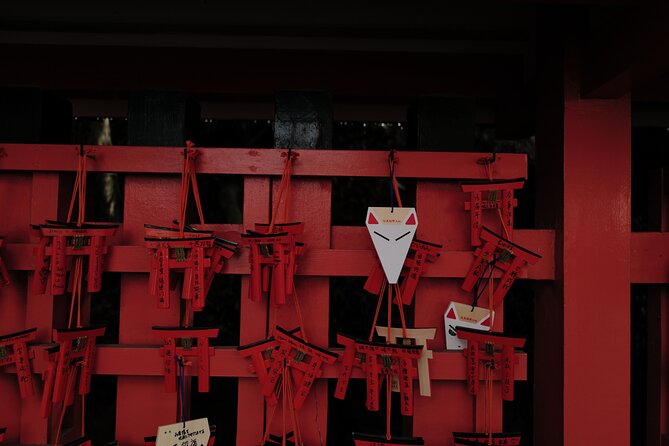
The fox is an important symbol here. Inari is associated with rice, agriculture, and business, and fox statues appear throughout the shrine grounds as messengers. That first meeting point is not random. It gives the guide a natural place to begin explaining the shrine’s symbols before the group starts uphill.
Guide quality is a major strength of this tour. Jem is praised for keeping groups organized while explaining the importance of the shrines. Tammy has been especially helpful with advance directions and is noted for her friendly, patient manner. Caleb’s approach is described as lively and clear, including when children are in the group.
Other guides named in the feedback include Hiro, Masaki, Vincent, Yessi, Cade, and Navi. Their styles differ, but the common thread is strong preparation, warmth, and an ability to answer questions without making the visit feel like a lecture.
The lower shrine grounds and first torii gates
The opening section takes place around the main shrine grounds, where you begin to understand how Fushimi-Inari works as a living place of worship rather than just a famous Kyoto backdrop. Your guide explains the significance of Inari, the meaning of the torii gates, and the role of smaller shrines and fox figures.
This is where a guide adds real value. Without help, it is easy to walk under the gates, take photographs, and miss the meaning of the objects around you. Yessi, for example, is praised for pointing out small features that could easily be overlooked and for showing the proper way to pray at different sites.
The prayer rituals matter because they are not always identical from one place to another. A guide can help you approach the shrine respectfully and understand what you are seeing rather than treating every structure as scenery.
The lower section may still be busy when the tour starts. One evening tour began with plenty of people around, but the crowds gradually became smaller. If you want the quietest possible visit, a later start may help, though the exact balance between dusk and full darkness depends on the season and the scheduled departure.
Walking beneath the torii toward Mount Inari
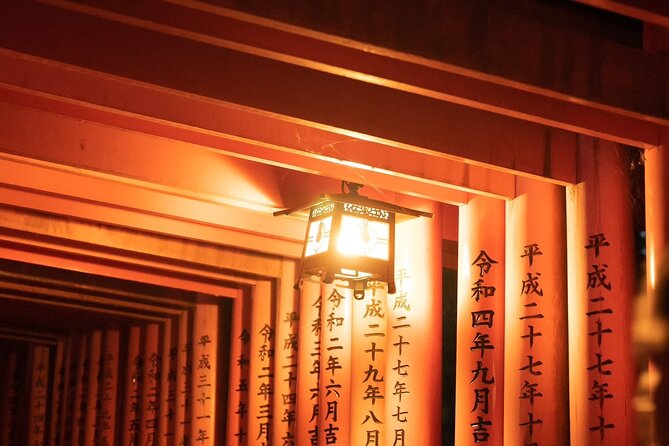
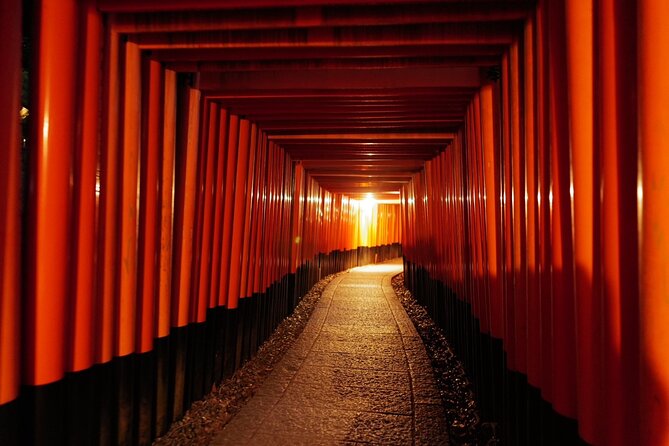
The torii gates are the visual heart of the outing. They stand close together in long rows, creating a tunnel-like path up the mountain. By night, the color becomes more dramatic, especially when lamps catch the inside of the gates and the surrounding trees fade into shadow.
The walk is not a flat city stroll. It includes mountain paths and some uphill movement, with the full outing lasting about 1 hour 30 minutes to two hours. The itinerary describes approximately two hours, so plan your evening around the longer end of that range.
You should wear walking shoes. One December visitor specifically advised bringing layers, while summer visitors appreciated the cooler nighttime temperature. Conditions can change quickly from warm and humid to cool once the sun disappears, so a light outer layer is a practical choice.
Rain is also possible. A rainy evening group still enjoyed having Hiro and Navi explain the shrine, and the smaller crowd made it easier to look closely at the setting. Still, wet paths may feel less comfortable, so bring suitable protection and take care on slopes.
The guide generally keeps the group together while allowing time for photographs. Vincent was singled out for being patient when a participant stopped to take pictures. That matters here because the gates invite constant pauses, but a group also needs to keep moving to finish the route safely and on time.
A completely different kind of day out:
- PERFECT KYOTO 1-Day Bus Tour
★ 5.0 · 13,518 reviews - [Kyoto & Nara Day Tour] Sagano Scenic Railway & Nara Park & Fushimi Inari Taisha Thousand Torii Gates & Togetsukyo Bridge & Bamboo Grove & Kimono Forest (Departing from Osaka)
★ 4.9 · 10,942 reviews - Kyoto: Fushimi Inari, Kinkakuji, Bamboo Grove 1 Day Bus Tour
★ 4.8 · 4,316 reviews - Kyoto: Tea Ceremony in a Traditional Tea House in Kiyomizu
★ 4.9 · 3,519 reviews
Small shrines, stone foxes, and the meaning behind the scenery
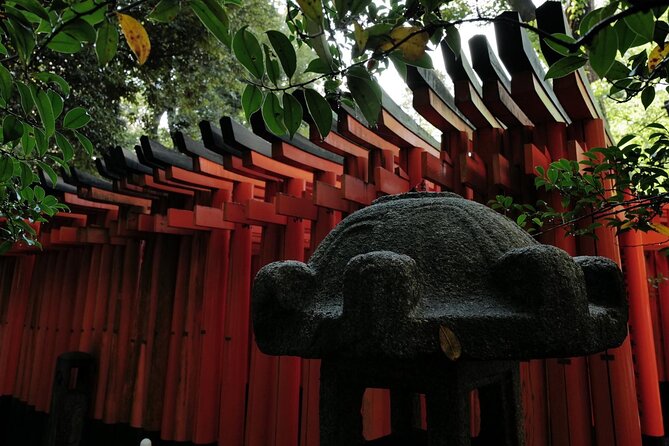
The path is filled with more than torii gates. You pass smaller worship areas, stone fox statues, and sections where the forest becomes part of the shrine’s character. The guide connects these features to Inari worship and to the prayers made for success, health, happiness, agriculture, and business.
This is the point where the tour moves beyond attractive photographs. Masaki is praised for explaining traditions and prayers, while Hiro is noted for giving clear answers about cultural practice and the shrine’s place in Japan. Caleb is described as sharing just enough information to keep the walk engaging without burying the group under long explanations.
That balance is important. Fushimi-Inari has a great deal to explain, but a nighttime walk is not the setting for a long classroom talk. The best guides keep information tied to what you are looking at right now: a gate, a fox, a prayer site, or a change in the path.
The small group size, capped at 12 people, supports this style. You are more likely to hear the guide, ask a question, or stop briefly for a photograph. It also creates a relaxed feel, though the group may be smaller or larger depending on the booking date.
The dusk-to-dark timing
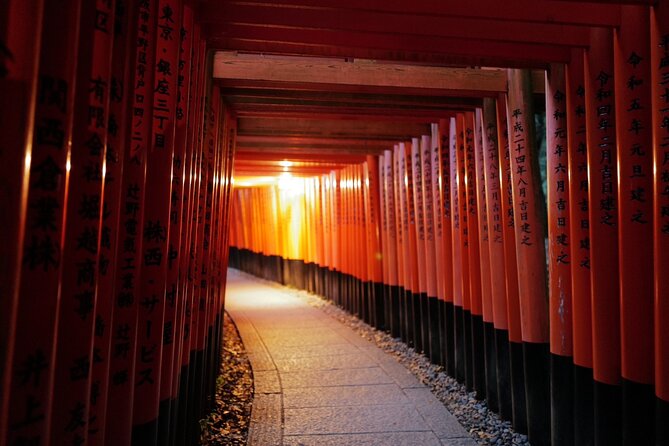
The tour is promoted as a nighttime visit, but the exact light depends on your start time and the season. A 6 p.m. start was described as pleasantly cool and less crowded, with the sun going down soon after the walk began. Other outings took place mostly in full darkness rather than at dusk.
This is worth understanding before you book. If you want a mix of evening color and illuminated gates, select a departure that begins before sunset when available. If your main goal is a darker, quieter atmosphere, a later time may suit you better.
Night photography can be rewarding, but do not expect every image to be bright and clear. The appeal is atmosphere, glowing gates, and contrast, not the same even lighting you get in the middle of the day. Give yourself time to look with your eyes too. It is easy to turn the whole walk into a camera exercise.
The cooler timing is a practical advantage in Kyoto’s warmer months. One visitor specifically enjoyed the nighttime tour during August heat. In December, layers were the better choice. The evening schedule can therefore improve comfort as well as crowd levels.
What the $43.11 price buys you
The $43.11 fee does not include an admission charge because entry to the shrine is free. You are paying for the guide’s time, interpretation, route planning, and the convenience of moving through a large shrine complex with someone who understands the setting.
That makes the price reasonable for the right kind of visitor. If you already know Shinto customs, have visited Fushimi-Inari before, and are comfortable finding your way through the mountain paths alone, you may prefer a self-guided visit. The shrine costs nothing to enter, and you can choose your own pace.
I see better value for a first visit, a night visit, or anyone who wants cultural context. The guides do more than point toward the torii gates. They explain prayers, traditions, symbols, and the purpose of the shrine, while also helping you avoid confusion on the branching paths.
The dinner and food suggestions offered by guides such as Masaki also add practical value to the evening, though these recommendations are informal and not part of the paid itinerary. Think of the tour as a guided introduction to Fushimi-Inari, not a full-day cultural program.
The main drawbacks to consider
The biggest drawback is the terrain. The tour follows paths toward Mount Inari, and you may spend much of the route walking uphill or through darkness. Anyone expecting a short, level photo visit may find the outing more demanding than expected.
The second issue is timing. The shrine does not become empty at sunset. You may still encounter plenty of people near the entrance and lower gates, with quieter conditions developing later. This tour reduces the crowd problem, but it cannot remove it entirely.
The third consideration is weather. Rain, humidity, summer heat, and winter chill can all affect your comfort. The reviews point to useful seasonal strategies: lighter clothing for August, layers for December, and patience when rain arrives.
Finally, guide style can vary. The named guides receive very strong praise, but each person will bring a different tone. Some focus more on history, some on cultural customs, and some on lively stories. The consistently positive pattern is that guides are friendly and willing to answer questions.
Who should book this Kyoto night tour?
I would recommend it to first-time visitors to Fushimi-Inari, people who want a cooler evening walk, and anyone who prefers a smaller group over a large organized outing. Families can also benefit, particularly when children respond well to stories and interactive explanations. Caleb was specifically praised for making the material understandable for children.
It suits curious visitors who want to know how to behave at a Shinto shrine. You will learn where to pause, how different sites are used, and why the fox statues and torii gates matter.
It is less suitable if you have limited walking ability, dislike uneven or sloping paths, or want complete solitude. The practical details say most people can participate, but the route is still a mountain walk and should be treated that way.
The activity allows service animals and is near public transportation. Confirmation arrives at booking, and the mobile ticket makes it easy to keep the reservation details on your phone. Free cancellation is available until 24 hours before the start time. Changes or cancellations inside that window are not refunded.
Should you book the Fushimi-Inari night walk?
Book it if you want meaning as well as photographs. The red torii gates are impressive on their own, but a guide helps you notice the fox messengers, understand the prayers, and find your way through a maze of paths after dark.
At $43.11, it is a fair purchase for a small group, a 90-minute to two-hour walk, and a guide who can make the shrine easier to understand. Bring comfortable shoes, a layer, and patience for changing light. If you accept that this is a real walk and not simply a quick entrance-area visit, the evening setting and strong guide support make it a worthwhile Kyoto activity.
FAQ
How much does the Kyoto Fushimi-Inari Night Walking Tour cost?
The tour costs $43.11 per person.
How long does the tour last?
The experience lasts approximately 1 hour 30 minutes to two hours. The planned itinerary describes about two hours.
Where does the tour begin?
It begins at the fox statue at the entrance to Fushimi-Inari Taisha Shrine in Kyoto’s Fushimi Ward.
Where does the tour end?
The tour ends back at the meeting point.
Is admission to Fushimi-Inari included?
The shrine admission is free, so there is no separate entrance charge listed for the visit.
How large is the group?
The tour has a maximum of 12 participants.
Is the tour suitable for most people?
The activity information says most people can participate. Keep in mind that the route includes mountain paths leading toward Mount Inari.
What should I wear or bring?
Walking shoes are recommended. Bring layers in cooler months, and prepare for evening weather. The path may be dark after sunset.
Can I cancel for a refund?
Yes. You can cancel at least 24 hours before the start time for a full refund. Cancellations or changes made less than 24 hours before the start time are not accepted for a refund.
Just added in Kyoto
- The “Golden Route” and Ancient Japan by DIAMIR Erlebnisreisen – 14-Day Tour★ 2.0 · 2 reviews
- Japan: Castles & Cuisine by G Adventures – 6-Day Kyoto to Osaka Tour★ 4.5 · 4 reviews
- Cycle Japan by Explore! – 13-Day Kyoto to Tokyo Tour★ 4.7 · 12 reviews
- Cycle Japan by Intrepid Travel – 11-Day Kyoto to Tokyo Tour★ 4.8 · 2 reviews
- Classic Japan by Intrepid Travel – 11-Day Kyoto to Tokyo Tour★ 4.4 · 14 reviews
- Ancient & Modern Japan 14-Day Tour by Exodus Adventure Travels★ 4.4 · 40 reviews
- 5 Day Cultural Adventure of Kyoto, Nara & Osaka by Tourist Journey★ 2.5 · 2 reviews
- 12 Days Kinosaki Onsen Escape: A Journey Through Japan’s Timeless Towns by UME Travel★ 4.8 · 5 reviews
Walking Tours, compared.
Kyoto Geisha Walking Tour: Gion District & Hidden Gems
Read our review →
Tokyo Tsukiji Fish Market Food and Culture Walking Tour
Read our review →
Gion Magical Night Walking Tour with Geisha Trivia
Read our review →
Imperial Palace and Shogun Historical Walking Tour
Read our review →
Gion Geisha District Walking Tour – Stories of Geisha
Read our review →

Shinjuku Local Bar and Izakaya Guided Walking Tour
Read our review →
Browse the lists this tour appears in