
Reviewed · WALKING TOURS
Kyoto Gion Historical Walking Tour
Kyoto reveals itself one lane at a time. This three-hour walk connects Gion and Higashiyama through old bridges, temple gates, wooded paths, cobbled slopes, and major cultural sights. I like the route for two clear reasons: it gives you a strong first look at eastern Kyoto, and the guides, including Jay, Ben, Ayumi, Michel, and Tommy, bring Japanese history and local stories to life in clear English. The main caution is simple: this is a real walking tour, with hills, stairs, and little time for a proper meal break.
I also like the small maximum group of 12, which should make questions easier and help you keep track of the guide in crowded areas. The route is packed with landmarks, but it can feel information-heavy, especially for younger children or anyone who prefers a slow sightseeing pace.
In This Review
- Key points to know before booking
- What this Kyoto walk is really designed to do
- Tatsumi Bridge and Gion Shibashi
- Chion-in’s great gate and temple grounds
- Maruyama Park and a change of pace
- Nene-no-Michi, the Path of Nene
- Yasaka Pagoda and the famous Higashiyama slopes
- Kiyomizu-dera: a strong finish with an extra cost
- The guide can make or break this tour
- Is $40 a fair price?
- Who should book this experience?
- My verdict on the Gion Historical Walking Tour
- FAQ
- How long does the Kyoto Gion Historical Walking Tour last?
- Where does the tour begin?
- Where does the tour end?
- Is admission to Kiyomizu-dera included?
- What should I wear for the tour?
- How large is the tour group?
- Can I cancel for a full refund?
Key points to know before booking
- Gion to Kiyomizu-dera route: You walk from Ben’s Cookies in central Kyoto through Gion and the Higashiyama district, finishing at Kiyomizu-dera.
- Three hours on foot: Comfortable shoes, water, and a snack matter more here than fancy camera gear.
- Strong guide record: Jay is praised for his history background and polished English, while Ben, Ayumi, Michel, and Tommy are also singled out for warmth, humor, and useful advice.
- Excellent cultural range: The walk touches on geisha, samurai, emperors, monks, religion, theater, the Meiji Restoration, and modern Kyoto.
- Admission is separate: The walking service is included, but Kiyomizu-dera admission and any other entry fee are not.
- Good value at $40: For a small-group route with a guide and several of Kyoto’s best-known eastern sights, the price is fair, provided you want explanation rather than a quick photo stop.
What this Kyoto walk is really designed to do
This is not a tour built around one temple. It is a connected introduction to Kyoto, moving from the old entertainment quarter of Gion into the temple-rich hills of Higashiyama. You get a sense of how religion, politics, architecture, theater, and everyday city life overlap here.
I would use this tour early in a Kyoto visit. The guide helps you understand why a quiet stone lane matters, why a temple gate is so imposing, and how Kyoto’s old institutions relate to modern Japan. Afterward, you can return to the places that caught your attention and explore them at your own speed.
The route also helps with orientation. You begin near Kyoto Shijo and finish at Kiyomizu-dera, rather than ending where you started. That is useful because you can continue sightseeing in Higashiyama after the walk instead of retracing the route across town.
The experience is offered with a mobile ticket, and the group can include no more than 12 people. That is a much better setup for questions than a large coach tour. It also means you should arrive at the stated meeting point, Ben’s Cookies Kyoto Shijo, with enough time to identify the group before departure.
More Walking Tours in Kyoto
- Kyoto Geisha Walking Tour: Gion District & Hidden Gems
★ 4.7 · 3,273 reviews - Kyoto: Gion Magical Night Walking Tour with Geisha Trivia
★ 4.9 · 2,393 reviews - Kyoto: Gion Geisha District Walking Tour – Stories of Geisha
★ 4.7 · 2,187 reviews
Tatsumi Bridge and Gion Shibashi
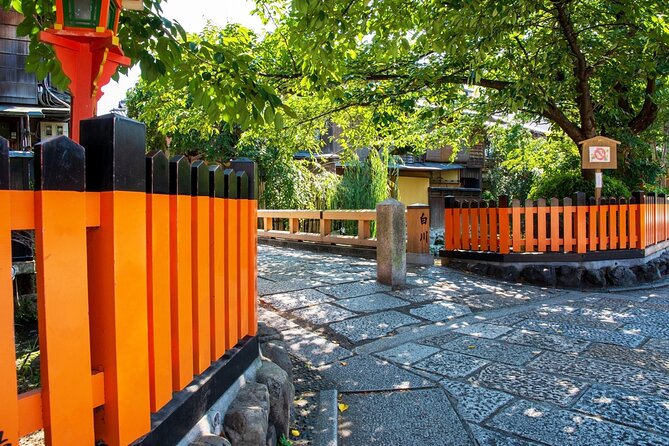
The first stop is Tatsumi Bridge, reached through Gion Shibashi, one of Kyoto’s most attractive traditional areas. The stop lasts about 15 minutes and costs nothing to enter.
This is a smart beginning. You start with the atmosphere many people hope to find in Gion: narrow streets, traditional buildings, and a setting connected with Kyoto’s geisha culture. The guide can give you the social and cultural background that is easy to miss when you are simply taking photographs.
The short stop also sets the pace. You are not spending an hour at the first sight, so the walk can cover several different parts of Kyoto. If you want a quiet, empty Gion, remember that this is one of the city’s popular areas. You may find other tour groups and plenty of foot traffic along the way.
A guide can also help you approach the district with respect. Gion is a living neighborhood, not a stage set. The most useful part of this stop is not just seeing a pretty bridge. It is learning how to look at the area without treating local life as a spectacle.
Chion-in’s great gate and temple grounds
From Gion, the route moves toward Chion-in Temple, beginning with the Sanmon gate. You have about 10 minutes at the gate, followed by roughly 20 minutes at the temple itself. There is no admission charge listed for these stops.
Chion-in Sanmon is a huge wooden Buddhist gate, and its size gives you an immediate sense of the temple’s importance. This is a good place for the guide to explain Buddhist architecture and the role of major religious institutions in Kyoto.
Inside the temple area, the focus broadens. Chion-in was founded in the 13th century and is one of Kyoto’s largest temples. The tour’s emphasis on religion and political history should be especially helpful here, since the site can otherwise become a quick stop for photographs and little else.
The time allocation is enough for an introduction, not a full temple visit. If you want to inspect every building, linger in silence, or explore the grounds in detail, you will need to return on your own. I see that as a reasonable tradeoff. The tour aims to show you a connected selection of Kyoto, not keep you inside one complex all afternoon.
Maruyama Park and a change of pace
Maruyama Park gives the route a brief open-air pause. The scheduled stop is about 10 minutes, with no admission charge.
After the gate and temple buildings, the park offers a different view of Kyoto. It is an urban green space with cultural importance and a calmer feel than the main shopping lanes. The guide may use this setting to connect Kyoto’s religious sites with the city’s gardens, trees, seasonal customs, and public spaces.
Do not expect a long rest here. Ten minutes passes quickly, and the walk continues into the eastern hills. If your knees or feet are sensitive, this is a good moment to drink water and adjust your pace.
One useful feature of a guided route is the regular check-in. Jay is praised for making sure the group was managing the long walk, and another account notes that a guide accommodated different needs and limitations. Still, you should judge your own fitness honestly. The tour requires a moderate physical fitness level, and the hills and steps become more noticeable later.
A completely different kind of day out:
- PERFECT KYOTO 1-Day Bus Tour
★ 5.0 · 13,518 reviews - [Kyoto & Nara Day Tour] Sagano Scenic Railway & Nara Park & Fushimi Inari Taisha Thousand Torii Gates & Togetsukyo Bridge & Bamboo Grove & Kimono Forest (Departing from Osaka)
★ 4.9 · 10,942 reviews - Kyoto: Fushimi Inari, Kinkakuji, Bamboo Grove 1 Day Bus Tour
★ 4.8 · 4,316 reviews - Kyoto: Tea Ceremony in a Traditional Tea House in Kiyomizu
★ 4.9 · 3,519 reviews
Nene-no-Michi, the Path of Nene
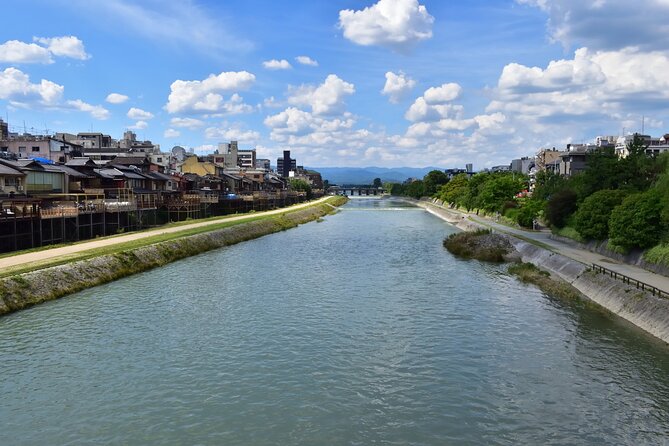
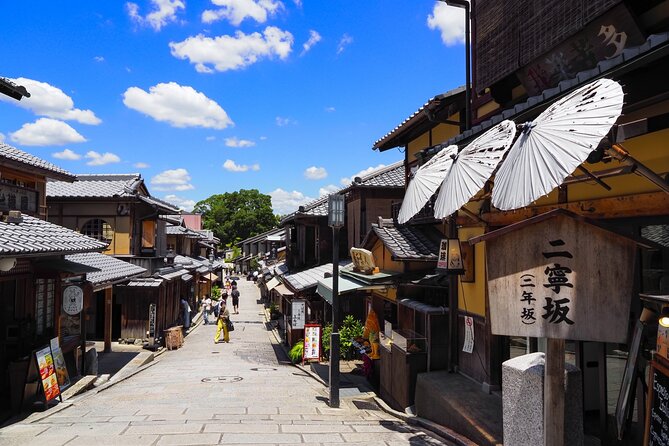
Nene-no-Michi is a historic stone-paved path named for Nene, the wife of Toyotomi Hideyoshi. It winds through one of the most photogenic parts of Higashiyama, with traditional buildings and narrow lanes.
This is the kind of place where a guide adds real value. On your own, you may see a handsome path and move on. With context, you can connect the lane to the people and events that shaped Kyoto’s eastern temple district.
The path is also a reminder that Kyoto’s appeal comes from the spaces between major sights. The small streets, walls, paving, and changes in elevation create much of the mood. You should keep your eyes on the surface, though. Stone paths and crowded lanes are not ideal for rushing.
The itinerary does not give a separate duration for Nene-no-Michi, so expect it to form part of the walk between the timed stops. That is normal for a walking tour, but it means the schedule is not a series of long, restful visits.
Yasaka Pagoda and the famous Higashiyama slopes

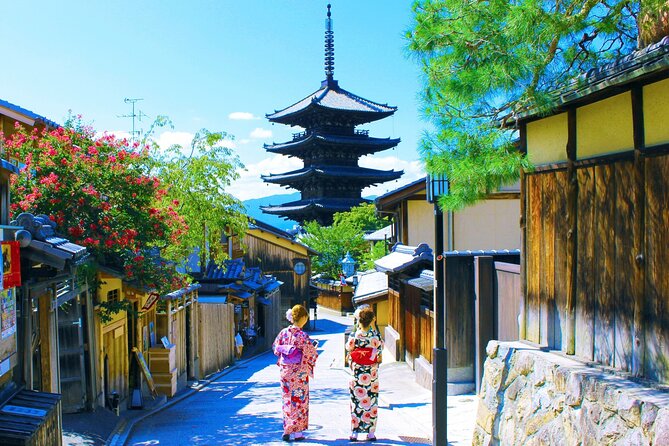
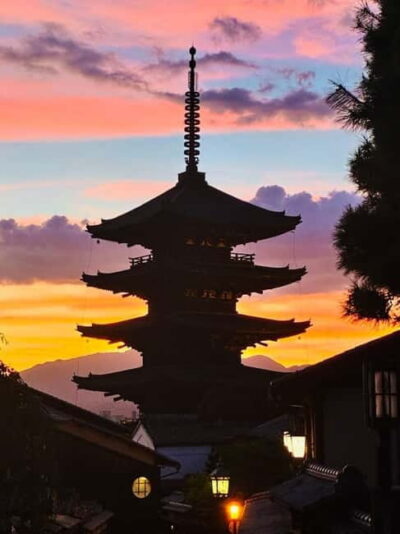
Hōkan-ji Temple, better known as Yasaka Pagoda, receives about 10 minutes. Its five-story pagoda is one of the most recognizable sights in the Higashiyama district.
This is a classic Kyoto photo stop, but the guide can add meaning beyond the familiar view. You can learn how the pagoda fits into the surrounding Buddhist setting and why this part of the district has retained such a strong traditional character.
Next come Ninen-zaka and Sannen-zaka, two historic pedestrian slopes lined with traditional buildings, tea houses, and souvenir shops. Ninen-zaka receives about five minutes, while Sannen-zaka receives about 10 minutes.
These lanes are attractive, but they are also among the more popular parts of Kyoto. Expect other people, shops, and frequent photo stops. The short scheduled visits are enough to get your bearings and hear the background, but not enough for relaxed browsing.
If you see a shop or café you want to revisit, make a note of it. The tour moves on, and you may want to return after the formal walk ends. The slopes are also where the physical demands become clear. A past participant specifically noted that there is considerable stair climbing, so anyone with mobility concerns should take that seriously before booking.
Kiyomizu-dera: a strong finish with an extra cost
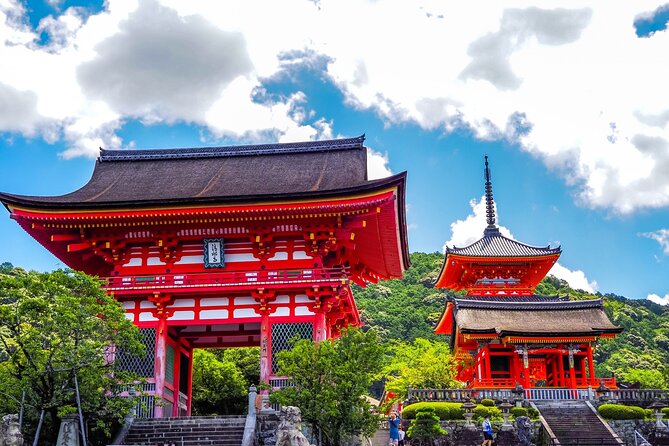
The final stop is Kiyomizu-dera, one of Kyoto’s best-known temples and a UNESCO World Heritage Site. The temple dates to the 8th century and sits on a hillside above the city, with broad views across Kyoto.
The scheduled time is about 10 minutes, and admission is not included. The tour information lists admission fees as excluded, so you should be ready to pay separately if you want to enter.
Ending here works well. Kiyomizu-dera is a major sight, and the walk through Gion and Higashiyama gives you useful context before you arrive. You finish at the entrance, not back at the starting point, which leaves you in a good area for continued sightseeing.
Ten minutes is brief for such a large complex. I would treat the stop as an introduction and a handoff. After the guide finishes, you can decide if you want to pay the entry fee and spend more time inside. The stated end point is in front of the Kiyomizu-dera entrance at 1-chōme-294 Kiyomizu.
The guide can make or break this tour
The strongest feature of this experience is the guiding. Jay receives repeated praise for explaining Japanese history in an engaging way, answering questions, taking photographs, and offering helpful shortcuts. One description notes that he studied history and has a graduate degree from the United States, while another mentions that he continued beyond the scheduled time after warning anyone who needed to leave for another reservation.
Ben is praised for memorable stories, a well-paced walk, and recommendations for gardens, temples, and interesting shops. Ayumi is described as energetic, warm, and especially good at discussing geisha and samurai culture. Michel and Tommy are also praised for being friendly, flexible, and easy to understand.
That range matters because the tour covers a lot. The subject matter includes Kyoto’s development, the Meiji Restoration, emperors, samurai, monks, theater, geisha, temples, shrines, and modern life. A dry guide could turn that into a three-hour lecture. The strongest accounts describe humor, enthusiasm, clear English, and a willingness to answer questions.
The exact guide assigned to your departure is not guaranteed by the information provided. I would book this for the structure and subject matter, while recognizing that your experience will depend partly on who leads the group that day.
Is $40 a fair price?
At $40 per person, the tour is reasonably priced for a three-hour small-group walk through some of Kyoto’s most important areas. You are paying for a guide who links the sights together, not just for access to places you could visit independently.
The value is highest if this is your first time in Kyoto, if you want historical background, or if you are unsure how Gion and Higashiyama fit together. It is also useful if you prefer asking questions rather than reading signs or guidebooks.
The value is lower if you already know Kyoto well, dislike set routes, or want long visits inside each temple. The tour includes walking only. Lunch, gratuity, and admission fees are extra, and the route offers few substantial food stops.
One participant advised eating beforehand or carrying snacks and water. I would follow that advice. Three hours is not extreme, but the steady pace, hills, stairs, and warm-weather exposure can make it feel longer.
Who should book this experience?
I would recommend it to adults and older children who enjoy cultural explanation and can walk for half a day. It suits first-time visitors particularly well because it combines orientation with major sights.
Families should think about attention span. An eight-year-old kept up physically, but the amount of temple and history content may become tiring for children after a while. If your children need frequent food stops or hands-on activities, this may not be the best choice.
You should also be comfortable walking on stone paths and climbing stairs. Service animals are allowed, and the tour is near public transportation, but the physical demands remain important. A moderate fitness level is required, and the route includes slopes that may be difficult for some people.
The free cancellation policy gives you some flexibility. You can cancel for a full refund up to 24 hours before the start time. Changes or cancellations inside that window are not accepted for a refund. Poor weather or failure to meet the minimum number of participants can also lead to a cancellation, in which case you are offered another date or experience, or a full refund.
My verdict on the Gion Historical Walking Tour
I would book this tour if I wanted a clear, lively introduction to Gion and eastern Kyoto. The route covers a lot without requiring you to solve Kyoto’s complicated geography on your own, and the guides are repeatedly praised for strong English, humor, historical skill, and practical advice.
I would skip it only if you need a slow pace, have trouble with stairs, or want to spend serious time inside each temple. For most first-time visitors who can manage the walking, $40 is a fair price for three hours of context, landmarks, and useful local orientation.
FAQ
How long does the Kyoto Gion Historical Walking Tour last?
The tour lasts approximately three hours.
Where does the tour begin?
It begins at Ben’s Cookies Kyoto Shijo, at 89 Shinchō, Shimogyo Ward, Kyoto, 600-8001, Japan.
Where does the tour end?
The tour ends in front of the entrance to Kiyomizu-dera at 1-chōme-294 Kiyomizu, Higashiyama Ward, Kyoto, 605-0862, Japan.
Is admission to Kiyomizu-dera included?
No. Admission to Kiyomizu-dera is not included, and admission fees are listed among the tour exclusions.
What should I wear for the tour?
Wear comfortable walking shoes. The route lasts about three hours and includes slopes and stair climbing.
How large is the tour group?
The maximum group size is 12 people.
Can I cancel for a full refund?
Yes. You can cancel up to 24 hours before the experience start time for a full refund. Cancellations or changes made less than 24 hours before the start time are not refunded.
Just added in Kyoto
- The “Golden Route” and Ancient Japan by DIAMIR Erlebnisreisen – 14-Day Tour★ 2.0 · 2 reviews
- Japan: Castles & Cuisine by G Adventures – 6-Day Kyoto to Osaka Tour★ 4.5 · 4 reviews
- Cycle Japan by Explore! – 13-Day Kyoto to Tokyo Tour★ 4.7 · 12 reviews
- Cycle Japan by Intrepid Travel – 11-Day Kyoto to Tokyo Tour★ 4.8 · 2 reviews
- Classic Japan by Intrepid Travel – 11-Day Kyoto to Tokyo Tour★ 4.4 · 14 reviews
- Ancient & Modern Japan 14-Day Tour by Exodus Adventure Travels★ 4.4 · 40 reviews
- 5 Day Cultural Adventure of Kyoto, Nara & Osaka by Tourist Journey★ 2.5 · 2 reviews
- 12 Days Kinosaki Onsen Escape: A Journey Through Japan’s Timeless Towns by UME Travel★ 4.8 · 5 reviews
Walking Tours, compared.
Kyoto Geisha Walking Tour: Gion District & Hidden Gems
Read our review →
Tokyo Tsukiji Fish Market Food and Culture Walking Tour
Read our review →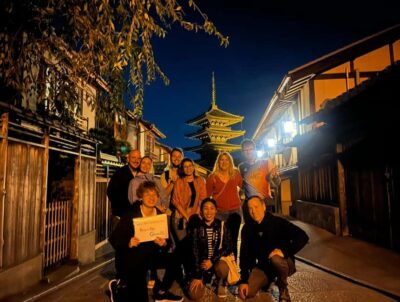
Gion Magical Night Walking Tour with Geisha Trivia
Read our review →
Imperial Palace and Shogun Historical Walking Tour
Read our review →
Gion Geisha District Walking Tour – Stories of Geisha
Read our review →

Shinjuku Local Bar and Izakaya Guided Walking Tour
Read our review →
Browse the lists this tour appears in