
Reviewed · WORKSHOPS
Kyoto: Japanese Calligraphy Class
Brushes make Kyoto feel personal. This one-hour Japanese calligraphy class gives you a calm, hands-on way to meet the writing system rather than simply look at it in a museum or shop. I like the English instruction and the friendly, patient teaching, especially for first-timers. I also like that you leave with your own work, including a scroll or other useful souvenirs.
The main drawback is the short session. You get a pleasant introduction, not a full study of Japanese calligraphy. The meeting point can also vary by the option you book, so check the exact location carefully, even though the advertised setting is in front of Kyoto Station.
In This Review
- Key points at a glance
- A gentle introduction to Japanese calligraphy
- What happens during the one-hour class
- First, learn the brush and ink
- Next, write basic characters
- Then create your name in Kanji
- Finish with handmade souvenirs
- Why the teaching matters more than the tools
- A useful pause from Kyoto sightseeing
- Is $51 a fair price?
- Best for families, first-timers, and creative souvenirs
- How to get the most from your hour
- Booking details that matter
- Should you book the Kyoto calligraphy class?
- FAQ
- Where is the Japanese calligraphy class held?
- How long does the calligraphy class last?
- How much does the experience cost?
- Is English instruction available?
- What materials are included?
- Can I take my calligraphy home?
- Do I need previous calligraphy experience?
- Can children join the class?
- Can I cancel or pay later?
Key points at a glance
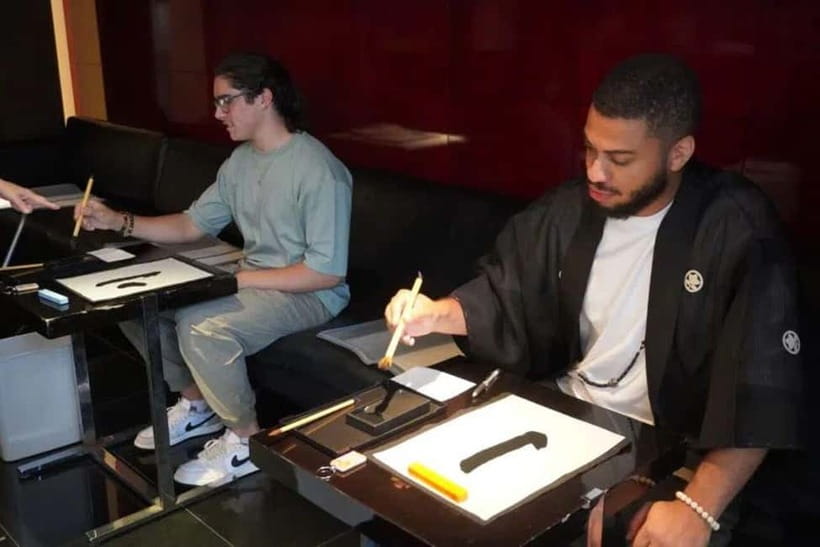
- Write your name in Kanji: Staff help turn names such as Brian or Liz into Kanji characters with meanings attached to each symbol.
- Practice before making keepsakes: You learn brush handling and ink application before creating a scroll, fan, postcard, picture frame, or stationery item.
- English help is included: The class is designed for English-speaking beginners, with staff available to explain writing and cultural questions.
- Convenient Kyoto Station setting: The advertised location is in front of Kyoto Station, useful before a train or after arriving in town.
- Private and small-group options: A smaller class can give you more direct help with each stroke.
- One hour, with flexibility: The activity usually takes about an hour, though finishing time can vary with the pace of your group.
A gentle introduction to Japanese calligraphy
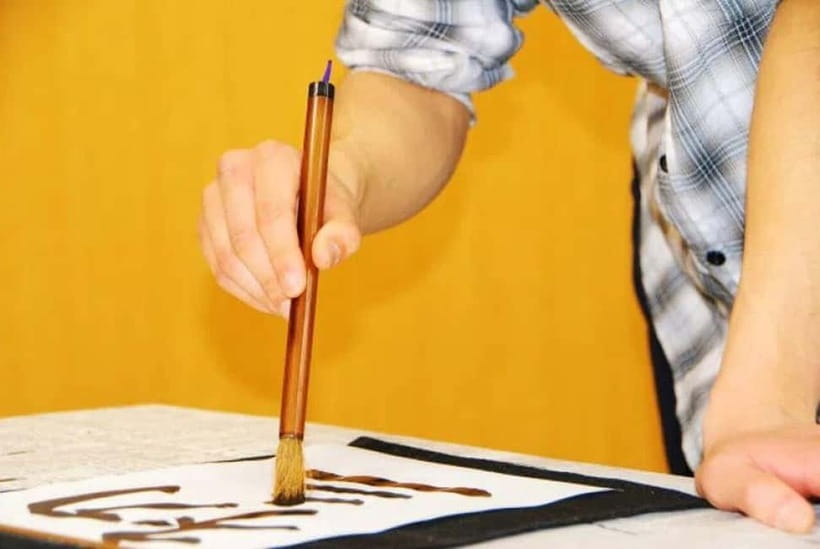
Japanese calligraphy, or shodo, can look intimidating at first. The tools are simple: brush, ink, and paper. The control required is not. A tiny change in pressure can make a line thick or thin, and the speed of a stroke changes its character.
This class wisely starts with the basics. The staff show you how to hold and use the brush, how to apply ink, and how to place each stroke. You are not expected to arrive knowing hiragana, katakana, or Kanji.
That beginner-friendly approach is one of the strongest parts of the experience. People with no previous knowledge have found it easy to get started, and the teaching can include one-to-one help. Staff members named Rena, Lana, Waka, Yoshia Kobayashi, and Kou have been praised for patient explanations and warm encouragement during different sessions.
The tone seems less like a formal school lesson and more like a guided cultural activity. You practice, ask questions, and try again. That matters because a first attempt at calligraphy is rarely perfect. A good teacher helps you enjoy the shape of the mark instead of worrying about making museum-quality art.
A few more options to weigh up in Kyoto
- PERFECT KYOTO 1-Day Bus Tour
★ 5.0 · 13,518 reviews - [Kyoto & Nara Day Tour] Sagano Scenic Railway & Nara Park & Fushimi Inari Taisha Thousand Torii Gates & Togetsukyo Bridge & Bamboo Grove & Kimono Forest (Departing from Osaka)
★ 4.9 · 10,942 reviews - Kyoto: Fushimi Inari, Kinkakuji, Bamboo Grove 1 Day Bus Tour
★ 4.8 · 4,316 reviews
What happens during the one-hour class
The class follows a clear series of steps. Your exact time may vary, since the activity can run slightly longer or shorter depending on how quickly you finish.
First, learn the brush and ink
The opening lesson covers the practical skills you need right away. You learn how to use the brush and how to apply ink to the washi paper.
This first stage is important because calligraphy is not just ordinary writing with a different pen. You have to manage pressure, ink, and the direction of each stroke. The staff guide you through the process before asking you to make something worth keeping.
You should expect practice rather than instant success. Some strokes may look uneven, and that is part of the fun. The teachers are there to correct your hand position and show how to set the strokes properly. For a complete beginner, that direct help can make the difference between frustration and a satisfying result.
Next, write basic characters
After the demonstration, you practice basic characters. The class uses these exercises to help you get used to the brush and the balance of the writing.
You may make a scroll from the Kanji characters you write. This gives the practice a clear purpose. Instead of throwing away your first attempts, you can turn some of them into a personal souvenir.
The scroll is also a useful reminder of what you actually learned. A shop-bought calligraphy print may look more polished, but it does not show your own first steps with the brush. Your finished piece will likely have a few imperfect lines, which is exactly what makes it yours.
A completely different kind of day out:
- Kyoto: Tea Ceremony in a Traditional Tea House in Kiyomizu
★ 4.9 · 3,519 reviews - Kyoto: Gion Make Your Own Chopsticks with Engraving Option
★ 5.0 · 3,465 reviews - Kyoto Nara Day Trip │ Kiyomizu-dera Temple + Fushimi Inari-taisha Shrine + Nara Park (Departing from Osaka/Kyoto)
★ 4.7 · 3,408 reviews - Kyoto Geisha Walking Tour: Gion District & Hidden Gems
★ 4.7 · 3,273 reviews
Then create your name in Kanji
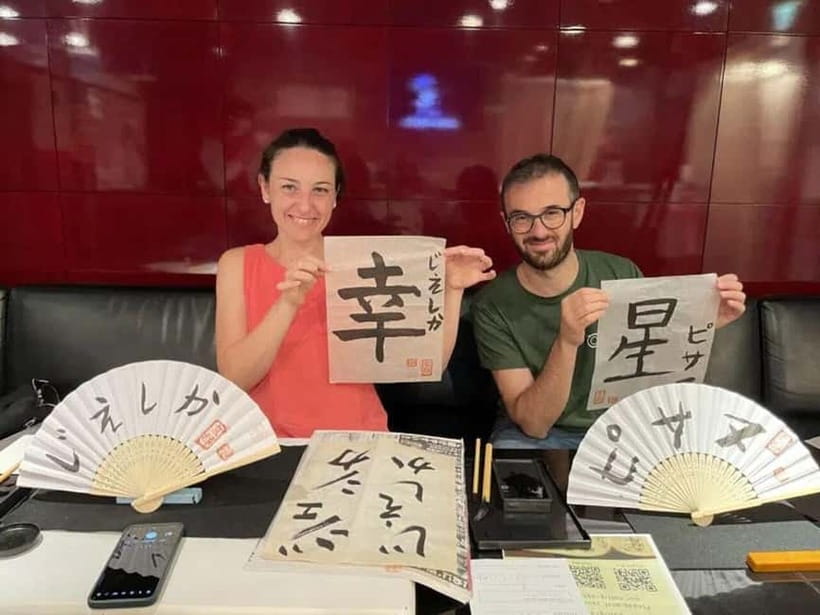
One of the most distinctive parts comes when you write your name and a favorite word in both Kanji and the alphabet.
The staff help suggest possible Kanji characters and explain their meanings. The result is not simply a phonetic spelling. It is a creative choice that links the sound of your name with the meaning of selected characters.
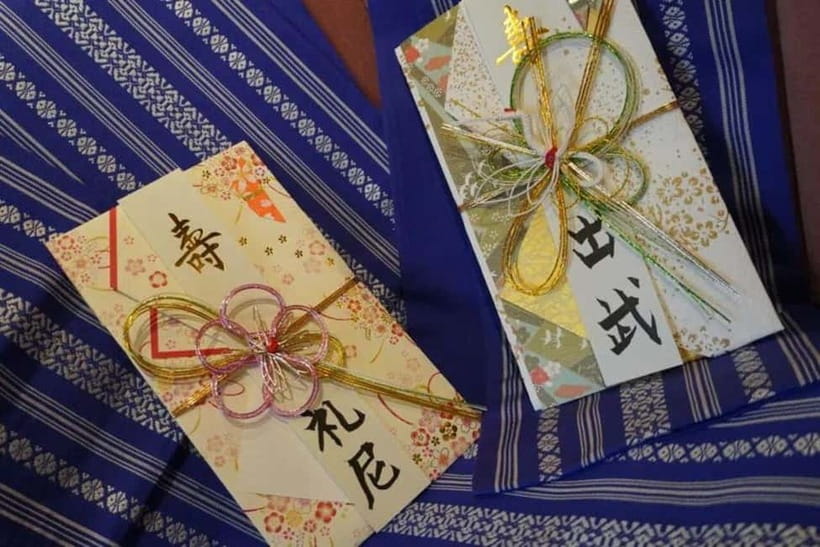
For example, Brian may become 武礼安. The characters can suggest martial strength or bravery, courtesy or gratitude, and peace. Liz may become 梨図, with meanings connected to pear and painting. These examples show why the activity is more than copying attractive symbols. You get a small lesson in how Japanese characters carry meaning.
You should treat the Kanji name as a fun interpretation rather than a single official translation. Staff assist with possible characters, so you can ask about the meaning and choose the version that appeals to you.
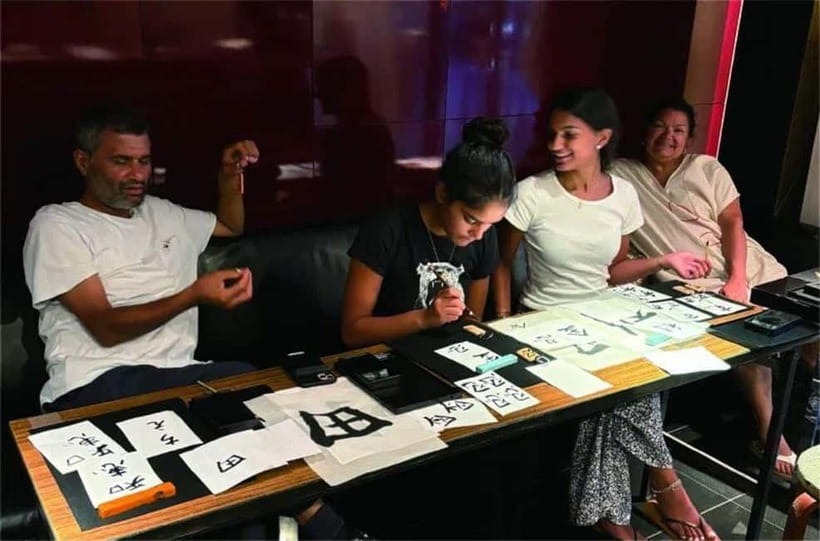
This part works especially well for families and friends. You can compare the meanings chosen for each person, then take home a set of names that recalls your time in Kyoto.
Finish with handmade souvenirs
The final stage lets you put your calligraphy on souvenirs. Depending on the activity option and the items available, these may include a Japanese fan, picture frame, postcard, or stationery.
A fan is a particularly fitting keepsake. It is light, easy to pack, and gives your calligraphy a useful surface rather than leaving it as a loose sheet of paper. A postcard or framed piece can also make a thoughtful gift.
The available items may differ, so do not assume that every listed example comes with every booking. What is clear is that some take-home products are included, along with the use of brushes, ink, and washi paper.
Why the teaching matters more than the tools
You can buy a brush and ink in Kyoto, but that does not tell you what to do with them. The value here is the guidance.
The strongest praise has focused on staff patience, kindness, and clear explanations. Rena has been singled out for making complex writing feel approachable while answering questions with care. Lana and Waka have been praised for one-to-one instruction, particularly when helping with stroke placement. Yoshia Kobayashi and Kou have also received warm comments for making the session enjoyable and helping with the workshop.
That personal attention is especially useful if your group has mixed ability. One person may want to ask about the language, while another simply wants to make a neat fan. A small group or private format gives the instructor more room to respond to both.
The class also offers cultural context. You can ask about the writing system, the meaning of characters, and aspects of Japanese culture. It is not a long academic lecture, but the explanations add meaning to the activity. You begin to see why the order and shape of strokes matter.
The best approach is to arrive curious rather than perfectionist. You are learning a traditional art in a short session, not training to become a professional calligrapher.
A useful pause from Kyoto sightseeing
Kyoto can fill your day with temples, train rides, queues, and long walks. Calligraphy gives you a quieter hour.
The activity requires attention, but not in a tiring way. You sit, slow down, and repeat a movement until it feels more natural. One person described the calm pace as a welcome contrast to the rush of a wider trip, and that makes sense. The class has a different rhythm from sightseeing.
The location helps. Being in front of Kyoto Station makes this a practical activity before catching a train, after arriving in the city, or during a gap in your schedule. It is easier to fit into a busy day than an experience far outside the central transport area.
Still, you need to confirm the exact meeting point for your chosen option. The meeting location may vary, even though the main location is described as being in front of Kyoto Station. Kyoto Station is a large and busy area, so allow enough time to find the right place.
Is $51 a fair price?
At $51 per person, this is not the cheapest way to spend an hour in Kyoto. You are paying for instruction, materials, staff time, and several take-home items rather than simply paying for access to a room.
I think the price is reasonable if you value personal instruction and souvenirs. Brushes, ink, and washi paper are included, and you can leave with work made during the class. The name-in-Kanji activity adds another layer that you would not get from a basic craft table.
The value is stronger for a family, couple, or small group that wants a shared activity. A group of four, for example, can make the hour feel like a joint project, with each person choosing a name or word and comparing the results.
The value is weaker if you are looking for serious technical training. One hour cannot cover the full writing system or give you sustained practice. If you already study Japanese calligraphy, you may find the class too introductory.
For most short-term visitors, though, the point is not mastery. It is a personal object, a little cultural understanding, and a chance to try something with your hands. On those terms, $51 can make sense.
Best for families, first-timers, and creative souvenirs
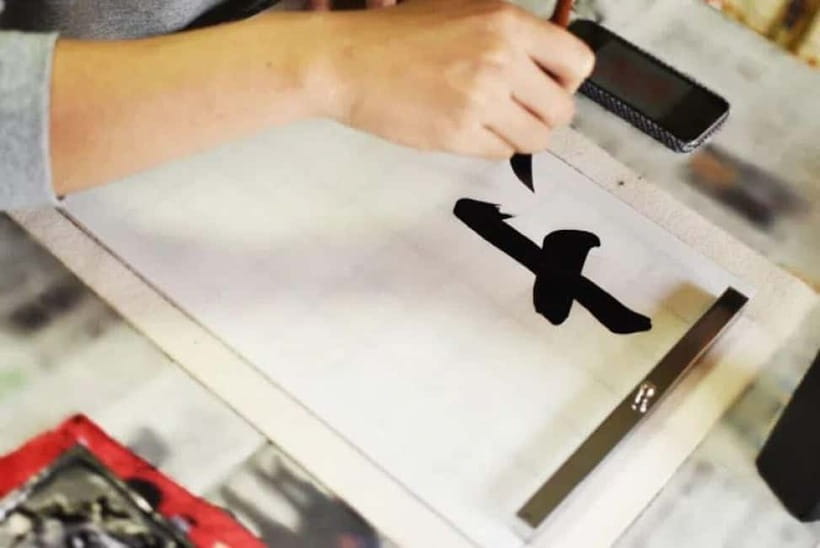
This class suits people who want to do something rather than only see something. You do not need to know Japanese, and the staff can help explain possible Kanji for your name.
Families have found the format particularly rewarding. Children can practice characters, choose words, and bring home their work. The official minimum age is five, so children under five should not attend.
It also works well for couples and friends. A shared Kanji name project gives everyone a clear task, while the choice of fan, postcard, stationery, or another item lets each person create something slightly different.
I would also recommend it to solo visitors who enjoy guided activities. The class gives you a structured way to ask questions and meet an instructor without committing half a day.
This may not suit you if you dislike crafts, have very limited time, or want a quiet observation-only experience. Calligraphy involves repeated practice, ink, and making a finished object. That hands-on element is the reason to book it.
How to get the most from your hour
You will get more from the class if you think about a favorite word before you arrive. It could be peace, courage, friendship, family, or another idea with personal meaning.
You can also prepare the spelling of your name in the alphabet. Staff will help with the Kanji choices, but having a little time to consider what you want makes the name activity more enjoyable.
Ask about the meaning of each character before choosing one. The point is not just to find symbols that sound similar. The meanings are part of the souvenir.
Do not rush the practice stage. Your first brush marks may look shaky, but the class is designed to guide you toward a better result. Listen closely when the instructor demonstrates pressure and stroke order.
Finally, leave room in your luggage. The materials are included and the products can go home with you, but a fan, scroll, or framed piece needs a little care when packed.
Booking details that matter
The class lasts about one hour, with the possibility of a small variation based on how your group completes the activities. Starting times depend on availability.
English instruction is included, and English is the listed language for the activity. Private and small-group formats are available, which may be worth choosing if you want more direct help or are booking for a family.
The experience costs $51 per person. You can reserve now and pay later, which keeps your plans flexible. Free cancellation is available up to 24 hours before the activity for a full refund.
The meeting point may depend on the option you select. Check that detail before setting out, even if your booking information refers to the area in front of Kyoto Station.
Should you book the Kyoto calligraphy class?
Book it if you want a short, friendly cultural activity with something personal to take home. The patient English teaching, name-in-Kanji exercise, and handmade souvenirs give the class more substance than a quick brush demonstration.
I would especially choose it for families with children aged five or older, first-time visitors to Japan, couples, and anyone who wants a slower hour between Kyoto sightseeing stops. The $51 price is fair when you use the materials and take home several pieces of your own work.
Skip it if you want advanced calligraphy study or a long lesson. For everyone else, this is a practical, low-pressure way to connect with Japanese writing, right near one of Kyoto’s most useful transport points.
FAQ
Where is the Japanese calligraphy class held?
The advertised location is in front of Kyoto Station in Kyoto, on Honshu. The exact meeting point may vary depending on the option you book, so check your selected option carefully.
How long does the calligraphy class last?
The class takes about one hour. The duration may vary slightly depending on how long your group takes to complete the activities.
How much does the experience cost?
The listed price is $51 per person.
Is English instruction available?
Yes. English instruction is included, and English is the listed language for the activity.
What materials are included?
The class includes the use of brushes, ink, and washi paper.
Can I take my calligraphy home?
Yes. You can take home some of the products you make, such as a scroll, Japanese fan, picture frame, postcard, or stationery, depending on the items available with your option.
Do I need previous calligraphy experience?
No previous experience is stated as a requirement. The class begins with instruction on using the brush and applying ink, making it suitable for beginners.
Can children join the class?
Children under five are not suitable for this activity. Children aged five and older can attend, and the class has been enjoyed by families.
Can I cancel or pay later?
You can reserve now and pay later. You can also cancel up to 24 hours in advance for a full refund.
Just added in Kyoto
- The “Golden Route” and Ancient Japan by DIAMIR Erlebnisreisen – 14-Day Tour★ 2.0 · 2 reviews
- Japan: Castles & Cuisine by G Adventures – 6-Day Kyoto to Osaka Tour★ 4.5 · 4 reviews
- Cycle Japan by Explore! – 13-Day Kyoto to Tokyo Tour★ 4.7 · 12 reviews
- Cycle Japan by Intrepid Travel – 11-Day Kyoto to Tokyo Tour★ 4.8 · 2 reviews
- Classic Japan by Intrepid Travel – 11-Day Kyoto to Tokyo Tour★ 4.4 · 14 reviews
- Ancient & Modern Japan 14-Day Tour by Exodus Adventure Travels★ 4.4 · 40 reviews
- 5 Day Cultural Adventure of Kyoto, Nara & Osaka by Tourist Journey★ 2.5 · 2 reviews
- 12 Days Kinosaki Onsen Escape: A Journey Through Japan’s Timeless Towns by UME Travel★ 4.8 · 5 reviews
Workshops, compared.

Sushi Making Tokyo Roll and Authentic Japanese Sushi Class
Read our review →
Gion Make Your Own Chopsticks with Engraving Option
Read our review →
Roll and Authentic Sushi Making Class in Asakusa
Read our review →
Ramen Cooking Class at Ramen Factory in Kyoto
Read our review →
Tokyo Asakusa Chopsticks Workshop: Make Your Own Pair
Read our review →
Ring Making Workshop : Vintage Japanese Coin Ring
Read our review →Browse the lists this tour appears in