
Reviewed · WORKSHOPS
Kyoto: Japanese Calligraphy Workshop
Your souvenir can begin with a single brushstroke. This Kyoto workshop gives you a friendly, hands-on introduction to shodo, the Japanese art of calligraphy, at Gojo Paradiso beside the Takase River. I especially like the patient, step-by-step teaching and the chance to take home a finished piece on rice paper. The main consideration is age: children under 10 cannot join.
The class lasts about one to two hours, costs $32 per person, and limits the group to 10 people. I also like that instructor Takako takes time with each participant, helps you write your name in kanji, and adds a stamp to the finished work. If you want a quiet cultural activity rather than another sightseeing stop, this is a very good fit, though anyone hoping to become a calligraphy expert in one afternoon should keep expectations realistic.
In This Review
- Key Points Before You Book
- What This Kyoto Calligraphy Workshop Is Really Like
- Arriving at Gojo Paradiso Beside the Takase River
- First Lesson: The Meaning and History of Shodo
- Basic Brush Strokes Before the Kanji
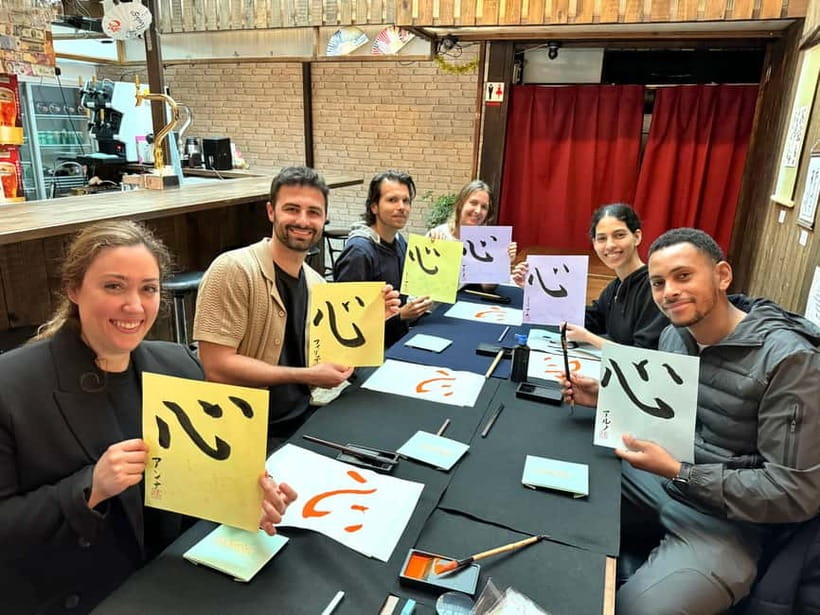
- Creating Your Own Kanji Artwork
- Writing Your Name in Japanese
- A Quiet Gallery Finish and Time for Photos
- How Much Value Do You Get for $32?
- Timing, Group Size, and Practical Limits
- Who Will Enjoy This Experience Most?
- A Few Sensible Tips for Your Session
- Should You Book the Gojo Paradiso Workshop?
- FAQ
- How much does the Kyoto calligraphy workshop cost?
- How long does the workshop last?
- Where does the workshop meet?
- Is the workshop suitable for complete beginners?
- Which languages are spoken?
- Can I take my calligraphy home?
- Are children allowed to participate?
- Is the workshop wheelchair accessible?
Key Points Before You Book
- Practice comes before the finished artwork: You learn basic brush strokes before attempting kanji characters, so beginners are not thrown in at the deep end.
- Takako teaches with patience: She explains clearly in English and Japanese, encourages you to improve, and gives individual help during the exercises.
- Your finished work is personal: You create a character and write your name in Japanese, then take home the completed piece on beautiful rice paper.
- The setting is calm and central: Gojo Paradiso sits on Kiyamachi Street beside the Takase River, within an easy walk of Keihan Kiyomizu Gojo Station.
- Small groups make a difference: With no more than 10 participants, the instructor and her helpers can give useful attention to each person.
- It is good value at $32: Supplies, instruction, and a cultural keepsake are included, making this a modestly priced Kyoto activity.
What This Kyoto Calligraphy Workshop Is Really Like
This is not a formal lesson aimed at producing perfect Japanese handwriting. It is a short cultural workshop designed to let you try the tools, understand the basic principles, and create something personal.
That distinction matters. Japanese calligraphy looks simple when you see an experienced artist make one confident mark. In practice, brush pressure, speed, angle, ink, and posture all affect the result. You will not leave after one session with the control of a trained calligrapher, but you will understand why each stroke matters.
I like the balance here. You get enough instruction to make the activity feel meaningful, but the class remains approachable and fun. You are not expected to arrive with artistic skill or previous knowledge of Japanese writing.
The workshop has earned a 4.7 rating from 84 ratings, and the strongest praise centers on the same points: patient teaching, clear English, quality materials, and the pleasure of taking home a finished piece. Those are exactly the features that make a short cultural class worthwhile.
A few more options to weigh up in Kyoto
- PERFECT KYOTO 1-Day Bus Tour
★ 5.0 · 13,518 reviews - [Kyoto & Nara Day Tour] Sagano Scenic Railway & Nara Park & Fushimi Inari Taisha Thousand Torii Gates & Togetsukyo Bridge & Bamboo Grove & Kimono Forest (Departing from Osaka)
★ 4.9 · 10,942 reviews - Kyoto: Fushimi Inari, Kinkakuji, Bamboo Grove 1 Day Bus Tour
★ 4.8 · 4,316 reviews
Arriving at Gojo Paradiso Beside the Takase River
Gojo Paradiso is on Kiyamachi Street along the Takase River. It is about a five-minute walk from Keihan Kiyomizu Gojo Station and roughly a 10-minute walk from Keihan Shichijo Station. The stated distance from Kiyomizu Gojo Station is 386 meters.
That location works well in a Kyoto day plan. You can place the workshop near visits to the Kiyomizu Gojo area, the Kamo River, or central Kyoto. You do not need to commit half a day to reach it, and the short walking approach keeps the experience easy to fit between larger sights.
The venue also includes a gallery, which you can explore near the end of the session. The setting has been described as quiet, a useful contrast to Kyoto’s crowded temple lanes and busy shopping streets.
I would allow a little extra time to find the entrance, especially if you are unfamiliar with Kiyamachi Street. The meeting point is specific, so check the route before leaving your hotel and arrive ready to start at the scheduled time.
First Lesson: The Meaning and History of Shodo
The class begins with an introduction to Japanese calligraphy, known as shodo. You learn why the characters matter and how calligraphy connects writing with balance, movement, and presentation.
This opening gives the brushwork a cultural setting. You are not simply copying shapes from a worksheet. You begin to see that a kanji character is built from an ordered set of strokes, each with its own direction and pressure.
The instructor speaks English and Japanese. Several participants have found the English explanations clear, which is important in a class where small instructions affect the final result. Calligraphy can be hard to follow if you miss a detail about how to hold the brush or where a stroke should finish.
Takako also explains and helps with Japanese names. Having your own name written in kanji gives the session a personal touch, though the exact character choices may depend on the name and the instructor’s guidance.
Basic Brush Strokes Before the Kanji
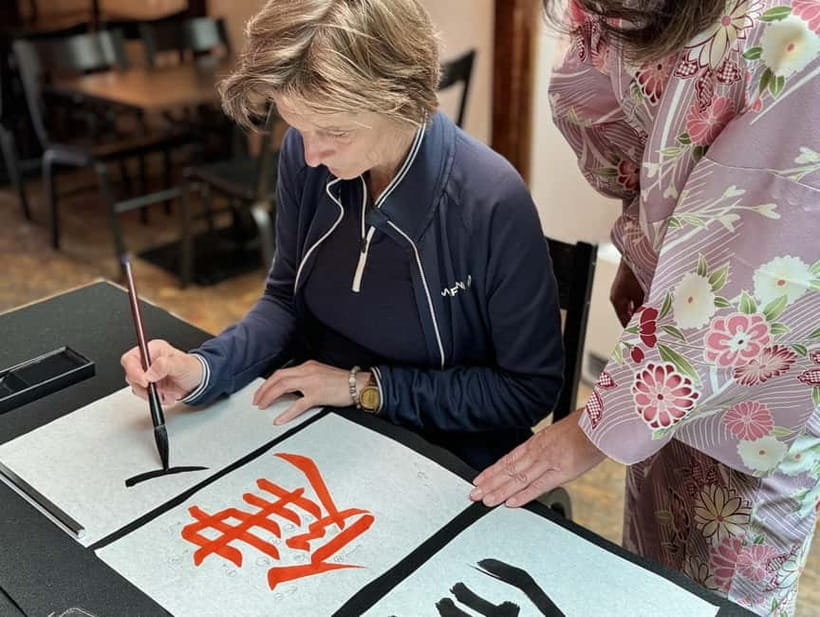
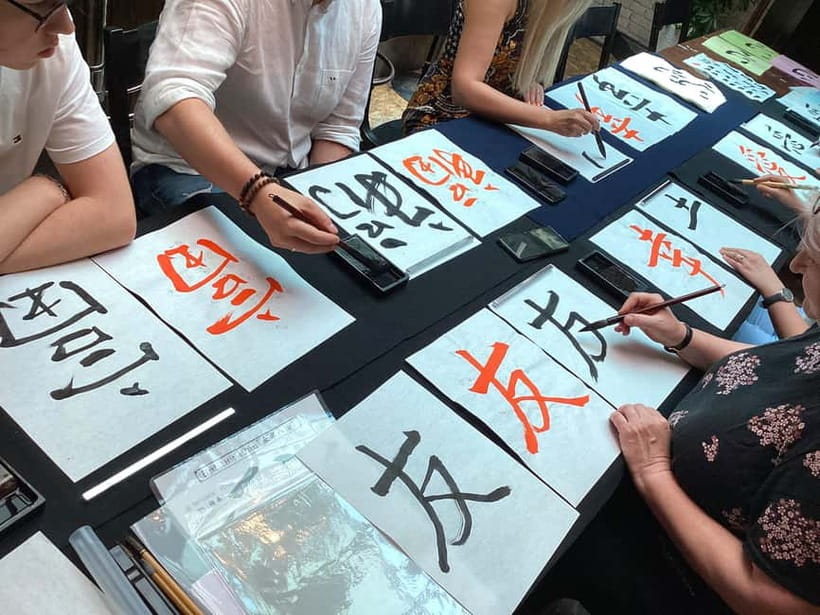
After the introduction, you practice fundamental brush strokes. This is the part where you learn how the brush responds to light pressure, firm pressure, a change in direction, and a controlled finish.
Expect practice sheets and repeated attempts. Do not rush this stage. The early exercises help you get a feel for the ink and brush, and they make the final character less intimidating.
The supplies are included, and the materials have received strong praise for their quality. That matters because poor paper or awkward brushes can make a beginner feel clumsy for the wrong reason. Here, the goal is to let you focus on the movement.
The instructor and her helpers offer individual support as you work. I would use that help. Show your brush position, ask for a correction, and try the stroke again while the instruction is fresh.
This is also the most relaxing part of the activity. The repeated movements require concentration, but there is no pressure to perform for an audience. You can treat the practice as a quiet break from sightseeing.
A completely different kind of day out:
- Kyoto: Tea Ceremony in a Traditional Tea House in Kiyomizu
★ 4.9 · 3,519 reviews - Kyoto: Gion Make Your Own Chopsticks with Engraving Option
★ 5.0 · 3,465 reviews - Kyoto Nara Day Trip │ Kiyomizu-dera Temple + Fushimi Inari-taisha Shrine + Nara Park (Departing from Osaka/Kyoto)
★ 4.7 · 3,408 reviews - Kyoto Geisha Walking Tour: Gion District & Hidden Gems
★ 4.7 · 3,273 reviews
Creating Your Own Kanji Artwork
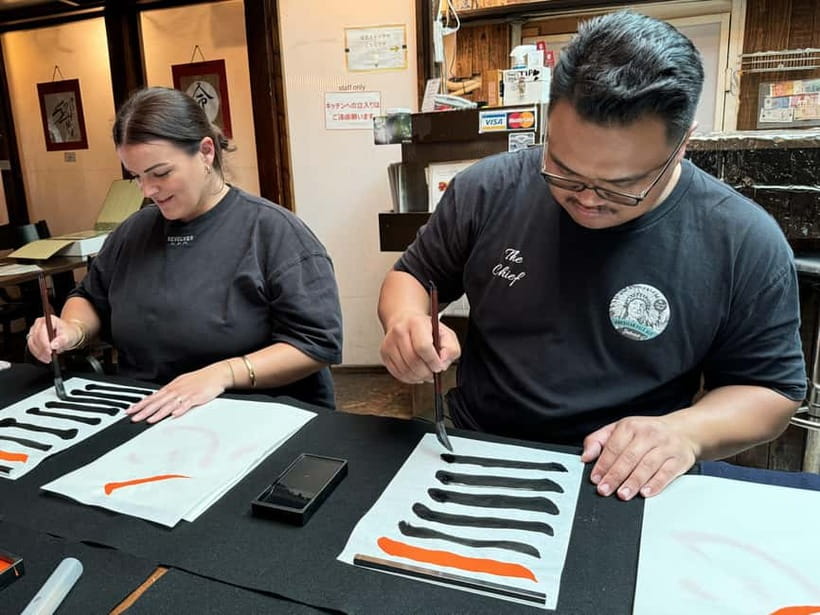
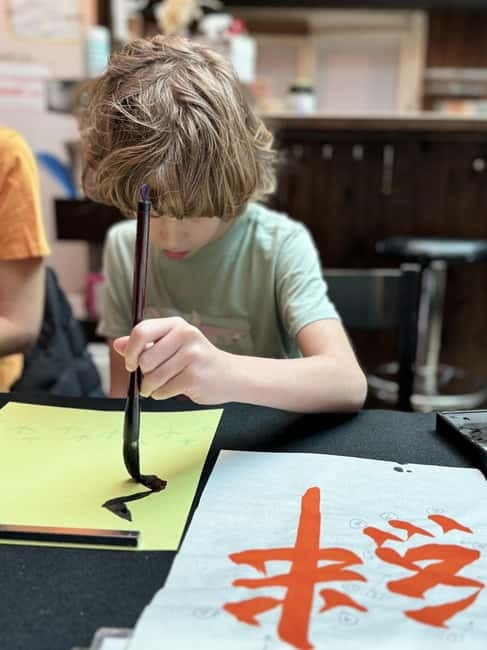
Once you have worked through the basic strokes, you move on to a kanji character. The teacher guides you through the order and shape of the strokes, then helps you turn your practice into a finished piece.
The final work is produced on rice paper. You can take it home as a one-of-a-kind souvenir, rather than buying an object made for the tourist market. That personal connection is the strongest reason to choose this workshop over a standard shopping stop.
You should not expect every line to look like the instructor’s. That is part of the charm. Your work records a particular afternoon in Kyoto, complete with the small variations that come from being a beginner.
Takako signs and stamps the finished piece. One detailed account also described receiving a handmade calligraphy gift accented with gold, though I would treat that as a possible extra rather than a guaranteed part of every booking. The confirmed takeaway is your own calligraphy artwork.
The class structure helps prevent the final task from becoming frustrating. You get instruction first, practice next, and a finished piece only after you have had time to understand the basics.
Writing Your Name in Japanese
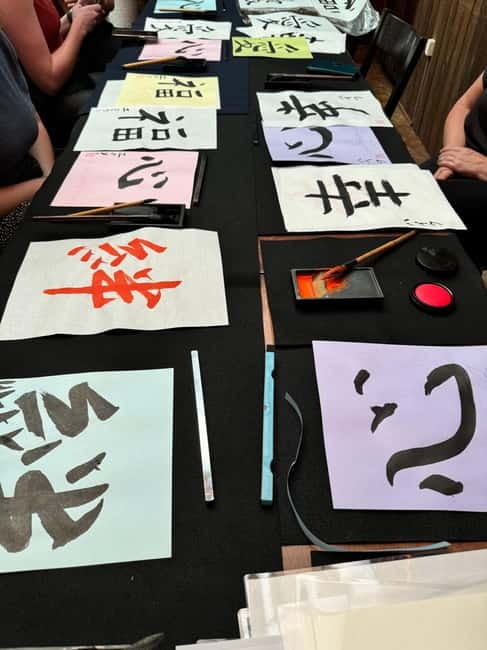
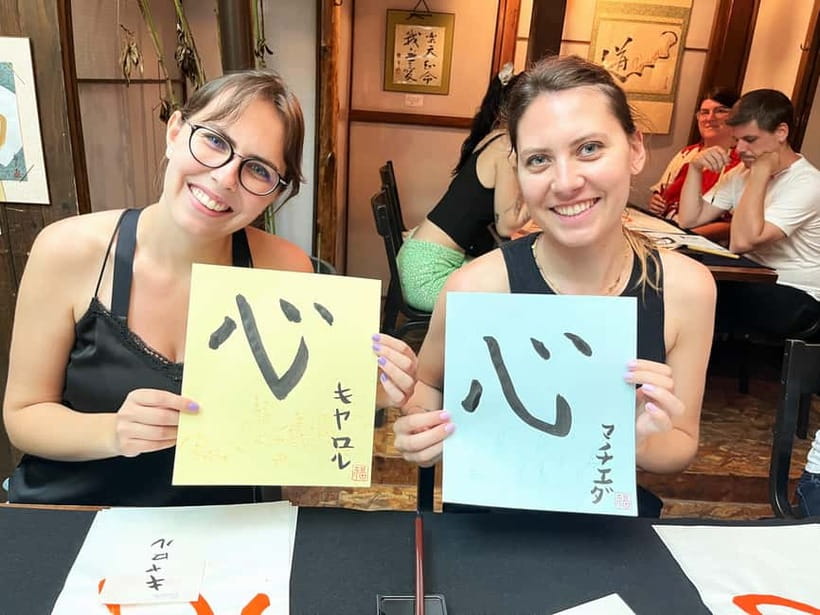
The name-writing portion adds something that a generic character exercise cannot. You are not only reproducing a symbol chosen for the class. You also leave with a piece connected directly to you.
The instructor helps translate or represent your name in kanji, then shows you how to write it. This can be one of the most memorable parts for families with older children, couples, and friends who want a shared souvenir with a personal mark.
Keep in mind that kanji names are not a simple letter-for-letter conversion like writing an English name in the Roman alphabet. The teacher’s guidance is important, and the result may focus on sound, meaning, or an appropriate Japanese character combination.
You also get the chance to sign your finished piece. With the instructor’s stamp added, the artwork feels more complete and ready to display.
A Quiet Gallery Finish and Time for Photos
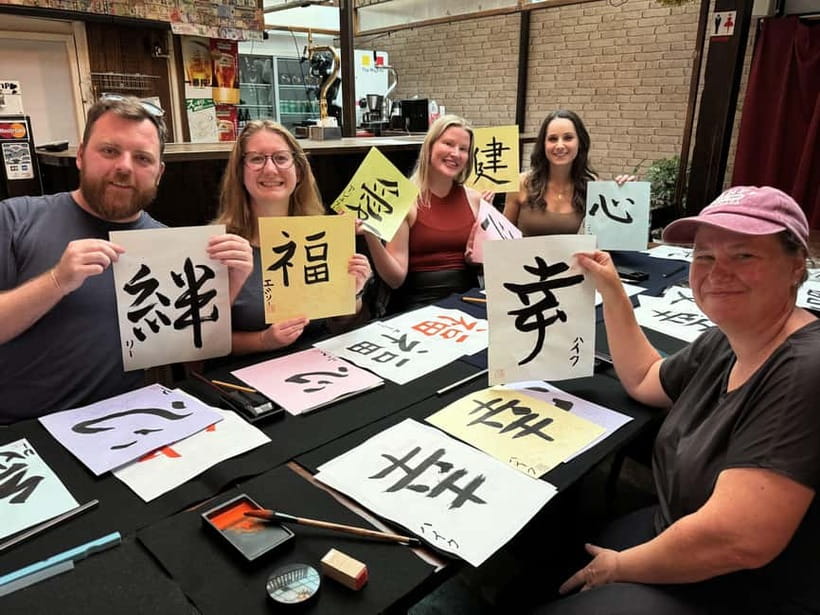
The last part of the workshop includes time for photos, a look around the gallery, and possible special orders. This gives the session a gentle finish rather than ending immediately after the final brush stroke.
The gallery visit may appeal to you if you want to see calligraphy beyond the beginner level. It gives context for the craft and lets you compare your first attempts with more polished work.
Special orders are available, but they are not part of the $32 price. If you are tempted by something in the gallery, ask about the cost and delivery details before committing. The included experience already provides a substantial souvenir, so you do not need to buy anything extra to feel that the workshop was worthwhile.
Photos are also useful because the artwork may need care during the rest of your trip. Take pictures of the process and final piece, then keep the rice paper flat and protected as much as possible.
How Much Value Do You Get for $32?
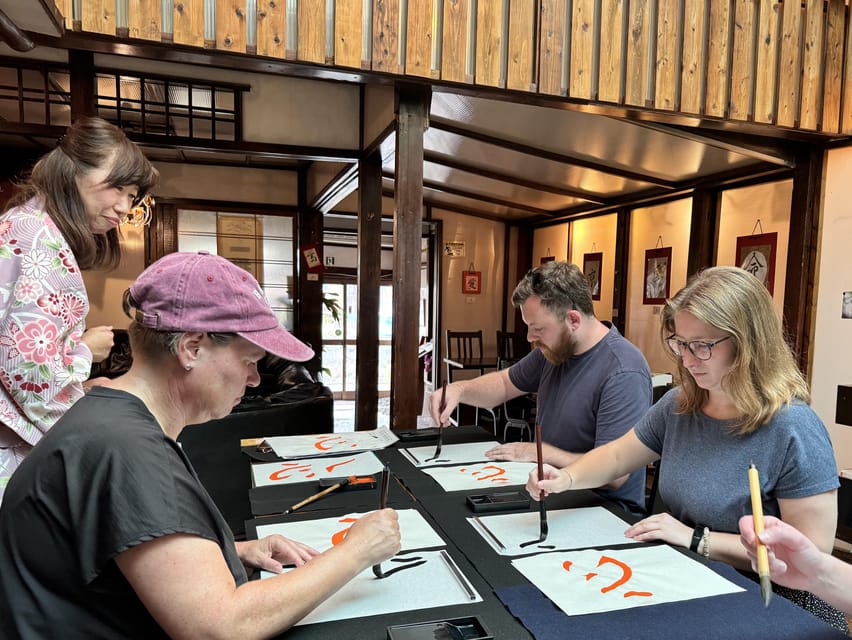
At $32 per person, this is a reasonably priced Kyoto activity. The fee covers an expert instructor, all necessary supplies, and a finished cultural souvenir.
Many short activities charge mainly for access or a demonstration. Here, you spend the session making something yourself. That hands-on element gives the price real value, especially if you enjoy creative activities and want more than a quick photo.
The small group limit of 10 also supports the price. You are not watching a large demonstration from the back of a room. The instructor and two helpers have been able to work with participants individually, correcting strokes and offering encouragement.
I would compare it with the cost of a casual shopping purchase. For roughly the price of a modest souvenir, you receive the materials, teaching, and a piece that carries your own effort. The artwork may not be museum quality, but it will mean more than a mass-produced item.
The value is less obvious if you dislike crafts or want a fast activity. Calligraphy requires sitting, listening, practicing, and repeating movements. If that sounds tedious, spend the money on a different Kyoto experience.
Timing, Group Size, and Practical Limits
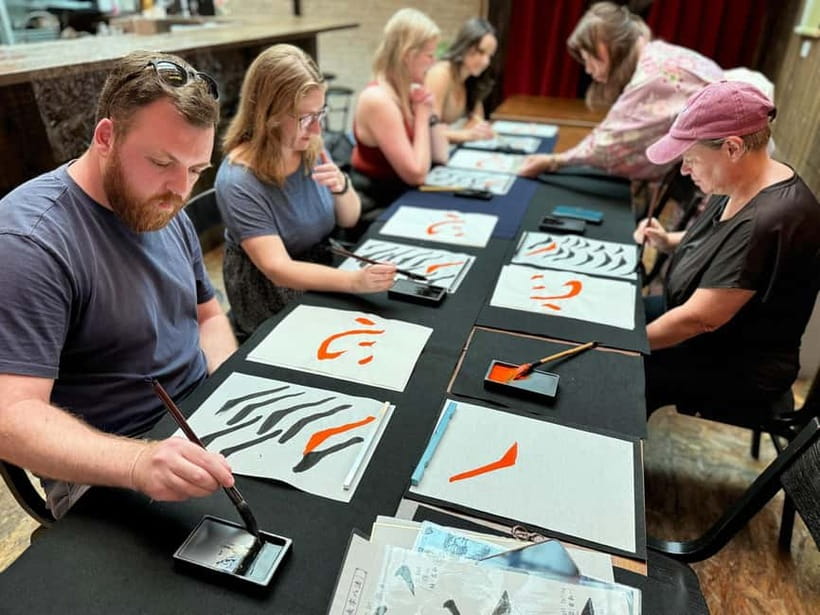
The workshop lasts between one and two hours, depending on the scheduled session and pace of the group. That is long enough for a proper introduction without taking over your whole day.
A group of up to 10 is small by tour standards. It gives you a better chance of receiving direct help, though the exact amount of one-to-one time can vary with the group and the number of exercises.
The instructor works in English and Japanese. English-speaking participants have found the explanations easy to follow, and the teacher has been praised for being polite, positive, and encouraging.
You must reserve at least one day ahead. The activity is wheelchair accessible, and children under 10 are not permitted. Those details make it easier to decide if the workshop fits your party before you book.
Cancellation is flexible: you can cancel up to 24 hours in advance for a full refund. You can also reserve now and pay later, which helps if your Kyoto schedule is still shifting.
Who Will Enjoy This Experience Most?
I would recommend this workshop to first-time visitors who want a direct introduction to Japanese culture. It gives you a little background, a real activity, and a souvenir in one compact session.
It is also a strong choice for couples. You can practice together, compare your brushwork, and leave with matching or complementary pieces. The calm setting makes it a nice change from a full day of temples and crowded streets.
Families with children aged 10 and older may also enjoy it, provided the children are comfortable following instructions and practicing carefully. Younger children cannot join, so check ages before booking.
The class suits solo visitors as well. The small group format and patient teaching make it easy to take part without needing a companion. You can focus on your own work and still receive direct support.
I would be less enthusiastic for anyone seeking an advanced technical course. The session is an introduction, not a long study program. You learn the foundations and produce a keepsake, but serious students will need continued practice after returning home.
A Few Sensible Tips for Your Session
Arrive with enough time to locate Gojo Paradiso. The meeting point is close to two Keihan stations, but Kyoto streets can still slow you down when you are reading signs or walking along unfamiliar lanes.
Wear something you can sit comfortably in and do not bring anything you would be upset to stain. Ink is part of the activity, and careful handling is sensible even when all materials are provided.
Listen closely during the first stroke demonstrations. The instructor’s advice about pressure and brush movement will help more than simply copying the finished character.
Use the individual help. Takako has been praised for spending time with each person and encouraging beginners rather than correcting them harshly. Ask her to watch your hand if a stroke feels awkward.
Plan how you will carry the rice paper afterward. The workshop provides the artwork, but you are responsible for keeping it safe during the rest of your trip.
Should You Book the Gojo Paradiso Workshop?
Book it if you want a quiet, affordable Kyoto activity with real participation and a personal souvenir. The strongest reasons are the patient instruction from Takako, the small group size, the good materials, and the chance to write both a kanji character and your own name.
Skip it if your schedule is packed with major sights or if you have no interest in sitting down to practice. Also remember that it is not suitable for children under 10 and is not designed as an advanced calligraphy course.
For most visitors, $32 buys a pleasant hour or two, useful cultural context, and artwork that cannot be duplicated by another souvenir shopper. I would place it on a Kyoto itinerary during a slower afternoon, especially near the Kiyomizu Gojo area.
FAQ
How much does the Kyoto calligraphy workshop cost?
The workshop costs $32 per person. The price includes the calligraphy instructor, all necessary supplies, and the cultural activity.
How long does the workshop last?
The experience lasts between one and two hours. Available starting times depend on the date you select.
Where does the workshop meet?
The meeting point is Gojo Paradiso on Kiyamachi Street, along the Takase River. It is about a five-minute walk from Keihan Kiyomizu Gojo Station and a 10-minute walk from Keihan Shichijo Station.
Is the workshop suitable for complete beginners?
Yes. The instructor provides guided, step-by-step instruction, beginning with basic brush strokes before moving on to kanji characters.
Which languages are spoken?
Instruction is available in English and Japanese. English-speaking participants can follow the teacher’s explanations and guidance.
Can I take my calligraphy home?
Yes. You create your own calligraphy artwork and can take it home as a personal Kyoto souvenir. The finished work is made on rice paper.
Are children allowed to participate?
Children under 10 are not suitable for this activity. Participants aged 10 and older may join.
Is the workshop wheelchair accessible?
Yes. The activity is listed as wheelchair accessible.
Just added in Kyoto
- The “Golden Route” and Ancient Japan by DIAMIR Erlebnisreisen – 14-Day Tour★ 2.0 · 2 reviews
- Japan: Castles & Cuisine by G Adventures – 6-Day Kyoto to Osaka Tour★ 4.5 · 4 reviews
- Cycle Japan by Explore! – 13-Day Kyoto to Tokyo Tour★ 4.7 · 12 reviews
- Cycle Japan by Intrepid Travel – 11-Day Kyoto to Tokyo Tour★ 4.8 · 2 reviews
- Classic Japan by Intrepid Travel – 11-Day Kyoto to Tokyo Tour★ 4.4 · 14 reviews
- Ancient & Modern Japan 14-Day Tour by Exodus Adventure Travels★ 4.4 · 40 reviews
- 5 Day Cultural Adventure of Kyoto, Nara & Osaka by Tourist Journey★ 2.5 · 2 reviews
- 12 Days Kinosaki Onsen Escape: A Journey Through Japan’s Timeless Towns by UME Travel★ 4.8 · 5 reviews
Workshops, compared.

Sushi Making Tokyo Roll and Authentic Japanese Sushi Class
Read our review →
Gion Make Your Own Chopsticks with Engraving Option
Read our review →
Roll and Authentic Sushi Making Class in Asakusa
Read our review →
Ramen Cooking Class at Ramen Factory in Kyoto
Read our review →
Tokyo Asakusa Chopsticks Workshop: Make Your Own Pair
Read our review →
Ring Making Workshop : Vintage Japanese Coin Ring
Read our review →Browse the lists this tour appears in