
Reviewed · WORKSHOPS
Kyoto Ninenzaka : Japanese Calligraphy Class in Townhouse
Slow down in old Kyoto. This 50-minute Japanese calligraphy class gives you a hands-on way to connect with local culture, just steps from Kiyomizu Temple and the stone lanes of Ninenzaka. I especially like the calm setting and the chance to take home your own kanji work instead of another ordinary souvenir. The main drawback is the short class time, which leaves little room for advanced practice.
I also like that you do not need Japanese language skills or art experience. The instructors provide careful guidance, and an English-speaking host or greeter helps keep the session accessible. Bring socks and clothes that can get dirty, since the class involves ink and takes place in a traditional townhouse setting.
In This Review
- Key points to know before booking
- Finding the townhouse beside Ninenzaka
- Starting with the story behind Japanese calligraphy
- Learning the tools before making marks
- Getting the brush grip and pressure right
- Practicing lines, dots, and sweeping strokes
- Writing simple kanji characters
- The cultural value of seasonal expressions
- What the $49 price includes
- Practical clothing and arrival advice
- Who will enjoy this Kyoto class most
- Booking advice for a smooth visit
- Should you book the Ninenzaka calligraphy class?
- FAQ
- Where is the Japanese calligraphy class held?
- How long does the calligraphy class last?
- How much does the experience cost?
- Do I need Japanese or art experience?
- What language is used during the class?
- What should I bring?
- Can I take my calligraphy home?
- Are children and large bags allowed?
Key points to know before booking
- A quiet townhouse near Ninenzaka: The class location sits at the end of the alley beside the Starbucks on Ninenzaka, close to Kiyomizu Temple.
- A real introduction to shodō: You learn brush handling, ink preparation, basic strokes, and simple kanji rather than only watching a demonstration.
- A handmade Kyoto souvenir: You can keep the calligraphy you create during the session.
- Patient teaching for beginners: No previous art or Japanese experience is needed, and the class includes an original calligraphy booklet.
- A compact 50-minute activity: It fits neatly before or after sightseeing, but the schedule is too short for a long, highly detailed lesson.
- A few practical restrictions: Children under 10 are not accepted, and large bags, strollers, pets, and selfie sticks are not allowed.
Finding the townhouse beside Ninenzaka
Location matters here. The class is near Kiyomizu Temple, at the end of the alley next to the Starbucks on Ninenzaka. That puts you in one of Kyoto’s most atmospheric sightseeing areas, where the experience can fit naturally into a morning or afternoon around Higashiyama.
You will need to make your own way to the venue because transportation is not included. Give yourself enough time to find the alley, especially if you are arriving during a busy sightseeing period. The meeting directions are specific, but Ninenzaka’s lanes can still take a little patience.
I would plan this class alongside Kiyomizu Temple and the nearby historic streets, rather than treating it as a stand-alone trip across the city. You can schedule calligraphy before visiting the temple, then continue through Ninenzaka afterward. Or reverse the order and use the class as a quieter break after walking uphill through Higashiyama.
The location adds real value to the $49 price. You are not simply spending 50 minutes in a generic activity room. You are learning a traditional art in the same Kyoto district many people visit for temples, old wooden buildings, and narrow lanes. The class does not include a temple ticket or transportation, but it pairs well with sightseeing you may already have planned.
A few more options to weigh up in Kyoto
- PERFECT KYOTO 1-Day Bus Tour
★ 5.0 · 13,518 reviews - [Kyoto & Nara Day Tour] Sagano Scenic Railway & Nara Park & Fushimi Inari Taisha Thousand Torii Gates & Togetsukyo Bridge & Bamboo Grove & Kimono Forest (Departing from Osaka)
★ 4.9 · 10,942 reviews - Kyoto: Fushimi Inari, Kinkakuji, Bamboo Grove 1 Day Bus Tour
★ 4.8 · 4,316 reviews
Starting with the story behind Japanese calligraphy
The lesson begins with an introduction to Japanese calligraphy, known as shodō. You learn about its cultural background, basic ideas, and connection to Japanese traditions before picking up the brush.
That short introduction matters. Calligraphy can look simple from a distance: a black brush, white paper, a few bold characters. In practice, each line depends on timing, pressure, balance, and control. Learning a little about the tradition helps you understand why the process begins slowly and carefully.
The class also brings in seasonal themes and expressions. This gives the activity more cultural meaning than copying random symbols. You are not just making marks for decoration. You are learning how written characters can express ideas tied to Japanese customs and the time of year.
The cultural explanation is necessarily brief because the whole session lasts only 50 minutes. If you want a long lecture on the development of Japanese writing, this is not the right format. I see the introduction as a useful doorway, giving you enough context to appreciate the practice without turning the class into a history seminar.
Learning the tools before making marks
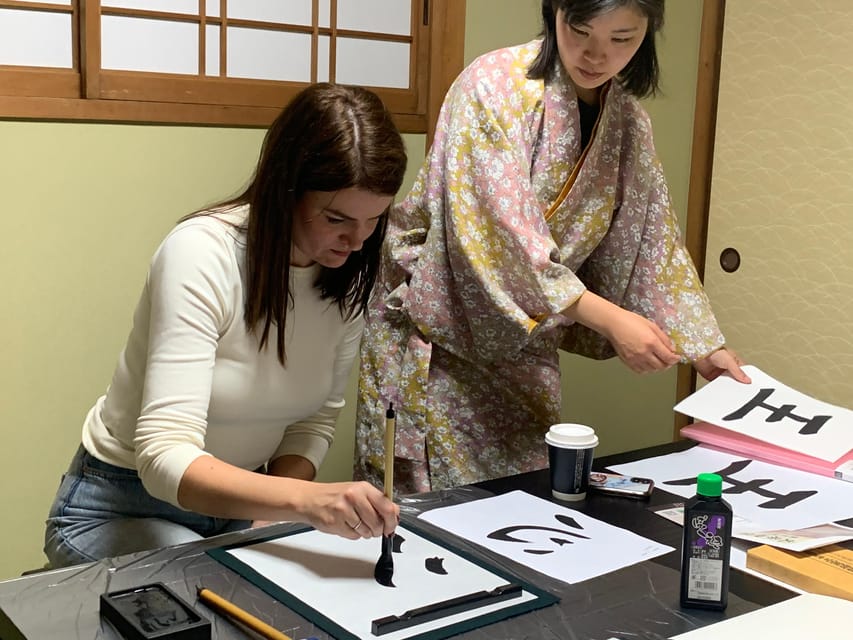
Next, the instructor explains the traditional tools. These include the brush, ink stick, inkstone, and paper. You also learn how to use and care for them.
For a first-time student, this part is valuable because the tools are not interchangeable craft supplies. The brush responds to pressure and movement. The ink must be handled with care. The paper has a specific purpose, and the inkstone is part of the preparation rather than a decorative object.
You also learn how to position the writing paper and use a paperweight. This preparation may feel slow if you are eager to start writing, but it is part of the experience. The quiet setup helps you shift from sightseeing mode to focused practice.
I like this pause because it shows that calligraphy is not just about producing a finished character. The preparation itself is part of the discipline. You handle the materials, settle your posture, and pay attention to the surface in front of you.
The class includes an original booklet about calligraphy. It gives you something to refer to after the session and adds a little practical value to the price. Do not expect a full manual, but it can help you remember the basic ideas and tools.
Getting the brush grip and pressure right
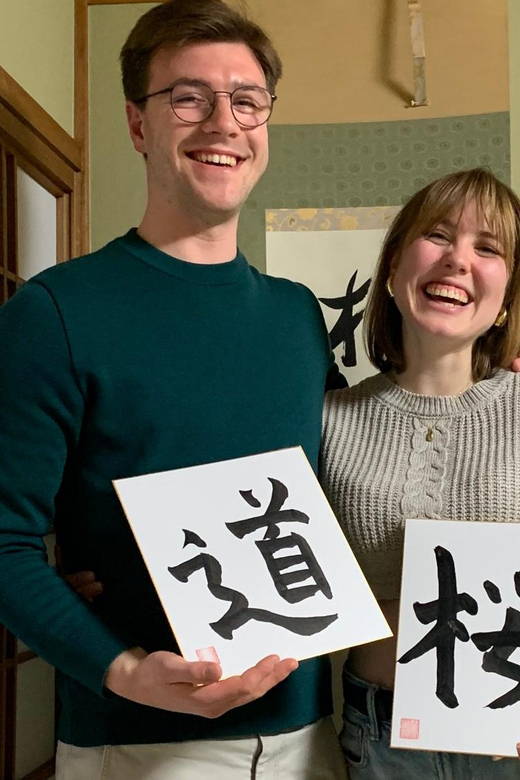
Proper brush handling is one of the most important parts of the class. The instructor shows you how to hold the brush and adjust the pressure as you move across the paper.
That sounds basic, but it is where many beginners quickly discover that a brush is not a marker. A light touch creates a different line from a firm press. The angle and movement of your hand affect the shape of the stroke. You will need to pay attention to both your hand and the brush tip.
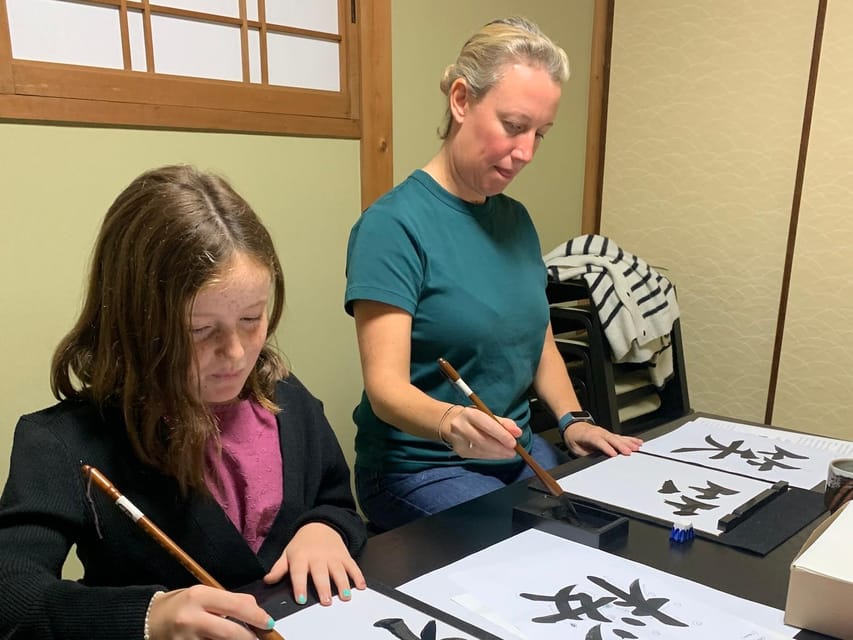
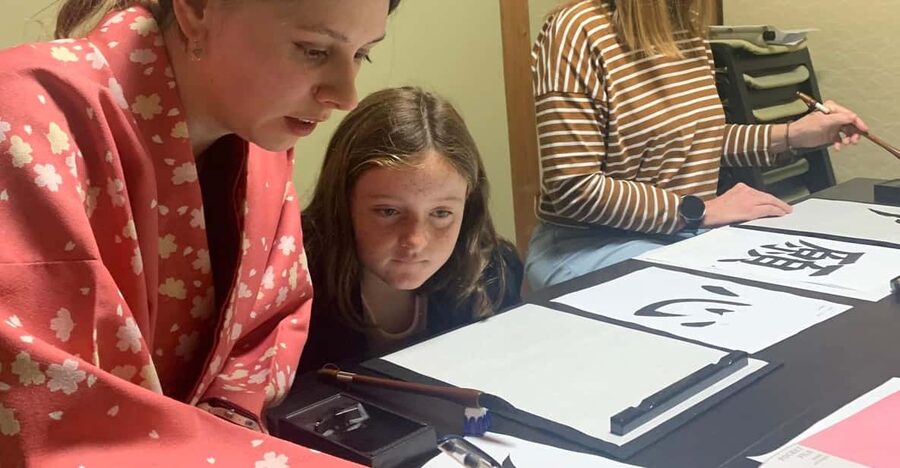
The class gives you guided practice rather than leaving you to guess. An experienced instructor and assistant can watch your technique and help correct small problems. One particularly positive account described the master and assistant as patient, with plenty of opportunity to ask questions in a small class.
A small class is not guaranteed for every session, so I would not book solely on that expectation. Still, the format appears suited to personal guidance, and the lesson is designed for people starting from zero. That makes it a stronger choice than a large demonstration where you only watch someone else write.
A completely different kind of day out:
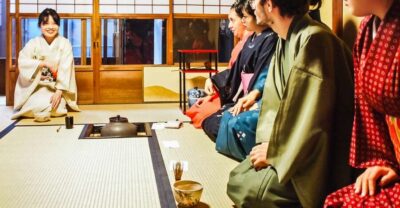
- Kyoto: Tea Ceremony in a Traditional Tea House in Kiyomizu
★ 4.9 · 3,519 reviews - Kyoto: Gion Make Your Own Chopsticks with Engraving Option
★ 5.0 · 3,465 reviews - Kyoto Nara Day Trip │ Kiyomizu-dera Temple + Fushimi Inari-taisha Shrine + Nara Park (Departing from Osaka/Kyoto)
★ 4.7 · 3,408 reviews - Kyoto Geisha Walking Tour: Gion District & Hidden Gems
★ 4.7 · 3,273 reviews
Practicing lines, dots, and sweeping strokes
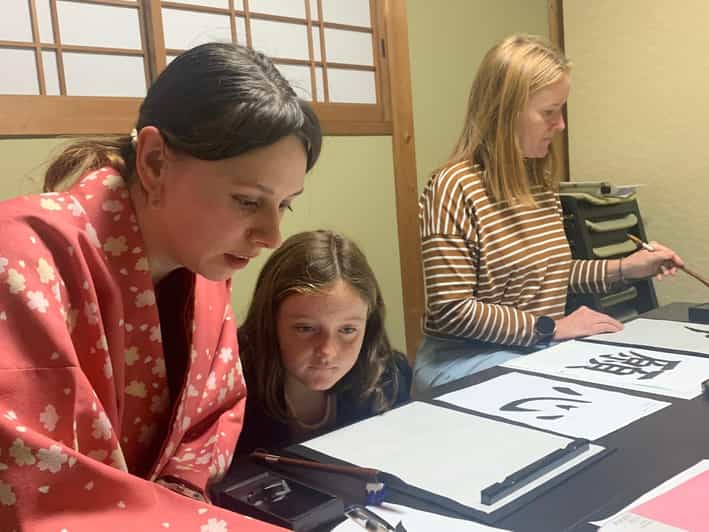
Before you write kanji, you practice basic brush techniques. These include lines, strokes, and dots or sweeping movements.
This progression is sensible. You begin with the building blocks rather than trying to copy a complex character immediately. The exercises help you feel how the brush starts, moves, slows, and finishes. They also introduce the balance between control and release that gives calligraphy its distinctive look.
You should not expect every practice line to look elegant. That is part of the fun. The brush has a mind of its own at first, especially when you are thinking about pressure, posture, paper placement, and direction all at once.
The instructor’s guidance is especially useful here. The lesson focuses on technique, not on judging you by artistic ability. You can make mistakes, adjust your grip, and try again before moving to the finished characters.
This part may be the most meditative section of the class. Ninenzaka outside can be full of people, but the calligraphy process asks you to work quietly and pay attention to one stroke at a time. The activity offers a welcome change from rushing between famous sights.
Writing simple kanji characters
Once you have practiced the basic strokes, you move on to simple kanji. The instructor helps you focus on vertical and horizontal balance, spacing, and placement on the paper.
Kanji characters are not simply pictures to copy. Their shape depends on proportion and order. A character can look awkward when one side is too heavy or when the strokes are crowded. The lesson gives you a practical sense of how balance affects the final result.
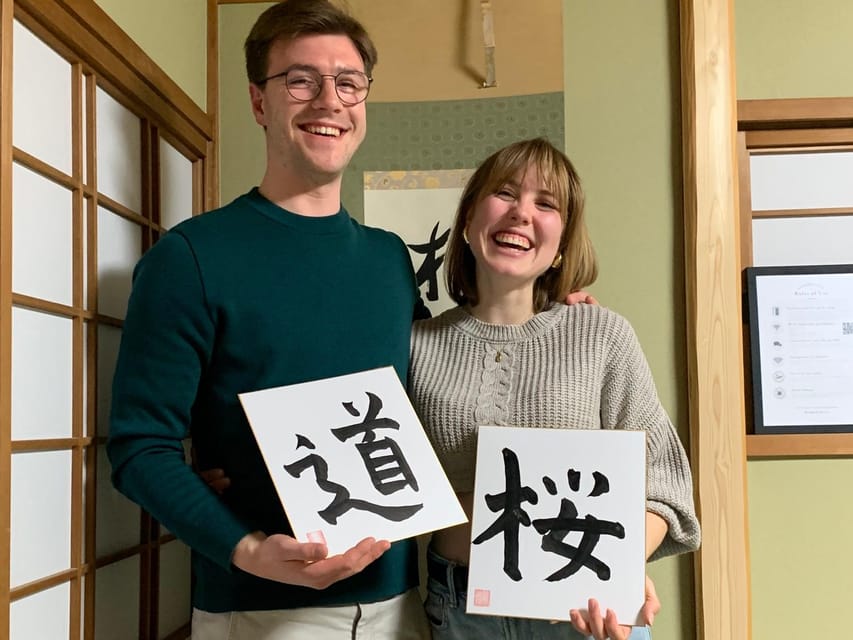
You will likely produce more than one attempt before choosing a piece to keep. The final work may not look like a master’s calligraphy, and that is not the point. Your finished character records the time you spent learning a traditional skill in Kyoto.
One useful detail from the class feedback is that students leave with their own handmade kanji symbol. That makes the souvenir personal. You are not buying an object made for tourists. You are taking home something connected to your own effort, even if the lines are a little uneven.
The short duration limits how many characters and techniques you can cover. This is a beginner lesson, not a serious course in Japanese calligraphy. If you already practice shodō, you may find the material too introductory. If you have never held a calligraphy brush, the pace should feel more suitable.
The cultural value of seasonal expressions
The class connects calligraphy with Japanese culture through seasonal themes and expressions. This is a thoughtful touch because Japanese cultural traditions often pay close attention to the time of year.
You may come away with a better sense of why words and characters can carry more than a direct translation. A seasonal expression can suggest a mood, an occasion, or a familiar part of Japanese life. Even a simple character can become more meaningful when you understand the idea behind it.
The teaching stays practical. You are not expected to read Japanese, and you do not need to memorize a large vocabulary. The English-language support helps you follow the explanation and concentrate on the brushwork.
Because the class is short, the cultural material works best as an introduction. You will gain appreciation, not fluency. That is a fair trade for an activity designed to fit into a busy Kyoto sightseeing day.
What the $49 price includes
At $49 per person, this is not the cheapest short activity in Kyoto. The session lasts only 50 minutes, and you must pay separately for transportation, nearby attractions, and any optional kimono rental.
Still, the price includes more than a quick brush demonstration. You receive instruction from experienced teachers, careful guidance during the exercises, an original booklet, and a calligraphy piece to take home. The setting near Ninenzaka also means you can combine it with one of Kyoto’s main sightseeing areas.
I think the value is strongest for first-time visitors who want a cultural activity with a clear beginning and end. You do not need to commit half a day or buy special equipment. The class gives you an introduction, a guided creative process, and a physical reminder of Kyoto.
The value is weaker if you are mainly looking for a long workshop or professional-level correction. Fifty minutes goes quickly. You will learn the basics, but you will not master brush control or explore many characters in that time.
A 5.0 rating from 59 reviews, along with praise for the patient teaching and enjoyable format, supports the idea that this is a well-liked beginner experience. I would still judge it by your own priorities. A perfect score does not change the limited duration.
Practical clothing and arrival advice
Wear socks. This is a firm requirement, and if you arrive without them, socks can be provided for an additional fee.
Choose clothing that can get dirty. Ink is part of the activity, and even careful students should not wear an outfit they would hate to stain. If you plan to wear a kimono, note that a two-piece kimono is available for an additional payment, but it is not included in the class price.
Leave large bags and luggage behind. Baby strollers, non-folding wheelchairs, non-folding strollers, electric wheelchairs, selfie sticks, and pets are not allowed. Smoking indoors, alcohol, drugs, and making noise are also prohibited.
These rules fit the quiet townhouse setting, but they require planning. Do not arrive with your full daypack if you can avoid it. You should also know that children under 10 are not suitable for this activity.
The host or greeter speaks English. For bookings made the day before or on the same day, the requested arrangement may not be available, and the class may be conducted in English. If you need a particular language arrangement, book ahead rather than waiting until the last minute.
Who will enjoy this Kyoto class most
I would recommend this experience to:
- First-time visitors who want a hands-on cultural activity
- Adults and children aged 10 or older who enjoy making something
- Visitors already sightseeing around Kiyomizu Temple and Ninenzaka
- Couples, friends, and small groups looking for a calm break
- Anyone who wants a compact activity with a take-home souvenir
- Beginners who do not speak Japanese and have no art background
I would be more cautious if you want a long, technical workshop. The lesson is designed to introduce you to shodō, not train you as an accomplished calligrapher.
It may also be less suitable for families with young children. The minimum age is 10, and the quiet setting does not allow noise. Anyone with mobility equipment should check the restrictions carefully because non-folding and electric wheelchairs are not permitted.
Booking advice for a smooth visit
The activity offers free cancellation up to 24 hours before the start time, with a full refund. You can also reserve now and pay later, which helps if your Kyoto schedule is still changing.
I would reserve ahead if you are visiting during a short stay. The class is brief, but its location and limited schedule can make it a useful piece of a carefully planned day. Same-day and day-before bookings may not always be accommodated as requested.
Allow time to reach the alley beside Starbucks on Ninenzaka. Do not assume that being near Kiyomizu Temple means the entrance will be obvious. Have socks on, wear practical clothes, and carry only what you need.
Should you book the Ninenzaka calligraphy class?
Book it if you want a short, personal introduction to Japanese culture with a souvenir you make yourself. The patient instruction, calm townhouse setting, English support, and location near Kiyomizu Temple make it easy to add to a Kyoto day.
Skip it if you want advanced calligraphy, a long workshop, or a broad range of characters. At 50 minutes, the class is an introduction rather than a full course. For most beginners, though, $49 is a fair price for guided practice, cultural context, and a handmade kanji piece that carries more meaning than a shop-bought trinket.
FAQ
Where is the Japanese calligraphy class held?
The class is near Kiyomizu Temple at the end of the alley next to the Starbucks on Ninenzaka in Kyoto.
How long does the calligraphy class last?
The class lasts 50 minutes.
How much does the experience cost?
The price is $49 per person.
Do I need Japanese or art experience?
No. The class is beginner friendly, and you do not need Japanese language or previous art experience.
What language is used during the class?
English is available through the host or greeter. For reservations made the day before or on the same day, the class may be conducted in English if the requested arrangement cannot be accommodated.
What should I bring?
Bring socks and clothes that can get dirty. If you arrive without socks, they may be provided for an additional fee.
Can I take my calligraphy home?
Yes. You can keep the calligraphy you create as a souvenir.
Are children and large bags allowed?
Children under 10 are not suitable for the class. Luggage and large bags are not allowed, along with pets, baby strollers, selfie sticks, and non-folding or electric wheelchairs.
Just added in Kyoto
- The “Golden Route” and Ancient Japan by DIAMIR Erlebnisreisen – 14-Day Tour★ 2.0 · 2 reviews
- Japan: Castles & Cuisine by G Adventures – 6-Day Kyoto to Osaka Tour★ 4.5 · 4 reviews
- Cycle Japan by Explore! – 13-Day Kyoto to Tokyo Tour★ 4.7 · 12 reviews
- Cycle Japan by Intrepid Travel – 11-Day Kyoto to Tokyo Tour★ 4.8 · 2 reviews
- Classic Japan by Intrepid Travel – 11-Day Kyoto to Tokyo Tour★ 4.4 · 14 reviews
- Ancient & Modern Japan 14-Day Tour by Exodus Adventure Travels★ 4.4 · 40 reviews
- 5 Day Cultural Adventure of Kyoto, Nara & Osaka by Tourist Journey★ 2.5 · 2 reviews
- 12 Days Kinosaki Onsen Escape: A Journey Through Japan’s Timeless Towns by UME Travel★ 4.8 · 5 reviews
Workshops, compared.

Sushi Making Tokyo Roll and Authentic Japanese Sushi Class
Read our review →
Gion Make Your Own Chopsticks with Engraving Option
Read our review →
Roll and Authentic Sushi Making Class in Asakusa
Read our review →
Ramen Cooking Class at Ramen Factory in Kyoto
Read our review →
Tokyo Asakusa Chopsticks Workshop: Make Your Own Pair
Read our review →
Ring Making Workshop : Vintage Japanese Coin Ring
Read our review →Browse the lists this tour appears in