
Reviewed · WALKING TOURS
One-Day Walking Tour of Amazing 8th Century Capital Nara
Nara rewards curious walkers. This private, eight-hour tour brings together Naramachi’s old merchant houses and Todai-ji’s enormous Buddha, while a local guide handles the route and explains the customs behind the sights. I like the clear focus on Nara’s three major areas, and I like having a guide who can adjust the day when your interests change.
The main caution is cost. The advertised price is $137.17 per person, but public transport and entrance fees add ¥3,500 per person. Also, the tour is private, but it is not automatically a fully customized itinerary. That distinction matters if you expect to replace the planned stops with your own list.
In This Review
- Key points to know before booking
- Why Nara makes a strong day trip from Kyoto
- Naramachi: merchant houses and a slower first hour
- Kasuga Grand Shrine and the Fujiwara connection
- Nara Park and the freely roaming deer
- Todai-ji: the day’s grandest sight
- What the private guide adds
- Price, added costs, and what you receive
- Pace, practical details, and who should book
- The guides receive unusually strong praise
- Should you book this Nara day?
- FAQ
- How long is the Nara walking tour?
- Is the tour private?
- What locations are included?
- Are transportation and admission fees included?
- Is the tour customized?
- What happens if the weather is poor?
Key points to know before booking
- Naramachi begins the day with old merchant homes: Expect traditional latticed houses, narrow streets, and a look at Nara’s change from temple town to commercial district.
- Kasuga Grand Shrine adds sacred atmosphere: The eighth-century shrine connects Nara to the powerful Fujiwara clan and remains one of the city’s key religious sites.
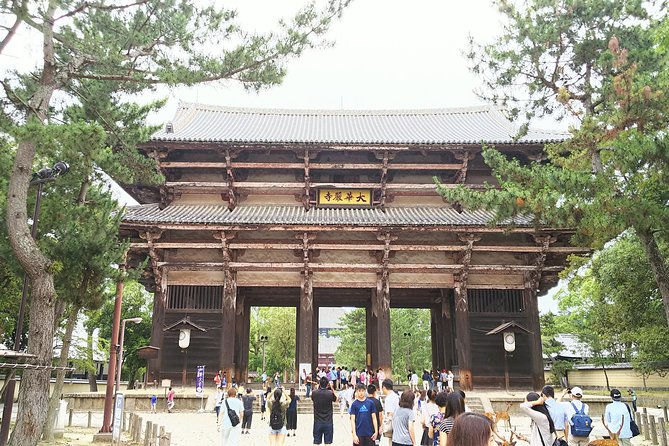
- Todai-ji provides the big finish: You will see one of Japan’s most famous Buddhist temples, its giant wooden hall, and the enormous Buddha inside.
- Nara Park’s deer are part of the experience: The animals roam freely and give the day an unusual, memorable touch.
- Private guiding is the real value: Your guide can answer questions, manage navigation, and make reasonable adjustments for your pace or interests.
- The day is not transport-free: About ¥2,000 per person is needed for public transportation, with another ¥1,500 for Todai-ji and Kasuga Taisha admission.
Why Nara makes a strong day trip from Kyoto
Kyoto can fill several days with temples, gardens, and old streets. Nara feels different. It was Japan’s capital in the eighth century, and its monuments are tied to the early development of Japanese government, Buddhism, and court culture.
That age gives the day a useful shape. You are not just moving from one pretty building to another. You begin in a former temple district that became a merchant quarter, continue to a shrine linked to an aristocratic clan, and finish at a temple founded by Emperor Shomu more than 1,300 years ago.
I like this kind of route because it gives you a story to follow. The guide can explain how religious institutions, ruling families, merchants, and imperial power shaped Nara. Without that context, the buildings can blur together. With it, each stop has a clearer role.
The tour starts at 8:30 a.m. and lasts about eight hours. The listed visits account for roughly three and a half hours, so the rest of the day allows for walking, public transport, transitions, and time around the sites. You should plan for a full day, not a quick morning outing.
More Walking Tours in Kyoto
- Kyoto Geisha Walking Tour: Gion District & Hidden Gems
★ 4.7 · 3,273 reviews - Kyoto: Gion Magical Night Walking Tour with Geisha Trivia
★ 4.9 · 2,393 reviews - Kyoto: Gion Geisha District Walking Tour – Stories of Geisha
★ 4.7 · 2,187 reviews
Naramachi: merchant houses and a slower first hour
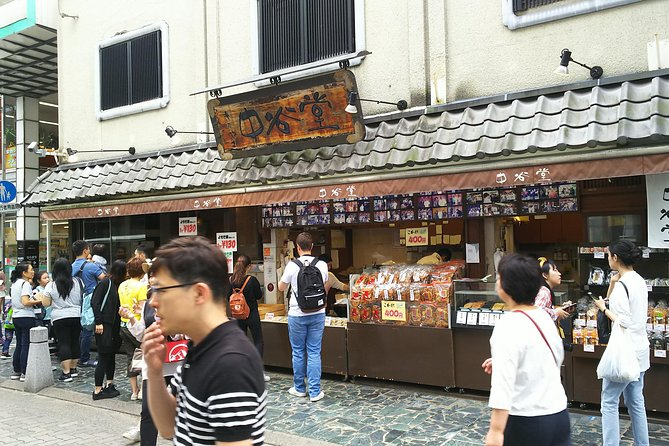
The tour starts in Naramachi, an area first founded as a temple town in the eighth century before developing into a merchant district. That change is the heart of the visit. Naramachi helps you see Nara as a lived-in city, not only as a collection of grand religious monuments.
The traditional houses are especially appealing. Many have wooden lattices and date back 100 years or more. Their modest fronts tell you something about old urban life. This is not the broad ceremonial scale of a major shrine or temple. It is a closer look at homes, shops, and streets shaped by daily business.
You have about 90 minutes here, with no admission fee listed for the stop. That makes it a gentle opening to the day. You can get your bearings, ask questions, and notice details that are easy to miss when walking alone.
I would pay attention to how the houses meet the street. The architecture is practical as well as attractive, and the guide can help explain what made the district a merchant quarter. This is also the part of the day that should appeal most to anyone who prefers ordinary city life over famous photo points.
The drawback is that Naramachi may feel less dramatic than Todai-ji. If you want immediate spectacle, the opening can seem quiet. I think that calm start works well, but you should know that the day builds toward its biggest visual impact rather than delivering it at once.
Kasuga Grand Shrine and the Fujiwara connection
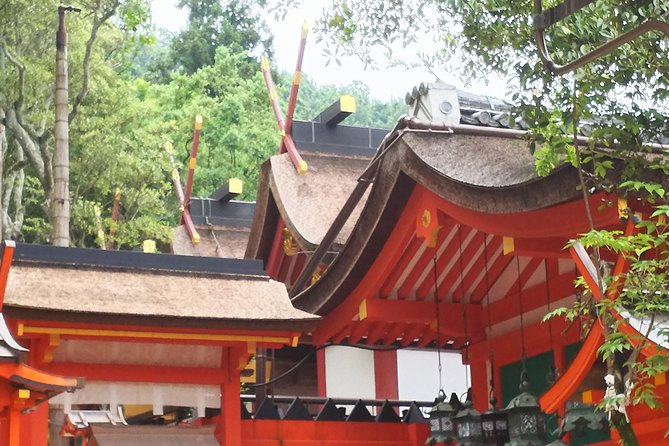
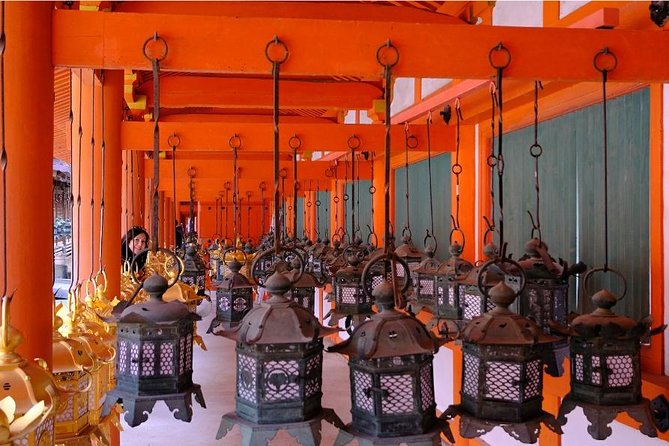
Next comes Kasuga Grand Shrine, founded in the eighth century by the Fujiwara clan. The Fujiwara family was one of the most powerful aristocratic groups in Japanese history, and the shrine gives you a way to connect Nara’s sacred places with the people who held influence at court.
You have about an hour here. Admission is not included, and the stated entrance cost for Kasuga Taisha Shrine and Todai-ji together is ¥1,500 per person. Set that aside before you go so the extra charge does not catch you by surprise.
Kasuga is valuable for more than its age. A guide can explain why the shrine mattered to the Fujiwara family and how its role continues today. The head priest is still a descendant of that family, which adds a direct link between the site’s early foundation and its present religious life.
This is a place where explanation helps. Japanese shrines can look beautiful while their symbols and customs remain unfamiliar. A private guide gives you room to ask simple questions without worrying about holding up a large group.
The shrine visit also gives the day a change of mood. Naramachi is urban and domestic. Kasuga is more ceremonial and spiritual. You will want comfortable shoes, since this is a walking tour and the route includes several major areas rather than one compact building.
Nara Park and the freely roaming deer
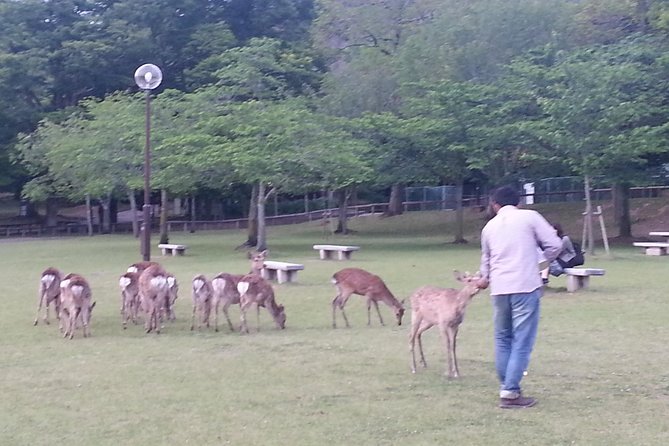
Nara Park is one of the day’s most distinctive features. The deer roam freely, and seeing them around the historic sites gives Nara a character you will not find in the same way in Kyoto.
The animals are not a minor side note. They are part of how many people remember the city. You can watch them moving through the park and see how closely nature, religion, and tourism meet here. Several people who enjoyed the tour singled out feeding the deer as a unique experience.
Still, keep your expectations sensible. The deer are wild animals, not trained performers. They can be eager around food, so follow local guidance and handle any feeding carefully. The tour description confirms the chance to see them, but it does not promise a particular animal encounter or a specific feeding activity.
I like that the deer appear within a larger cultural day. If you visited the park alone, you might remember only the animals. Here, the guide can connect them to the meaning of the place and help you shift your attention back to the shrine and temple buildings.
For families, this may be the most immediately engaging part of the tour. For adults interested in architecture and history, the deer are a welcome change of pace between major monuments.
A completely different kind of day out:
- PERFECT KYOTO 1-Day Bus Tour
★ 5.0 · 13,518 reviews - [Kyoto & Nara Day Tour] Sagano Scenic Railway & Nara Park & Fushimi Inari Taisha Thousand Torii Gates & Togetsukyo Bridge & Bamboo Grove & Kimono Forest (Departing from Osaka)
★ 4.9 · 10,942 reviews - Kyoto: Fushimi Inari, Kinkakuji, Bamboo Grove 1 Day Bus Tour
★ 4.8 · 4,316 reviews - Kyoto: Tea Ceremony in a Traditional Tea House in Kiyomizu
★ 4.9 · 3,519 reviews
Todai-ji: the day’s grandest sight
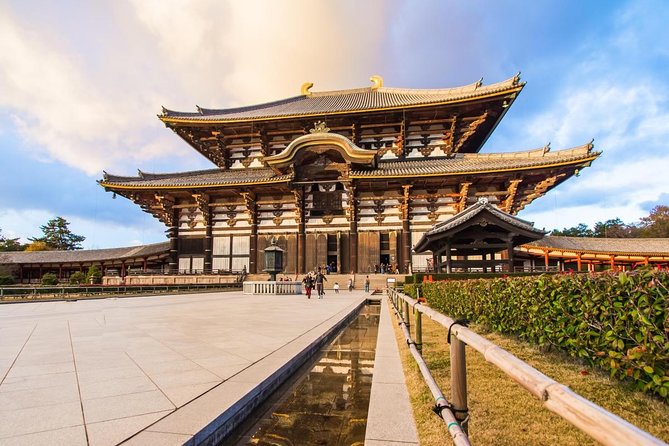
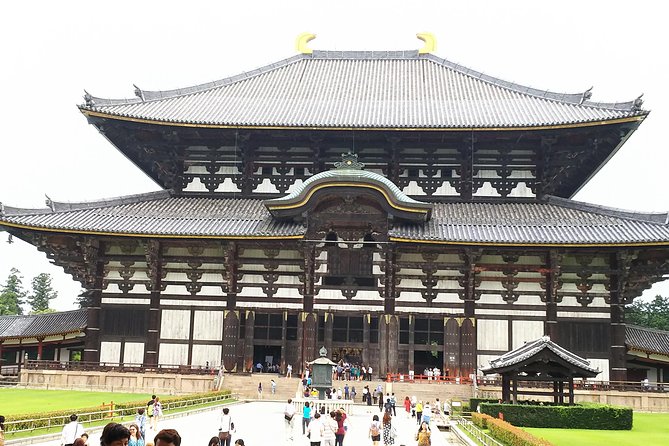
Todai-ji is the main event. Founded by Emperor Shomu more than 1,300 years ago, the temple is a UNESCO World Cultural Heritage site and one of Nara’s essential stops.
The temple sits beneath Mt. Wakakusa within a large precinct containing several historic buildings. The scale matters. This is not a small neighborhood temple that you can understand in five minutes. Even the approach prepares you for something far larger than the average wooden religious building.
Inside, the enormous Buddha is the sight most likely to stay with you. One person who enjoyed the tour called the largest wooden structure and the giant Buddha a particular favorite. That reaction makes sense. Todai-ji combines engineering, religious purpose, imperial ambition, and sheer physical size.
You have about an hour at the temple. Admission is extra, included in the combined ¥1,500 figure for Todai-ji and Kasuga Taisha Shrine. The guide can help you look beyond the scale of the hall and explain why Emperor Shomu ordered such a major Buddhist foundation.
The main limitation is time. An hour gives you a strong introduction, but it may not satisfy you if you want to inspect every building in the wider precinct. The description refers to several historic structures, yet the scheduled visit does not promise an extended exploration of all of them.
I would treat Todai-ji as the anchor of the day, not the entire day. You get the essential experience, then leave with a better sense of Nara’s place in Japanese history.
What the private guide adds
The guide is the reason to choose this tour instead of following a map. You are not simply paying for entry to three locations. You are paying for orientation, explanation, and help moving through a city with several separated sights.
The guides named in the feedback include Satomi, Emi, Tomoko, Fumiko, Noriko, Norika, and Fuji. The strongest pattern is personal care. Tomoko adjusted the day for a husband with a bad knee, while Fumiko answered questions about Japanese culture and history. Noriko was praised for making the day fun, and Fuji adapted the tour to a participant’s interests.
Satomi offers a useful example of flexibility. One participant added the Nara National Museum, which was not part of the planned route. Satomi had not prepared specifically for that change, but still helped explain the exhibits and later suggested a good place for dinner.
That does not mean every request is guaranteed. The tour is described as private, and one participant misunderstood that to mean fully personalized. The operator clarified that it is private rather than automatically customized. You should ask in advance if you want to alter the route, add a museum, or focus on a particular subject.
The private format also means only your group participates. That can make it easier to set a comfortable pace and ask questions. It is especially useful if your group has mixed interests or needs to walk more slowly.
Price, added costs, and what you receive
The listed price is $137.17 per person. That includes a professional guide, but not public transportation or the main entrance fees.
The additional costs are clearly stated:
- Public transportation: ¥2,000 per person
- Todai-ji and Kasuga Taisha entrance fees: ¥1,500 per person
That brings the listed extras to ¥3,500 per person. Exchange rates will affect the dollar total, but you should include these costs when comparing the tour with a self-guided day.
Is it good value? I think so for a first visit if you care about context and want a private pace. Nara’s key sights are spread across different areas, and a guide can save you from spending time checking routes or trying to decode the meaning of each place.
It is less compelling if you already know Nara well, speak Japanese comfortably, and enjoy researching temple and shrine history on your own. You may pay more than necessary for transportation and explanation you do not need.
Group discounts are available, though the exact discount is not stated. Since the tour is private, the cost may make more sense when shared by several people in one booking. Check the final price for your group before committing.
Pace, practical details, and who should book
The start time is 8:30 a.m., and the tour ends in a different location from where it begins. The exact ending point is not supplied, so confirm where you will finish before planning dinner or your return journey.
The experience is near public transportation, and public transport costs are not included. You should budget for those fares and wear shoes suitable for a full day on foot.
Most people can participate, and service animals are allowed. One guide handled a participant with a bad knee, but that does not mean the route is fully step-free or suitable for every mobility need. If walking is a concern, contact the provider before booking and explain what your group requires.
The tour requires good weather. If poor weather forces cancellation, you are offered another date or a full refund. You can cancel for a full refund up to 24 hours before the start time, but changes made inside that window are not accepted.
I would recommend this experience to:
- First-time visitors to Nara
- Families who want the deer and a clear route
- History and architecture fans
- Small groups that prefer a private guide
- People who want help adjusting the pace
I would be more cautious if you want a fully bespoke day. The guide may be flexible, but the planned route remains Naramachi, Kasuga Grand Shrine, and Todai-ji.
The guides receive unusually strong praise
The experience has a five-star rating from 15 reviews, with 100 percent recommending it. That is a small sample, but the praise is consistent enough to matter.
The repeated strengths are guide quality, patience, cultural explanation, and flexibility. Fumiko made the day enjoyable through clear answers about history and culture. Noriko was described as fun and helped make Nara a favorite stop. Norika was praised for patience and warmth with a family group.
Those personal details are more useful than a generic claim that the guides are good. You can see how the service works in practice: a guide may help with an unplanned museum visit, slow down for a sore knee, explain exhibits, or suggest a dinner spot after the official tour ends.
The rating does not remove the need to manage your expectations. The tour description could be clearer about the difference between private and custom. If you want a particular restaurant, museum, or extra temple, raise that before the morning begins.
Should you book this Nara day?
Book it if you want a well-shaped introduction to Nara without spending your evening researching routes, shrine customs, and temple history. The combination of old merchant streets, Fujiwara-linked worship, free-roaming deer, and Todai-ji gives you a satisfying picture of the ancient capital in one day.
The best reason to book is the guide. A private guide can turn a string of famous sites into a connected story, and the named guides have shown care with different interests and physical needs. The main reasons to pause are the extra ¥3,500 per person, the full eight-hour commitment, and the fact that private does not mean fully customized.
For a first visit from Kyoto, I think this is a strong choice. Confirm the meeting and ending points, ask about any changes you want, budget for transport and admission, and wear good shoes. Do that, and you should get a useful, lively day in one of Japan’s most important old capitals.
FAQ
How long is the Nara walking tour?
The tour lasts approximately eight hours and starts at 8:30 a.m.
Is the tour private?
Yes. Only your group participates in the activity.
What locations are included?
The planned route includes Naramachi, Kasuga Grand Shrine, and Todai-ji Temple. It also includes a chance to see the freely roaming deer in Nara Park.
Are transportation and admission fees included?
No. Public transportation costs ¥2,000 per person. Entrance fees for Todai-ji and Kasuga Taisha Shrine cost ¥1,500 per person.
Is the tour customized?
It is a private tour, but it is not automatically a customized tour. Some guides may accommodate reasonable changes, so ask the provider before booking if you want a different route.
What happens if the weather is poor?
The experience requires good weather. If it is canceled because of poor weather, you can choose another date or receive a full refund.
Just added in Kyoto
- The “Golden Route” and Ancient Japan by DIAMIR Erlebnisreisen – 14-Day Tour★ 2.0 · 2 reviews
- Japan: Castles & Cuisine by G Adventures – 6-Day Kyoto to Osaka Tour★ 4.5 · 4 reviews
- Cycle Japan by Explore! – 13-Day Kyoto to Tokyo Tour★ 4.7 · 12 reviews
- Cycle Japan by Intrepid Travel – 11-Day Kyoto to Tokyo Tour★ 4.8 · 2 reviews
- Classic Japan by Intrepid Travel – 11-Day Kyoto to Tokyo Tour★ 4.4 · 14 reviews
- Ancient & Modern Japan 14-Day Tour by Exodus Adventure Travels★ 4.4 · 40 reviews
- 5 Day Cultural Adventure of Kyoto, Nara & Osaka by Tourist Journey★ 2.5 · 2 reviews
- 12 Days Kinosaki Onsen Escape: A Journey Through Japan’s Timeless Towns by UME Travel★ 4.8 · 5 reviews
Walking Tours, compared.
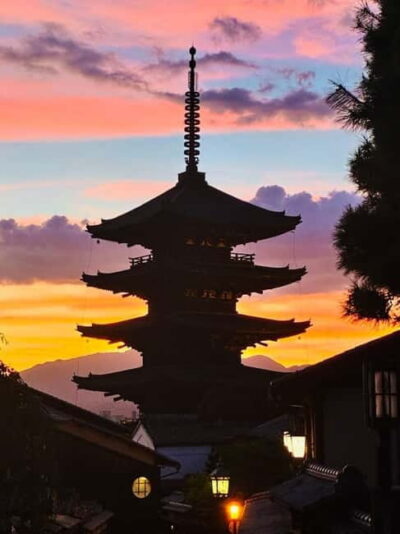
Kyoto Geisha Walking Tour: Gion District & Hidden Gems
Read our review →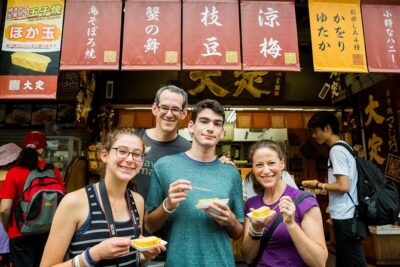
Tokyo Tsukiji Fish Market Food and Culture Walking Tour
Read our review →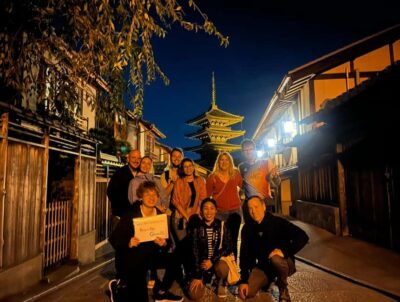
Gion Magical Night Walking Tour with Geisha Trivia
Read our review →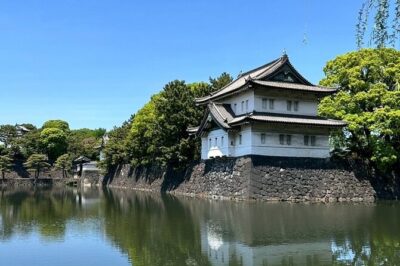
Imperial Palace and Shogun Historical Walking Tour
Read our review →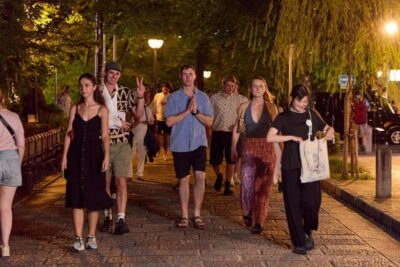
Gion Geisha District Walking Tour – Stories of Geisha
Read our review →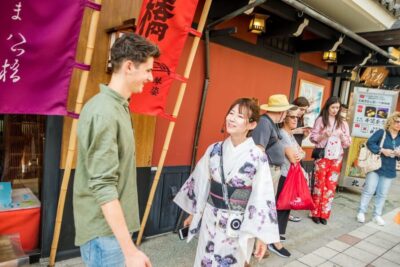
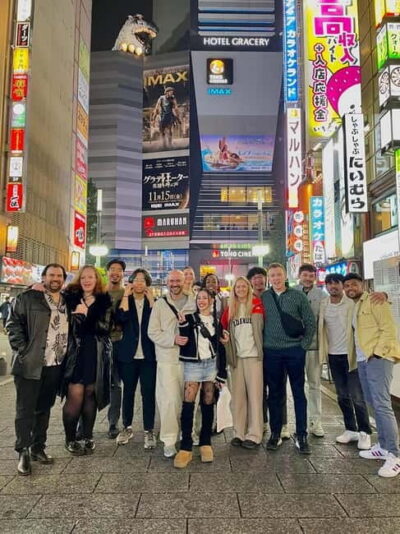
Shinjuku Local Bar and Izakaya Guided Walking Tour
Read our review →
Browse the lists this tour appears in