
Reviewed · CYCLING AND E-BIKE TOURS
Tokyo: 3-Hour Bike/E-Bike Tour of the City’s Hidden Gems
Tokyo reveals itself quickly from a bicycle seat. This three-hour ride covers about 18 kilometers, linking Zojo-ji, the Imperial Palace, Tokyo Station, Olympic sites, Aoyama, and Shibuya in one well-packed outing. I like the way the route mixes major sights with quieter streets, and I especially like how an e-bike lets you cover far more ground than you could on foot.
The small group, capped at seven people, also helps. Guides such as Show, Naoki, Kosei, Miguel, and Rinto have earned praise for keeping riders safe and answering questions about Japanese culture. The main catch is simple: this is still a real bike ride in city traffic, and three hours can feel demanding in Tokyo’s heat, even with an e-bike.
In This Review
- Key points to know before you book
- Why a bicycle works so well in Tokyo
- Starting at Zo-jo-ji with Tokyo Tower overhead
- The Imperial Palace and Otemon Gate
- Tokyo Station’s red-brick face
- Akasaka Palace and the Olympic district
- Aoyama streets and the move toward Harajuku
- Finishing at Shibuya Crossing
- Choosing between a regular bike and an e-bike
- Safety, traffic, and what to bring
- Guide quality and the small-group advantage
- Is $59.45 a fair price?
- Who should book this ride?
- Should you book the Tokyo bike tour?
- FAQ
- How long is the Tokyo bike and e-bike tour?
- How many people can join the tour?
- Where does the tour start?
- Where does the tour end?
- Is an e-bike included?
- Is a helmet included?
- Is a child seat available?
- What languages does the guide speak?
- What happens if bad weather cancels the tour?
Key points to know before you book
- About 18 kilometers in three hours: You see a broad slice of central Tokyo instead of spending the whole morning at one attraction.
- A strong route from Tokyo Tower to Shibuya: Zo-jo-ji, the Imperial Palace, Tokyo Station, Olympic venues, and Shibuya Crossing all fit into one ride.
- E-bikes help on hills and in hot weather: Riders in their late 60s found the electric option especially useful, while some regular-bike riders lagged on climbs.
- Very small groups: With no more than seven people, the guide can answer questions and adjust the pace more easily than on a big coach outing.
- Helmet rental costs extra: A helmet is available for ¥1,000, and you need cash if you want one.
- The finish is useful for the rest of your day: The ride ends in Jinnan, about five minutes from Yoyogi Park and roughly ten minutes on foot from Shibuya Station.
Why a bicycle works so well in Tokyo
Tokyo is easy to reach by train, but the rail network can make the city feel like a series of separate stops. A bike connects those stops. You glide from temple grounds to palace walls, then into office districts, fashion streets, and the noisy spectacle of Shibuya.
That is the real value of this outing. You are not only checking off sights. You are seeing how the city changes block by block. A quiet shrine area can give way to the grand red-brick face of Tokyo Station, then to polished Aoyama shops and the youthful streets around Harajuku.
The ride covers a lot, but it is not a race. The schedule includes short stops for photos and explanations. Guides have also been willing to pause for extra questions and pictures when time allows, though that can make the three-hour finish less exact.
The group size matters here. A maximum of seven riders creates a more personal feel, and solo riders can get plenty of chances to ask questions. The guide leads the route, points out hazards, and gives context at the stops rather than leaving you to follow a flag through the city.
More Bike Tours in Tokyo
- Tokyo Great Cycling Tour
★ 5.0 · 811 reviews - Tokyo Top Highlights 3h Guided E-bike Tour
★ 5.0 · 714 reviews - 3h Tokyo E-Bike Tour: Hidden Gems, and Local Life with guide
★ 5.0 · 670 reviews
Starting at Zo-jo-ji with Tokyo Tower overhead
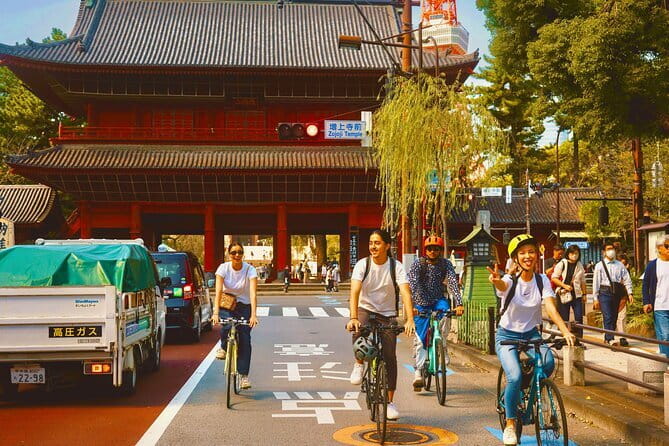
The meeting point is in Shiba Park, at Shiba Park BLD in Minato City. The first stop is Zo-jo-ji, one of Tokyo’s best combinations of traditional architecture and modern city scenery.
The temple is especially photogenic because Tokyo Tower rises behind it. You get a classic Tokyo picture in a single frame: a major Buddhist temple in the foreground and the orange tower above the trees and rooftops.
The stop lasts about 15 minutes. You may be able to go inside the temple, though that is not guaranteed. Admission to the stop itself is free, and the guide can give you a quick introduction to the site before the group moves on.
This opening stop sets the pattern for the tour. You get a major sight, a photo opportunity, and a short cultural explanation without spending most of your day in one place.
The Imperial Palace and Otemon Gate
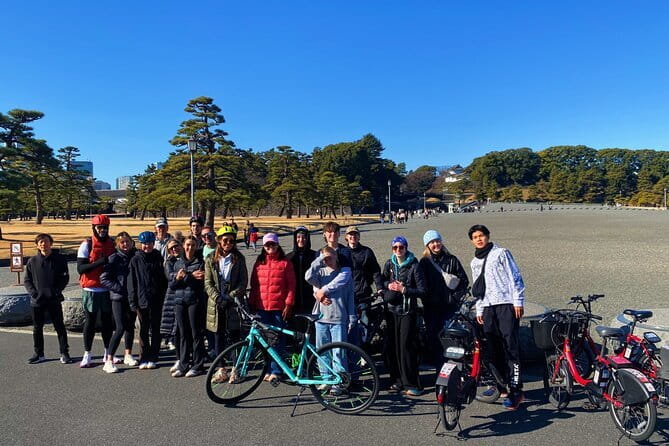
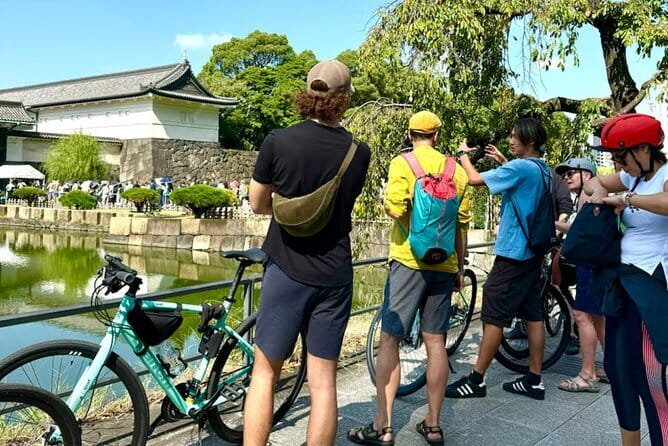
The ride continues to the Imperial Palace, where you see the entrance area and palace guards. The visit is brief, about ten minutes, so you should think of it as an orientation stop rather than a palace tour.
That distinction is important. You do not enter the private areas where the Emperor resides, and this experience does not include a full palace interior visit. You are seeing the exterior setting, the entrances, and the monumental scale of the grounds.
The nearby Kokyo Otemon Gate receives another ten-minute stop. This historic gate is a strong place for photographs, with its heavy construction and formal entrance giving you a sense of the old defensive character of the palace grounds.
The two palace stops work well together, though the tight timing means you will want to have your camera ready. If you hoped for a slow walk through the gardens, this ride will feel too quick. If you want a first look before exploring the palace area on your own, it works nicely.
Tokyo Station’s red-brick face
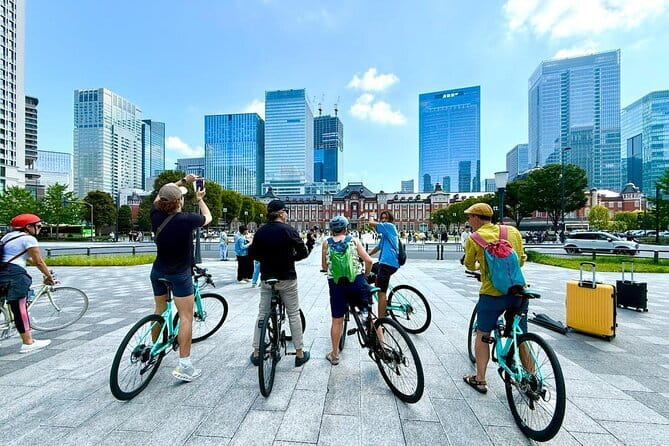
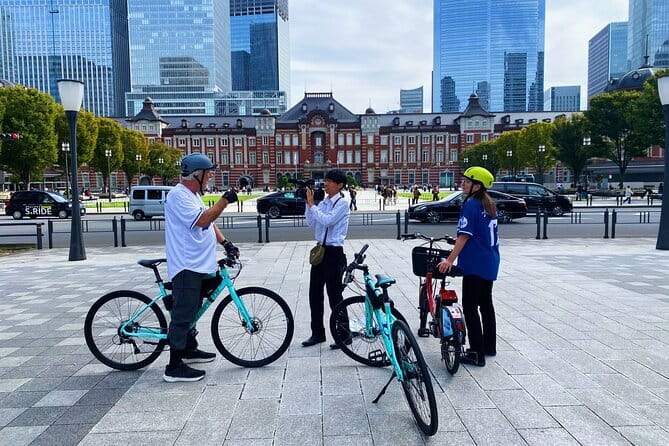
Tokyo Station Marunouchi Station Square is one of the route’s most striking changes of mood. The station opened in 1914, and its red-brick exterior gives this very modern city an older European-influenced landmark.
You have about ten minutes here. That is enough to admire the facade and take pictures, but not enough to explore the station’s huge interior, shops, or platforms.
I like this stop because it shows a side of Tokyo that can be missed if you focus only on neon and skyscrapers. The station is both a transport hub and an architectural landmark. From the bike, you also get a useful sense of how the Marunouchi business district is arranged around it.
A completely different kind of day out:
- Tokyo Disney Resort – Tokyo Disneyland & Tokyo DisneySea Park Tickets
★ 4.8 · 99,488 reviews - SHIBUYA SKY Ticket
★ 4.7 · 46,509 reviews - JR Whole Japan Rail Pass
★ 4.8 · 29,150 reviews - Mt Fuji and Hakone 1-Day Bus Tour Return by Bullet Train
★ 5.0 · 26,383 reviews
Akasaka Palace and the Olympic district
Akasaka Palace, also called the State Guesthouse, is the next notable stop. It began as a royal villa and now serves as a state guesthouse. The listed stop is only about five minutes, and admission is not included, so you should expect an exterior look rather than a full visit.
That short pause still adds variety. You have already seen a Buddhist temple and the Imperial Palace, and now you are looking at a formal government building with a different role in Japan’s public life.
The tour then heads to Japan National Stadium, the site of the 2020 Tokyo Olympic and Paralympic Games. The stop lasts about 15 minutes and admission is free. For sports fans, this may be one of the most memorable sections, while other riders may value it mainly as a marker of modern Tokyo.
The route gives you a quick lesson in how the city uses public architecture. Temples, imperial grounds, government buildings, and sports venues all appear within a few hours, without requiring a long subway transfer between each one.
Aoyama streets and the move toward Harajuku
Aoyama brings a different kind of Tokyo into view. You ride past high-end fashion brands and distinctive architecture, with only about five minutes set aside for the area.
This is not a shopping stop. You will not have time to browse stores, and the point is to see the streets as part of the ride. Aoyama is useful because it lets you watch Tokyo’s style shift from formal civic buildings to design-conscious retail districts.
From there, the route enters Shibuya Cat Street. This short stop includes fashion brands and vintage shops, again with about five minutes to look around. The area feels more youthful and informal than Aoyama, and the contrast makes the route more interesting than a simple list of famous monuments.
The itinerary calls these areas lesser-known corners, but expectations should stay realistic. Cat Street, Tokyo Station, Zo-jo-ji, and the Imperial Palace are all established sights. The less familiar part comes from reaching them by bicycle and connecting them through side streets rather than seeing each one as an isolated photo stop.
Finishing at Shibuya Crossing
The ride reaches Shibuya Crossing for a five-minute stop. Depending on the traffic and pedestrian flow, you may bike through or near the famous crossing area, guided by the tour leader.
This is the dramatic finish. The ride begins with temple roofs and Tokyo Tower, passes palace gates and station architecture, and ends in one of the world’s best-known urban scenes.
Do not expect an extended stop in Shibuya. Five minutes is enough for a quick look and a picture, not for shopping or a long visit to the surrounding stores. The tour ends in Jinnan, a shopping and dining area between Yoyogi Park and Shibuya.
That location is practical. You can walk to Yoyogi Park in about five minutes, or reach Shibuya Station in roughly ten minutes. It gives you an easy way to continue your day with lunch, shopping, or a longer look at Harajuku and Shibuya.
Choosing between a regular bike and an e-bike

The standard bicycle is suitable if you already ride regularly and feel comfortable with moderate exertion. One rider found the regular bike perfectly manageable, but other riders fell behind on hills while using pedal bikes.
The e-bike is the safer choice for many people, especially in summer, on inclines, or if you want to concentrate on the scenery instead of your legs. Several riders described the electric option as making the route much easier, and a couple in their late 60s enjoyed the ride with e-bikes.
Still, an e-bike does not turn this into a passive sightseeing trip. You must pedal, steer, stop, and ride among cars and pedestrians. One rider found the overall outing fairly physically demanding despite using an e-bike, and another reported that an e-bike felt too small and did not work well. Bike fit and equipment condition may vary, so contact the provider if size is a concern.
Tokyo’s summer heat is another reason to consider electric assistance. The tour includes a raincoat on wet days, but food and drinks are not included. Bring water and dress for the weather.
Safety, traffic, and what to bring
The provider includes bicycle insurance and an in-person guide in English or Japanese. Guides have been praised for giving clear route instructions and keeping groups together, and some have stopped for water breaks.
You should still be comfortable riding a bicycle in traffic and around pedestrians. The experience asks for a moderate level of physical fitness. If you rarely ride, feel nervous near cars, or have trouble with hills, an e-bike can help, but it cannot remove the need for basic city-riding confidence.
A helmet is not included. You can rent one for ¥1,000, and you should bring cash on the day. This is an important extra cost, particularly if you are booking for several people.
Each bike includes a small pouch for a phone, wallet, and keys. That is handy because you can keep your pockets light and reach your phone for quick photos. Child seats cost ¥3,000 to set up, require contact at least two days before the ride, and also require cash on the day.
Guide quality and the small-group advantage
The human side of the ride is one of its strongest features. Guides including Show, Naoki, Kosei, Kazu, Kei, Miguel, and Rinto have been praised for being friendly, clear, patient, and willing to answer questions.
Show, in particular, has been singled out for explaining Japanese culture and history at the stops. Naoki has been praised for combining routes around a rider’s interests, while Rinto made a point of keeping everyone informed about the path and stopping for breaks.
The depth of explanation may vary by guide. One rider described the information as light, while others found the cultural and historical background detailed enough to feel like a compact introduction to Japan. You should expect useful commentary and conversation rather than a university lecture.
There are no headsets, which is one of the few practical weaknesses. With traffic, wind, and pedestrians around you, it may be harder to hear every word while riding. The small group helps, since you can usually ask the guide to repeat or explain a point at the next stop.
Is $59.45 a fair price?
At $59.45 per person, the tour offers solid value if you have only half a day or want an introduction to central Tokyo. You are covering roughly 18 kilometers, using a bike, receiving a guide, and visiting a long list of major districts without paying separate admission charges at most stops.
The price is less attractive if you mainly want deep visits to two or three attractions. The stops are short, and Akasaka Palace admission is not included. You are paying for movement, orientation, and local explanation rather than extended time inside monuments.
For first-time visitors, I think the value is strongest early in a Tokyo stay. The ride helps you understand how Shiba, Marunouchi, Akasaka, Aoyama, Harajuku, and Shibuya relate to one another. You can then return by train or on foot to the places that caught your interest.
Free cancellation is available up to 24 hours before the start time. The experience depends on good weather, so a cancellation caused by poor conditions brings the choice of another date or a full refund.
Who should book this ride?
I would choose this tour if you want to see a lot of Tokyo quickly, enjoy light exercise, and prefer streets and neighborhoods to a coach window. It is also a good fit for solo riders, couples, and small groups who want to ask questions along the way.
The e-bike makes the tour more accessible to people who are not strong cyclists, but you still need moderate fitness and comfort around traffic. Families can ask about a child seat, though it must be arranged at least two days ahead and costs extra.
I would skip it if you want a slow temple visit, a full palace tour, or several hours of shopping in Aoyama and Shibuya. The ride is best understood as a fast, useful city introduction with plenty of photo stops.
Should you book the Tokyo bike tour?
Book it if you want a lively three-hour orientation and are happy to trade long attraction visits for range. I especially recommend the e-bike on hot days, for older riders, and for anyone unsure about hills.
The strongest reasons to go are the compact route, small group, practical finish near Yoyogi Park and Shibuya, and guides who add personal context to the city. Just budget for a ¥1,000 helmet if you want one, bring water, and be honest about your cycling comfort.
FAQ
How long is the Tokyo bike and e-bike tour?
The tour lasts about three hours and covers approximately 18 kilometers through central Tokyo.
How many people can join the tour?
The maximum group size is seven people.
Where does the tour start?
It starts at Shiba Park BLD in Shibakoen, Minato City, Tokyo 105-0011.
Where does the tour end?
It ends in Jinnan, near the Bell of Peace. The area is about a five-minute walk from Yoyogi Park and a ten-minute walk from Shibuya Station.
Is an e-bike included?
The experience includes use of a bicycle, but the supplied information notes different bike options and possible price differences. Check the available option when booking.
Is a helmet included?
No. Helmet rental costs ¥1,000, and you should bring cash if you want one.
Is a child seat available?
Yes. A child seat costs ¥3,000, must be arranged at least two days before the tour, and requires cash on the tour date.
What languages does the guide speak?
The tour offers an in-person guide in English or Japanese.
What happens if bad weather cancels the tour?
Because the experience requires good weather, you will be offered another date or a full refund if poor weather causes cancellation. You can also cancel up to 24 hours before the start time for a full refund.
Just added in Tokyo
- Very popular in Harajuku♡Animal petting zoo★ 4.6 · 39 reviews
- Yokohama Port: Private Customizable Tour with Transfer★ 5.0 · 19 reviews
- Yanaka District: Historical Walking Tour in Tokyo’s Old Town★ 4.8 · 117 reviews
- Wagyu & Sake 8 Course Tasting Dinner in Shinjuku★ 4.9 · 20 reviews
- Warner Bros. Studio Tour Tokyo – The Making of Harry Potter★ 4.8 · 181 reviews
- Tokyo: Classic Tsukiji Food Tour★ 4.9 · 78 reviews
- Tokyo: Tsukiji Fish Market Tour with 6 Stops & Seafood Lunch★ 4.5 · 165 reviews
- Tokyo Wagyu & Sake Pairing Tasting Experience with Local Flavors★ 5.0 · 108 reviews
Cycling and E-Bike Tours, compared.
3h Tokyo E-Bike Tour: Hidden Gems, and Local Life with guide
Read our review →
Arashiyama Bamboo Forest & Hidden Gems Bike Tour (Early Bird)
Read our review →
5 Top Highlights of Kyoto Full Day Bike Tour (E-bike option)
Read our review →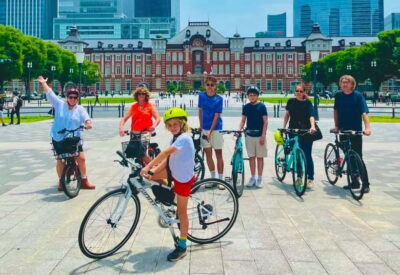
Hiroshima 2hr Peace Cycling Tour with Local Guide
Read our review →Browse the lists this tour appears in