Reviewed · GUIDED
Kyoto Highlights & Hidden Gems in Nature (Private Van Eng-Guide)
Kyoto rewards the curious driver. This six-hour private van tour links famous sights with quieter corners that are awkward to reach by bus. I especially like the door-to-door pickup across Kyoto City and the chance to reach mountain shrines, cedar groves, and viewpoints far beyond the usual central circuit. The English-speaking guide, Daiki, also adds useful context about Buddhism, Shinto, and Kyoto’s past rather than simply pointing at buildings.
The tour’s second strength is its flexibility. Daiki has adjusted routes for weather, crowds, and personal interests, and the air-conditioned van gives you a welcome break between stops. The main drawback is pace: with eleven listed stops plus a geisha district drive in about six hours, many visits are short, and entry fees of roughly ¥1,400 per person are extra.
In This Review
- Key points at a glance
- What this private Kyoto tour is designed to do
- Kinkakuji gives you Kyoto’s famous first photograph
- Arashiyama’s quieter temples come before the famous bamboo path
- The mountain road changes the mood completely
- Sacred trees and Kitayama cedars are the tour’s strongest discoveries
- A geisha district drive saves your feet, but requires respect
- Heian Jingu’s giant torii is a quick central Kyoto stop
- Fushimi Inari works best when the crowds thin
- Daiki makes the long route easier to enjoy
- What the $230.61 group price really buys you
- Who should book this Kyoto van tour?
- FAQ
- What time does the tour start?
- How long does the experience last?
- Is pickup included?
- Is the tour private?
- Are admission fees included?
- Is the tour conducted in English?
- Can the itinerary change?
- Should you book this Kyoto private van tour?
Key points at a glance
- A private Japanese minivan covers a lot of ground: You can cross Kyoto without juggling train connections, buses, and long transfers.
- The mountain section is the real prize: Arashiyama-Takao Parkway, Hozu Gorge, giant cedars, and Nakagawa Hachimangu Shrine show you a quieter side of Kyoto.
- Daiki is the guide to know: His friendly English commentary covers Japanese religion, history, local customs, and unusual details, including bamboo’s link to Edison’s light bulb work.
- The famous stops come with crowd concerns: Kinkakuji and Fushimi Inari are essential Kyoto sights, but the visit timing and short stop lengths matter.
- The schedule favors snapshots over long temple visits: Most secondary stops last only five to fifteen minutes, so this is a sampler rather than a slow cultural walk.
- The price works best for a small group: At $230.61 per group, the cost can be sensible for a family or group sharing one vehicle, but less attractive for one person.
What this private Kyoto tour is designed to do
This is a sightseeing day built around a simple idea: use a private vehicle to connect places that do not fit neatly into one public transportation route. You begin at 1:00 pm, ride in a Japanese minivan, and spend roughly six hours moving from northern Kyoto to Arashiyama, the mountain roads, central Kyoto, and Fushimi Inari.
I like this format for a first or second visit when you want to see a lot without spending half the day studying bus maps. Pickup and drop-off are offered anywhere in Kyoto City, and the van includes fuel, tolls, and parking. That matters here because the route uses the Arashiyama-Takao Parkway, a toll road that takes you into the hills.
The tradeoff is clear. You are not getting an unhurried morning at one temple or a long walk through Arashiyama. The schedule is broad and fast, with several five-minute viewpoints and fifteen-minute temple visits. Think of it as a carefully chosen overview with access to places a standard city tour may skip.
A few more options to weigh up in Kyoto
- PERFECT KYOTO 1-Day Bus Tour
★ 5.0 · 13,518 reviews - [Kyoto & Nara Day Tour] Sagano Scenic Railway & Nara Park & Fushimi Inari Taisha Thousand Torii Gates & Togetsukyo Bridge & Bamboo Grove & Kimono Forest (Departing from Osaka)
★ 4.9 · 10,942 reviews - Kyoto: Fushimi Inari, Kinkakuji, Bamboo Grove 1 Day Bus Tour
★ 4.8 · 4,316 reviews
Kinkakuji gives you Kyoto’s famous first photograph
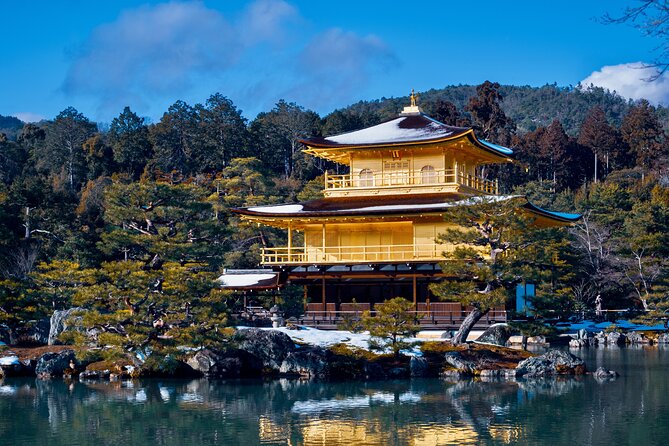
The Golden Pavilion, officially Kinkakuji, is the first major stop. Its gold-covered upper floors reflect over a pond, making it one of Kyoto’s most recognizable sights. The grounds are set in northern Kyoto, where reaching the temple by car can save time compared with a long public bus ride.
You get about 45 minutes here, which should allow time for the main garden route and photographs. The admission fee is not included, and entry costs form part of the approximate ¥1,400 per-person total for paid sites.
This is likely to be one of the busier stops. The private van solves the transport problem, not the crowd problem. If you want quiet contemplation, Kinkakuji may not provide much of it. If you want the classic Kyoto view without spending an hour getting there, it earns its place.
Arashiyama’s quieter temples come before the famous bamboo path
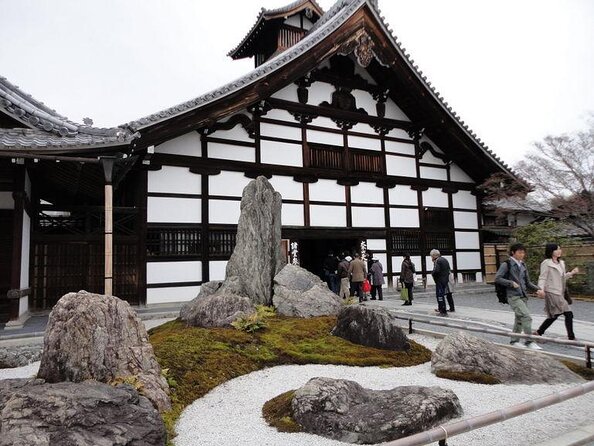
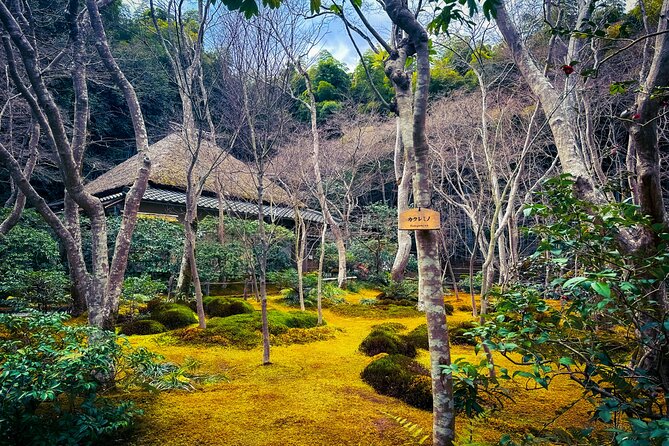
The route then moves to Gio-ji Temple, a small site in Arashiyama with a moss-covered garden, a thatched hut, and bamboo around the grounds. You have only about 15 minutes, so you will need to keep moving. Still, this is the sort of compact setting that can feel more traditionally Japanese than a large, famous temple complex.
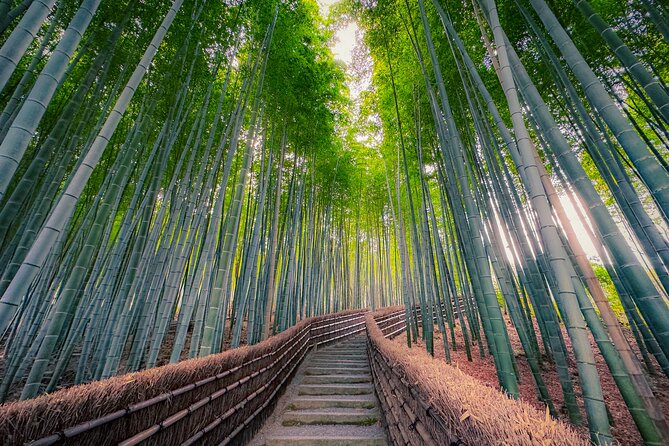
Next comes the Arashiyama Bamboo Forest. The walk lasts about 15 minutes and follows the well-known path through tall bamboo. Daiki explains the plant’s origins in Japan and its connection to Thomas Edison’s early experiments with light bulb filaments.
Fifteen minutes is enough to experience the path, but not enough for a long wander. The bamboo grove can also become crowded. One useful feature of a private guide is that the plan can change when conditions are poor. On one occasion, Daiki skipped the grove because it was too crowded and used the time elsewhere. That flexibility is valuable, though you should understand that a listed stop may be adjusted.
Otagi Nenbutsu-ji Temple follows. It sits at the northern end of the Arashiyama historic district, in an area with older Kyoto-style streets and fewer crowds. The temple is known for its many expressive stone figures, which give the grounds a playful character unlike the polished formality of Kinkakuji.
Again, the planned visit is only 15 minutes. You can see the setting and get a taste of the temple, but you will not have time for a lengthy look at every figure or garden detail.
The mountain road changes the mood completely
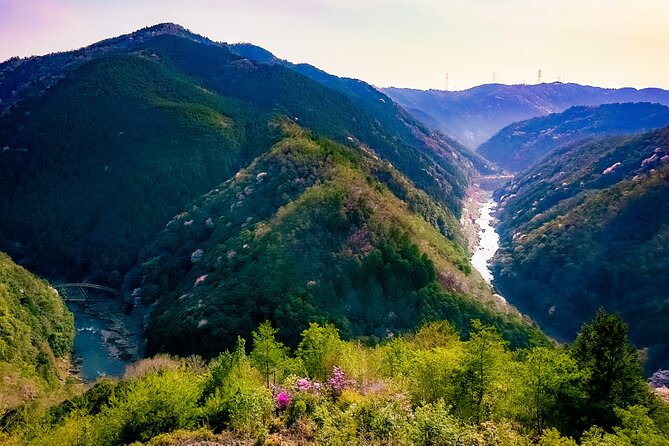
The Arashiyama-Takao Parkway is where this outing becomes different from a standard Kyoto highlights tour. The private van spends about 45 minutes on a toll road through the hills, with mountain scenery and seasonal trees along the route.
April brings cherry blossoms, while November brings maple color. Those seasonal details matter because the road itself is more about scenery than a single monument. Timing your trip during either period may make the drive especially attractive, although weather and exact color conditions can vary.
The first viewpoint is Mount Ogura Observatory, where you get a broad view over Kyoto. The scheduled stop is only five minutes, so treat it as a quick photograph and orientation point, not a hike or a long viewing session.
Hozukyo Observatory offers another five-minute stop, this time looking toward the Hozu Gorge. The gorge is also associated with traditional hard-stream boat rafting. Even with limited time, the view gives you a sense of the steep country around Kyoto, a sharp contrast to the city’s temples and shopping lanes.
These brief stops reveal both the strength and weakness of the itinerary. A car can bring you to several excellent viewpoints in one afternoon. But if you prefer sitting quietly with a view, the schedule may feel too hurried.
A completely different kind of day out:
- Kyoto: Tea Ceremony in a Traditional Tea House in Kiyomizu
★ 4.9 · 3,519 reviews - Kyoto: Gion Make Your Own Chopsticks with Engraving Option
★ 5.0 · 3,465 reviews - Kyoto Nara Day Trip │ Kiyomizu-dera Temple + Fushimi Inari-taisha Shrine + Nara Park (Departing from Osaka/Kyoto)
★ 4.7 · 3,408 reviews - Kyoto Geisha Walking Tour: Gion District & Hidden Gems
★ 4.7 · 3,273 reviews
Sacred trees and Kitayama cedars are the tour’s strongest discoveries
At Nakagawa Hachimangu Shrine, the guide introduces you to a local place built as a guardian shrine for the area. The main draw is an old Japanese cedar worshiped by local Shinto believers. You are invited to touch the tree and connect with its spiritual presence.
I find this kind of stop more revealing than another major monument. It shows how religion in Japan can remain tied to a particular tree, grove, or patch of ground. The planned visit lasts five minutes, so the value comes from Daiki’s explanation and the feeling of visiting a working local shrine rather than from a long list of architectural details.
The Kitayama Big Daisugi stop goes farther into northern Kyoto. The route reaches an area of giant platform cedar trees along a narrow cliff road. The trees are the focus, but the journey is part of the appeal. This is a remote-feeling corner that would be difficult to reach casually without a private vehicle.
The stop lasts about ten minutes. You might find this section especially rewarding if you have already seen Kyoto’s famous temples and want something less polished and more local. It is also the part most dependent on road conditions, season, and the guide’s judgment.
A geisha district drive saves your feet, but requires respect
The tour also passes through a 600-year-old street associated with geishas. Rather than walking through crowded lanes, you see the area from the van and can take photographs from inside.
This is a practical way to get a glimpse of the district without adding another long walk to an already busy day. But photography requires permission if you happen to see geishas. That is not a minor detail. Keep your camera ready for streets and buildings, but do not photograph people without their consent.
Because this part is experienced by car, it is best understood as a short visual introduction, not a full visit to the district. If the area is a major personal interest, you may want to return later on foot with more time and care.
Heian Jingu’s giant torii is a quick central Kyoto stop
The red torii gate of Heian Jingu is a five-minute photo stop. At 24.4 meters, or about 80 feet, it is one of the largest torii gates in Japan and an impressive sight even from the road.
You do not get a full visit to Heian Jingu Shrine itself. The stop focuses on the gate, which spans a broad city street and gives you a striking architectural moment between the mountain route and the final shrine.
This is another example of the tour’s approach: cover a lot, pause at the most useful point, then keep going. It works well if you want a broad first look at Kyoto. It will disappoint you if you expect every shrine to receive a proper temple-length visit.
Fushimi Inari works best when the crowds thin
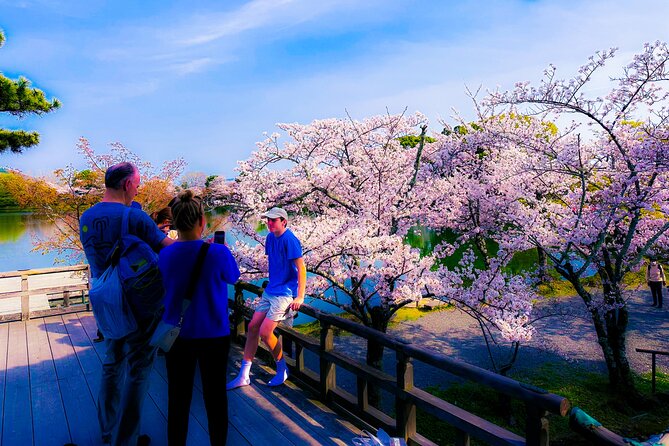
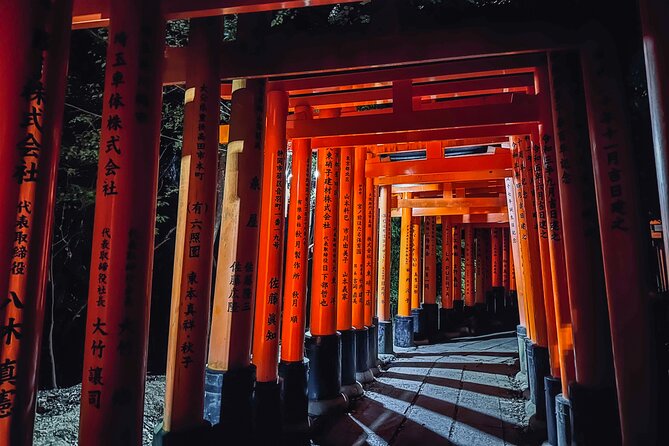
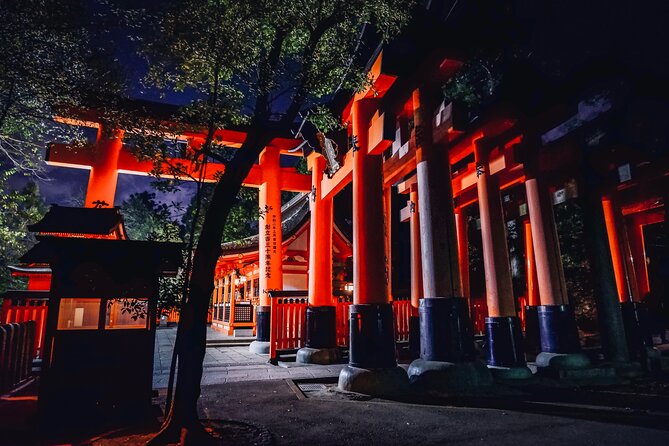
The final major stop is Fushimi Inari-taisha Shrine, famous for its long paths of orange torii gates. More than 10,000 gates now line the routes up Mount Inari, donated over time by individuals and businesses.
You have about 40 minutes here. That allows a meaningful walk into the torii tunnels, but not a full climb through the mountain paths. Wear comfortable shoes, since the shrine includes stairs and uphill walking. The guide can help you avoid some walking if needed, but ask in advance if stairs are a concern.
Timing can make a major difference. The tour begins in the afternoon, and the Fushimi Inari stop may come later in the day. A late visit can feel calmer than the midday crush. One especially useful point from the tour’s experience is that visiting the gates at night brought far fewer people and a better atmosphere. Exact timing can change, so do not treat that as a guarantee, but the afternoon-to-evening structure may work in your favor.
Fushimi Inari is free to enter. The shrine is not only a picture stop. Its torii path reflects the connection between Shinto worship, business success, and offerings made over many years. Daiki’s explanations can help turn a famous photo into a more meaningful visit.
Daiki makes the long route easier to enjoy
A private vehicle is helpful, but the guide determines much of the day’s quality. Daiki is described as friendly, easygoing, entertaining, and a safe driver. He walks around the sites with you, explains what you are seeing in fluent English, and adjusts the plan when weather or crowds interfere.
His background in Buddhism and Japanese history is especially useful at places such as Gio-ji, Otagi Nenbutsu-ji, Nakagawa Hachimangu Shrine, and Fushimi Inari. The difference between a quick stop and a useful stop often comes down to receiving enough context to know why the place matters.
He has also tailored visits to individual interests and needs. That does not mean every request can fit into six hours, but a private tour gives you more room to ask. If you care most about gardens, religious sites, mountain scenery, or photographs, mention that when arranging the day.
One practical warning: pickup was about ten minutes late on one occasion. That is not a major delay, but you should keep your phone available and allow a little patience at the start.
What the $230.61 group price really buys you
The listed price is $230.61 for a group of up to one, which needs clarification when you book because the tour is priced by vehicle rather than by each passenger in the usual way. A family of four found the arrangement reasonable because everyone shared the same private van. For a larger small group, the value improves quickly.
The price includes the vehicle, Kyoto City pickup and drop-off, guide service, fuel, tolls, and parking. Those extras matter on a route that uses a toll parkway and covers much of the city. You are also paying for time saved, especially when public transport would require several changes.
Temple entry is extra, with total admission fees estimated at about ¥1,400 per person. Kinkakuji and some other temples charge admission, while Arashiyama Bamboo Forest, the viewpoints, Heian Jingu torii, and Fushimi Inari are listed as free stops.
I would consider this good value for a family, two couples, or a small group with only one day to see Kyoto. For a solo visitor, the same price feels high unless private transport and local guidance are your top priorities.
Who should book this Kyoto van tour?
I would choose this experience if you want famous Kyoto sights plus mountain scenery in one afternoon. It suits first-time visitors with limited time, families who want to avoid complicated transfers, and anyone who has already seen central Kyoto and wants quieter places.
It is also a strong match for people who like learning as they go. Daiki’s explanations add substance to the short visits, and his willingness to adjust the route is useful when rain or heavy crowds affect the plan.
I would think twice if you want long temple visits, a serious hike, or a slow photography day. The itinerary is packed, and several stops last only five or fifteen minutes. Some temples involve stairs and walking, although you can ask the guide about avoiding difficult sections.
The tour is private, so only your group participates. Service animals are allowed, and the experience is near public transportation, though the main benefit is that you do not need to use it during the tour.
FAQ
What time does the tour start?
The tour starts at 1:00 pm.
How long does the experience last?
The tour lasts approximately six hours.
Is pickup included?
Yes. Pickup and drop-off are offered anywhere in Kyoto City.
Is the tour private?
Yes. Only your group participates in the activity.
Are admission fees included?
No. Temple admission fees are extra and total approximately ¥1,400 per person.
Is the tour conducted in English?
Yes. The guide provides fluent English guidance.
Can the itinerary change?
Yes. Parts of the route may change because of the season, weather, crowds, or other circumstances.
Should you book this Kyoto private van tour?
Book it if you want efficient sightseeing with a personal guide, especially if you are splitting the cost among several people. The best reasons are the comfortable air-conditioned van, Kyoto City pickup, Daiki’s friendly explanations, and access to mountain roads and cedar groves that are hard to reach on your own.
Do not book it expecting a slow, meditative temple day. This is a broad sampler, with quick stops and a lot of ground covered. For the right visitor, that is exactly the point: Kinkakuji, Arashiyama, Fushimi Inari, and a quieter side of northern Kyoto, all in one well-planned afternoon.
Just added in Kyoto
- The “Golden Route” and Ancient Japan by DIAMIR Erlebnisreisen – 14-Day Tour★ 2.0 · 2 reviews
- Japan: Castles & Cuisine by G Adventures – 6-Day Kyoto to Osaka Tour★ 4.5 · 4 reviews
- Cycle Japan by Explore! – 13-Day Kyoto to Tokyo Tour★ 4.7 · 12 reviews
- Cycle Japan by Intrepid Travel – 11-Day Kyoto to Tokyo Tour★ 4.8 · 2 reviews
- Classic Japan by Intrepid Travel – 11-Day Kyoto to Tokyo Tour★ 4.4 · 14 reviews
- Ancient & Modern Japan 14-Day Tour by Exodus Adventure Travels★ 4.4 · 40 reviews
- 5 Day Cultural Adventure of Kyoto, Nara & Osaka by Tourist Journey★ 2.5 · 2 reviews
- 12 Days Kinosaki Onsen Escape: A Journey Through Japan’s Timeless Towns by UME Travel★ 4.8 · 5 reviews
Guided, compared.
Tokyo 6hr Private Tour with Government-Licensed Guide
Read our review →
Shiraito Falls & Forest Cafe & Handmade Flower Salt Pudding & Grilled Seafood & Totoro Forest & Sakurai Futamigaura & Angel’s Wings & Coconut Tree Swing Day Tour (Departing from Hakata Station, with Mandarin, English, and Cantonese speaking guide)
Read our review →
Shinjuku Local Bar and Izakaya Guided Walking Tour
Read our review →
Private City Highlights Tour with Local Guide
Read our review →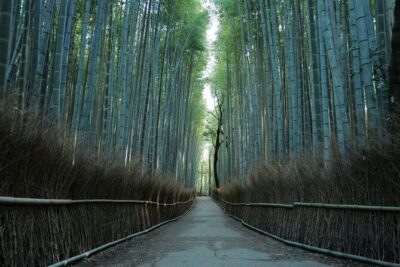
Kyoto Early Morning Tour with English-Speaking Guide
Read our review →