
Reviewed · 2-HOUR EXPERIENCES
Asakusa: 2-hour history exploration
Asakusa rewards a closer look. This two-hour walk connects the Sumida River, Kaminarimon Gate, Nakamise Street, Senso-ji Temple, and Asakusa Shrine into one clear story. I like the strong historical focus, and I especially like the headsets, which help you hear the guide in crowded streets. The included traditional snack adds a pleasant local touch.
The tour also gives you a useful view from the Asakusa Culture Tourist Information Center before you enter the temple grounds. The main consideration is pace: two hours is enough for an introduction, but not enough for a slow visit to every shop, hall, and side street in the district.
In This Review
- Key points to know before booking
- Why Asakusa is worth seeing with context
- Starting beside the Sumida River
- Seeing the whole route from the Tourist Information Center
- Reading the symbols at Kaminarimon Gate
- Walking the 250 meters of Nakamise Street
- Entering Hozomon, the Treasure-House Gate
- Understanding the rituals at Senso-ji Temple
- Why Asakusa Shrine belongs on this route
- Headsets, group size, and the morning pace
- Is $64.55 a fair price?
- Who will get the most from this walk?
- Should you book the Asakusa history exploration?
- FAQ
- How long does the Asakusa history exploration last?
- What time does the tour begin?
- Where does the tour meet?
- Where does the tour finish?
- Is hotel pickup included?
- What sights are included?
- Is the tour conducted in English?
- Are headsets provided?
- What is the cancellation policy?
Key points to know before booking
- A 1,400-year story: The walk explains how Asakusa grew around Senso-ji and the Sumida River.
- A useful morning start: The 9:30 am departure leaves much of the day free for museums, shopping, or a second look at the temple.
- Clear guiding in busy streets: Headsets are supplied for groups of three or more.
- One included snack: The guide buys a traditional Asakusa snack, with the choice of location shaped by the group’s preferences.
- A small enough group: The maximum is 20 people, with group discounts available.
- A strong first visit: The route covers the main sights without asking you to plan the order yourself.
Why Asakusa is worth seeing with context
Asakusa is easy to visit on your own. You can walk through Kaminarimon, follow Nakamise Shopping Street, take photographs of Senso-ji, and watch people pray at the incense burner. What is harder is understanding how the pieces fit together.
This district grew around Senso-ji, one of Tokyo’s most important Buddhist temples. The walk presents Asakusa as more than a photo stop. You learn how the Sumida River helped shape the area, why the temple and shrine share the same grounds, and how Buddhism and Shinto can exist side by side in everyday Japanese life.
That context has real value for a first visit. Without it, the enormous lantern at Kaminarimon is simply a famous object, and the long row of shops on Nakamise is just a convenient place to buy souvenirs. With a guide, those same places become parts of a larger story.
The English guiding is another strong point. Guides named in the feedback include Choco, Yasu, and Amy, each praised for clear communication and useful local advice. Amy, for example, helped with suggestions for buying a Japanese knife. Another guide added an origami lesson at the end, although extras can vary and should not be treated as part of the promised route.
A few more options to weigh up in Tokyo
- Tokyo Disney Resort – Tokyo Disneyland & Tokyo DisneySea Park Tickets
★ 4.8 · 99,488 reviews - SHIBUYA SKY Ticket
★ 4.7 · 46,509 reviews - JR Whole Japan Rail Pass
★ 4.8 · 29,150 reviews
Starting beside the Sumida River
The tour begins at 9:30 am near Burger King Asakusa Azumabashi, at 2-chōme-20-6 Kaminarimon. The meeting point is central and close to public transportation, but check the exact address carefully before setting out. The name includes several location terms, so a quick map check can save you from starting the morning at the wrong end of the neighborhood.
The first stop is the Sumida River, where Asakusa’s story begins. You cross Azumabashi Bridge and get views of Tokyo Skytree and the Asahi Breweries headquarters. The golden flame object above the Asahi building is one of the area’s most recognizable modern landmarks.
This opening stop lasts about 15 minutes and costs nothing beyond the tour price. I like this beginning because it gives you a physical sense of Asakusa’s position. The river is not just scenery. It helps explain why this part of Tokyo developed as a place of movement, worship, entertainment, and trade.
The stop is brief, so do not expect a long riverside walk. Its purpose is orientation. You see the modern skyline, hear about the district’s beginnings, and then move toward the older streets.
Seeing the whole route from the Tourist Information Center
From the river, the group walks to the Asakusa Culture Tourist Information Center. The building itself is worth noticing. Designed by a famous Japanese architect, it looks like several wooden structures stacked on top of one another at different angles.
The group spends about 15 minutes here, including time on the open terrace observation deck on the eighth floor. This is one of the smartest parts of the route because you can look down at the places you are about to visit.
From above, you can pick out Kaminarimon, Nakamise Shopping Street, Hozomon Gate, and Senso-ji Temple. You have already seen Skytree and the Asahi flame from the river, so the view links the modern city with the temple district.
I find this kind of orientation especially helpful on a first morning in Tokyo. Asakusa can feel confusing at street level, with gates, temple buildings, shops, and side lanes appearing in quick succession. The terrace gives you a simple mental map before the walking becomes more detailed.
Reading the symbols at Kaminarimon Gate
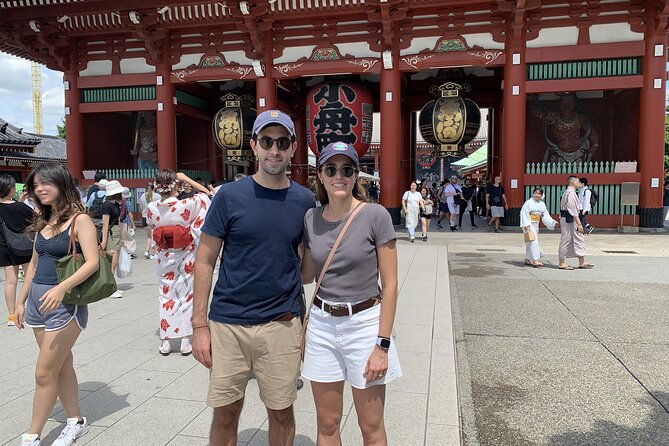
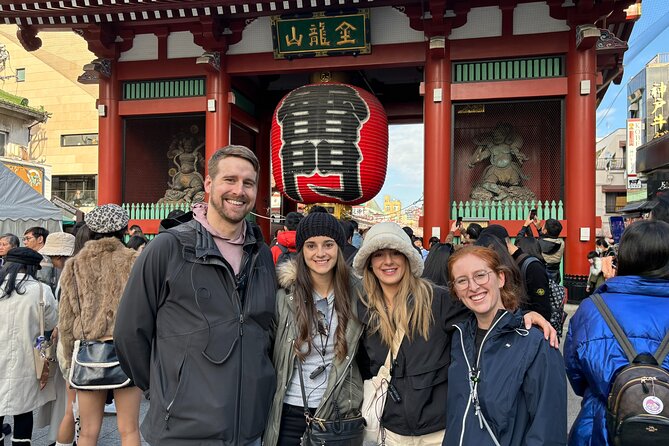
Kaminarimon means Thunder Gate. It is the outer gate leading toward Senso-ji and the first major visual welcome to the temple district.
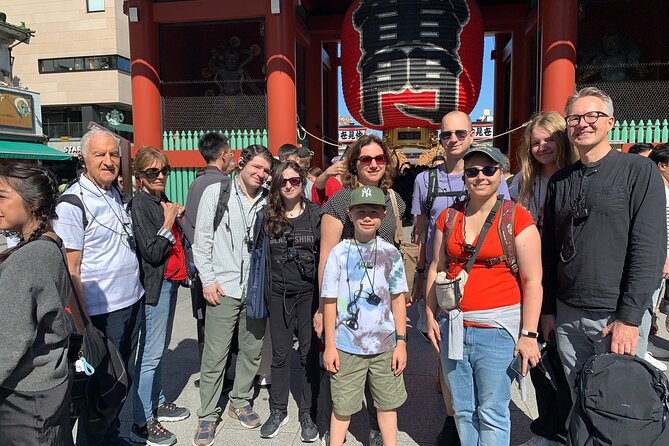
The huge red lantern draws nearly every camera. The guide explains the lantern and the surrounding statues, helping you understand that the gate is not merely a colorful entrance. The stop lasts around 15 minutes, which is enough for an explanation and photographs without making the group linger too long.
This is also where the difference between a guided visit and a solo stroll becomes clear. You can easily walk under the lantern by yourself, but you may not know what the figures represent or why this gate matters within the approach to Senso-ji.
Expect other people around you. Kaminarimon is one of Asakusa’s busiest points, and the tour does not remove you from the crowd. The headsets help here, especially when you want to look around while still following the guide.
A completely different kind of day out:
- Mt Fuji and Hakone 1-Day Bus Tour Return by Bullet Train
★ 5.0 · 26,383 reviews - TOKYO SKYTREE® Ticket
★ 4.7 · 25,136 reviews - teamLab Borderless Tickets: MORI Building DIGITAL ART MUSEUM
★ 4.7 · 24,126 reviews - teamLab Planets TOKYO Ticket
★ 4.7 · 21,663 reviews
Walking the 250 meters of Nakamise Street
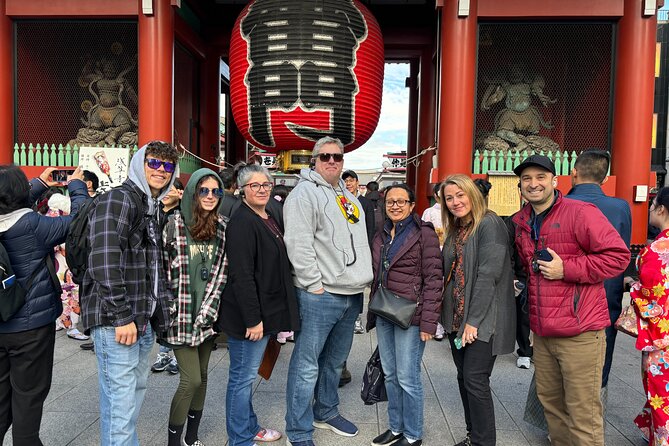
Nakamise Shopping Street runs about 250 meters from Kaminarimon to Senso-ji’s inner gate. Souvenir shops and food stalls line both sides, making this the most commercial stretch of the tour.
I would not treat Nakamise as a place to complete all your shopping during the walk. Two hours is a short window, and stopping at every stall would make it hard to keep up. Instead, use the guide’s local advice to note shops you may want to revisit later.
The guide also buys a traditional Asakusa snack for the group. The location can change based on your preferences, so this is not a fixed tasting menu. It is a modest inclusion, but a useful one: you get to try something local without having to guess which stall to choose.
The snack is also one reason to mention any preferences early. The supplied information does not specify the exact food, so do not book expecting a particular sweet or savory item. Think of it as a small sample connected to the neighborhood, not a full food tour.
Along the street, you see historical tablets explaining how Asakusa began and developed around Senso-ji. This gives the shopping street more meaning. Nakamise is not just a modern retail strip placed in front of a temple. It is part of the approach that has long supported the religious and social life of the area.
The itinerary gives this section about 30 minutes, the longest single stop. That makes sense. You need time to walk, listen, sample the snack, and take in the layers of old and new.
Entering Hozomon, the Treasure-House Gate
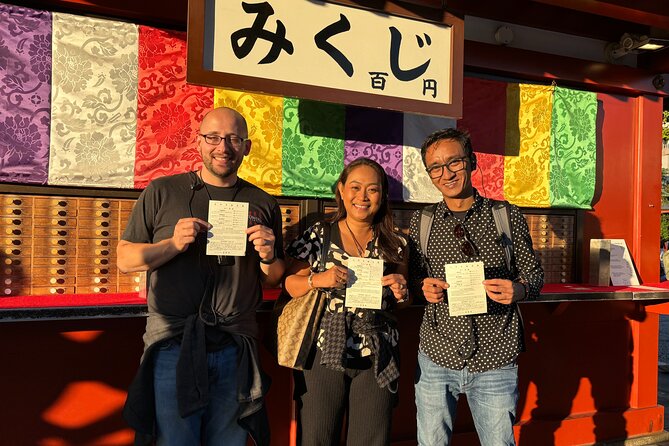
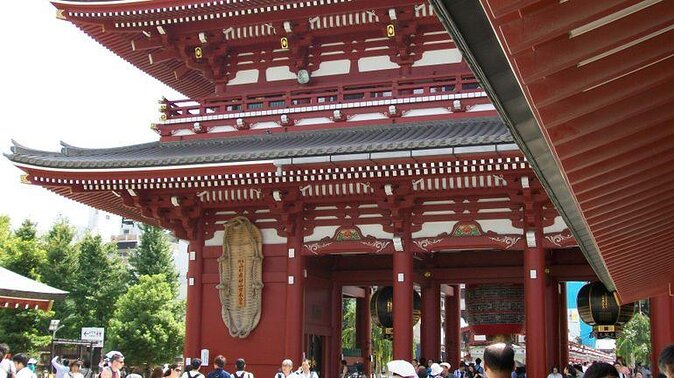
At the end of Nakamise, you reach Hozomon, the inner gate leading to Senso-ji. The two-story structure is called the Treasure-House Gate because the second floor holds temple treasures.
The first level contains two statues, three lanterns, and two large sandals. These details are easy to miss when you are focused on reaching the main hall. A guide can direct your eyes to the objects that give the gate its character.
The stop lasts about 15 minutes. That is enough for a close explanation, but not a full architectural study. If you have a particular interest in temple design, you may want to return later and look again at your own pace.
Hozomon also marks a useful shift in the walk. Nakamise is full of buying and browsing. Beyond this gate, the mood becomes more focused on worship and temple space, although the grounds remain active and full of people.
Understanding the rituals at Senso-ji Temple
Senso-ji is the heart of the experience. The temple is linked to a 1,400-year history, and the tour uses the space between Hozomon and the main hall to explain what you are seeing and how people use it.
The Five-storied Pagoda rises about 53 meters and is described as Japan’s second-highest pagoda. Its top floor holds Buddha’s ashes given by the Sri Lankan government. Even from ground level, the pagoda gives the temple grounds a strong vertical marker.
Before entering the main hall, you have three important things to observe or try. First, you may draw an omikuji, a paper fortune. This is a simple way to take part in a familiar Japanese temple practice, though the experience does not promise a particular result or interpretation beyond the guide’s explanation.
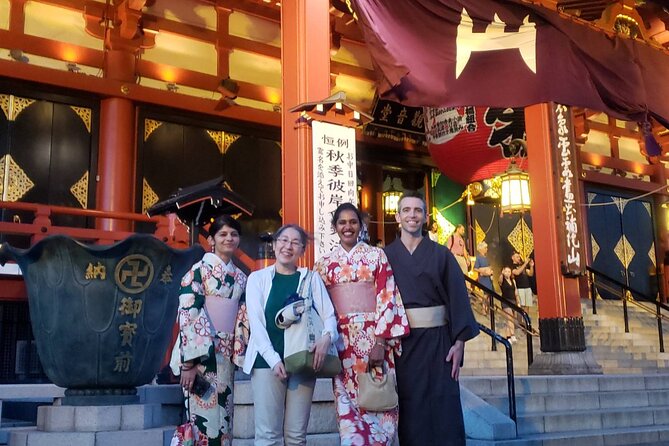
Second, you can stand near the large bronze incense burner and let the smoke pass over your hands and face. Many Japanese people do this as a ritual intended to ward off illness before prayer.
Third, you use the water purification fountain. The guide explains how worshipers purify themselves before approaching the hall. These actions may look like small customs, but they help you behave respectfully in a sacred place instead of treating it as a backdrop.
The listed timing for Senso-ji is about 15 minutes. That is the clearest drawback for anyone who wants a quiet temple visit. The tour introduces the main practices and features, but you will likely want to stay afterward if you wish to pray, draw a fortune at leisure, or study the pagoda and main hall more closely.
Why Asakusa Shrine belongs on this route
Asakusa Shrine sits on the same grounds as Senso-ji. For many people, this creates the most interesting question of the tour: how can a Buddhist temple and a Shinto shrine share the same setting and history?
The guide explains the relationship between the two faiths and how Buddhism and Shinto remain part of ordinary Japanese life. This is not a side note. It helps correct the assumption that Japanese religious buildings always function in separate worlds.
The 15-minute stop is short but well chosen. After learning about temple customs, you can see a Shinto shrine and compare the two traditions in one compact area. I consider this one of the strongest reasons to choose the guided walk instead of only photographing Senso-ji’s main gate.
The tour ends at Saryō Ichimatsu, 1-chōme-15-1 Kaminarimon, at the restaurant where the geisha activity is held. Hotel pickup is not included, so you make your own way to the starting point and continue independently after the finish.
Headsets, group size, and the morning pace
The maximum group size is 20 people. That is not a private tour, but it is manageable for a walking route through busy streets. The headsets are supplied for groups of three or more, and this feature receives particular praise because it lets you hear the guide clearly from a short distance.
That matters in Asakusa. You may want to stop for a photograph, look at a shopfront, or examine a gate while the guide continues speaking. Without audio equipment, you might miss key explanations. With it, you have a little more freedom while staying connected to the group.
The leisurely pace suits most people who can participate in a standard walking tour. You should still wear comfortable shoes and expect to remain on your feet for most of the two hours. The route has several short stops rather than one long indoor visit.
The 9:30 am start is practical. It leaves the afternoon open, and it puts the historical sights first on your schedule. Since the tour is often reserved about 30 days ahead, booking early is sensible if your Tokyo dates are fixed, especially when you want a particular morning.
Is $64.55 a fair price?
At $64.55 per person, this is not the cheapest way to see Asakusa. You can enter the public temple grounds without paying an admission fee, and you can walk the route independently.
The price pays for structure, live English guiding, local explanations, the snack, and headsets for qualifying groups. The value is strongest if you are a first-time visitor who wants to understand what you are seeing rather than simply collect photographs.
I would be less enthusiastic about the price if you already know Senso-ji well, speak Japanese comfortably, or prefer to spend an hour browsing shops at your own pace. The tour is an introduction, not a private history seminar or a food-focused outing.
The strong 4.9 rating from 32 submitted ratings and a 97 percent recommendation figure support the idea that the guiding is the main product. The most praised qualities are clear English, friendly guides, useful historical detail, and the ability to answer questions. One lower rating pointed to a lack of structure, and the provider acknowledged that too many details can sometimes crowd out the promised story. That is a fair caution: the experience depends greatly on how your guide balances facts and narrative.
Who will get the most from this walk?
I would recommend the tour most strongly to first-time Asakusa visitors, people interested in Japanese religious history, and anyone who prefers a clear route over independent research. Families and mixed-age groups may also appreciate the short stops, snack, and practical format.
It suits you if you want to ask questions. Guides such as Choco, Yasu, and Amy were praised for explaining clearly in English, and Amy was willing to help with shopping questions beyond the main route.
You may want to skip it if you have only a few hours and care mainly about shopping, or if you want a quiet, unhurried temple visit. In that case, a self-guided morning may give you more control.
Free cancellation is available up to 24 hours before the 9:30 am start. Changes or cancellations made inside that window are not accepted for a refund. Confirmation arrives when you book, service animals are allowed, and the activity is near public transportation.
Should you book the Asakusa history exploration?
Book it if you want Asakusa explained, not just photographed. The Sumida River viewpoint, eighth-floor city map, temple customs, traditional snack, and Buddhist-Shinto comparison create a well-shaped introduction to the district.
I would treat the two hours as a foundation. Afterward, stay in the area to revisit Senso-ji, shop along Nakamise, or explore at your own speed. At $64.55, the tour is best value when clear English guidance and historical meaning matter more to you than saving money.
FAQ
How long does the Asakusa history exploration last?
The experience lasts approximately two hours.
What time does the tour begin?
The tour starts at 9:30 am.
Where does the tour meet?
The meeting point is Burger King Asakusa Azumabashi, Bil Royal Palace, 2-chōme-20-6 Kaminarimon, Taito City, Tokyo 111-0034, Japan.
Where does the tour finish?
The tour ends at Saryō Ichimatsu, 1-chōme-15-1 Kaminarimon, Taito City, Tokyo 111-0034, Japan, at the restaurant where the geisha activity is held.
Is hotel pickup included?
No. Hotel pickup is not included.
What sights are included?
The route includes the Sumida River, Asakusa Culture Tourist Information Center, Kaminarimon Gate, Nakamise Shopping Street, Hozomon Gate, Senso-ji Temple, and Asakusa Shrine.
Is the tour conducted in English?
Yes. A local certified expert guide provides live guiding in English.
Are headsets provided?
Headsets are provided for groups of three or more so you can hear the guide clearly from a distance.
What is the cancellation policy?
You can cancel at least 24 hours before the experience start time for a full refund. Cancellations and changes made less than 24 hours before the start are not accepted for a refund.
Just added in Tokyo
- A One-of-a-Kind Sushi Experience in a Special Place of Japan★ 5.0 · 15 reviews
- Tokyo Cute Bento Cooking Class – Make a Kawaii Character Lunchbox★ 5.0 · 126 reviews
- Japanese Home Cooking Class & Walk in Todoroki Temple Tokyo★ 5.0 · 88 reviews
- Japan Tokyo Tower Observatory Deck E-Ticket★ 4.0 · 34 reviews
- Catch a Baseball Game in Tokyo with a Local – Tickets Included★ 5.0 · 24 reviews
- JDM Experience with Fast&Furious RX-7 (English speaking Driver)★ 5.0 · 57 reviews
- Tokyo Private Day Tour by Car with English speaking Driver Guide★ 4.0 · 29 reviews
- Japan Classic 10 Day – One Life Adventures★ 5.0 · 129 reviews
2-Hour Experiences, compared.
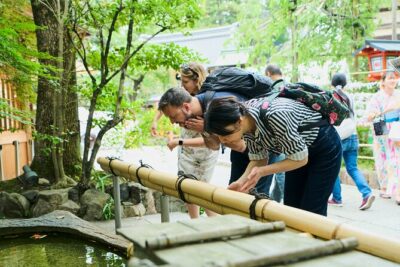
Kyoto Gion: 2-Hour Geisha Culture & History Walking Tour
Read our review →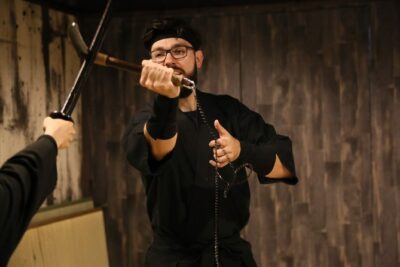
Ninja 2-hour Hands-on Lesson by Japanese master in Kyoto -Medium
Read our review →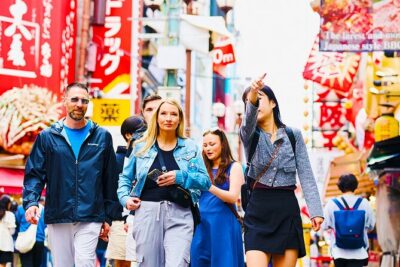
2-Hour Nightlife District Walking & Local Food Culture
Read our review →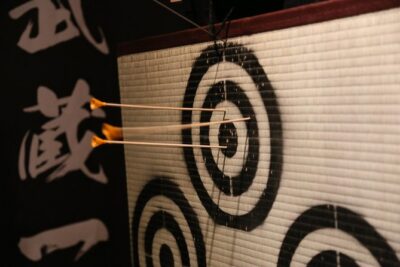
Ninja Samurai 2-hour hands-on lesson by Japanese master in Tokyo
Read our review →
Tokyo 2-Hour Genuine Samurai Experience: Kendo in Japan
Read our review →
2-Hour Local Street Food Tour – Dotonbori & Namba
Read our review →
Flagship 2-Hour Street Go-Kart Tour by Street Kart
Read our review →Browse the lists this tour appears in