
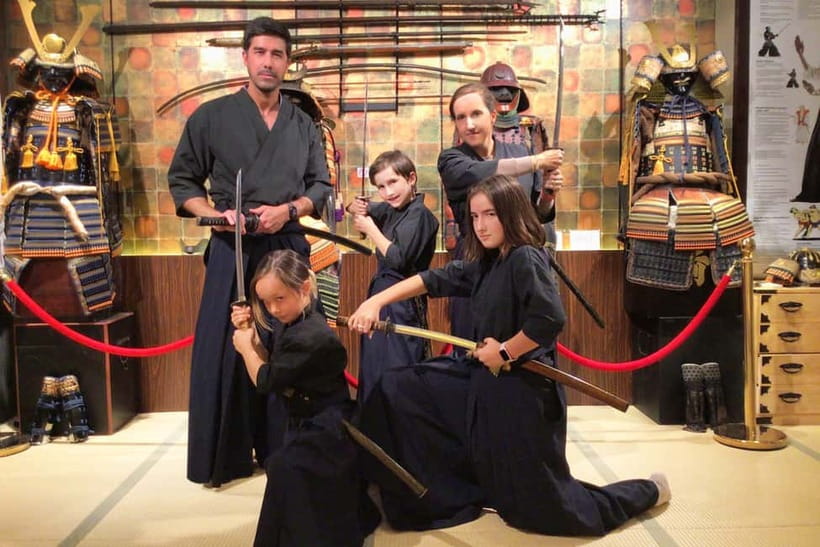
Reviewed · MUSEUMS AND GALLERIES
Kyoto : Family-Friendly Sword Lesson at Samurai Ninja Museum
Pick up a katana, then keep your balance. This two-hour Kyoto experience gives you samurai clothing and armor, a sword lesson, staged photographs, and a short look at Japan’s warrior past. I like the clear instruction, especially the chance to learn set movements rather than simply hold a prop, and I like the mix of serious practice with playful family fun.
The English-speaking instructors add a personal touch. Ken taught two kata, or choreographed movement sequences, while Raito earned praise as an experienced teacher, and Nobu and Jukia were also singled out for making the session enjoyable. The main consideration is value: at $66 per person, this is a paid activity built around costumes, instruction, and photos, and you must arrange your own transportation.
In This Review
- Kyoto samurai lesson at a glance
- Putting on the hakama and armor
- Watching the katana demonstration
- Learning about samurai and ninja culture
- Trying ninja weapons and posing for photos
- Why the two-hour format works
- Group size, accessibility, and family fit
- The $66 price and what you receive
- Getting there and planning your day
- Who should book this Kyoto experience
- Should you book the samurai lesson?
- FAQ
- How long does the samurai experience last?
- How much does the activity cost?
- Is the sword lesson taught in English?
- What is included in the price?
- Is transportation included?
- Can children participate?
- Is the venue wheelchair accessible and stroller accessible?
- Can I cancel the booking for a refund?
Kyoto samurai lesson at a glance
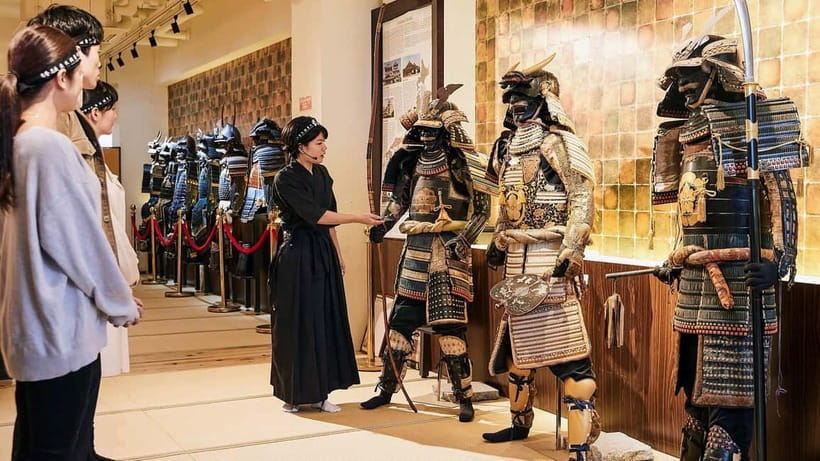
- Two hours of hands-on activity: You watch a sword demonstration, practice with a katana, try ninja weapons, and pose in themed settings.
- Traditional clothing is part of the fun: Hakama, samurai armor, and a helmet help turn a simple photo stop into a role-playing experience.
- Children under three cannot enter: Older children can take part, and the format is designed with families in mind.
- English instruction keeps the lesson accessible: The instructors explain the movements and guide the group through the activities.
- Small-group format is advertised: The experience is limited to 10 participants, although the venue information also gives a maximum capacity of 22.
- The price includes equipment and costumes: Transportation to and from the activity is not included, so add that cost and time to your plans.
Putting on the hakama and armor
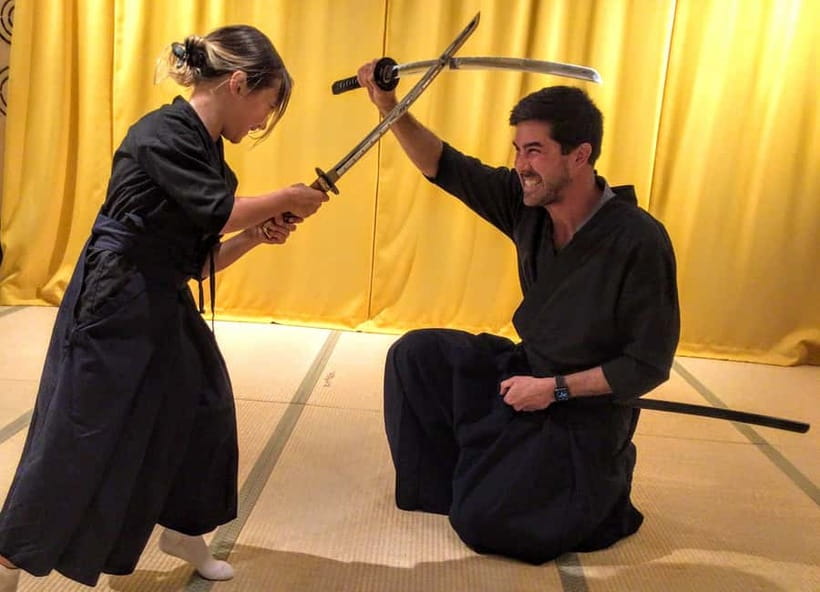
The experience begins with the visual transformation. You put on hakama, the pleated trousers associated with formal Japanese dress, then use a samurai helmet and armor for the full effect. For children, this is often the moment when the activity changes from a museum visit into a game they can understand immediately.
I like that the clothing is not treated as an optional extra. It gives the sword lesson a sense of occasion and makes the photographs more memorable. You are not simply standing beside a display case holding a wooden sword. You are dressed for the part before the instructor asks you to move.
The costume also helps families take part together. Adults can join the children instead of watching from the side, which makes the activity feel shared rather than like a performance arranged only for younger visitors. The experience is suitable for most participants, and the venue is wheelchair accessible and stroller accessible.
Still, you should allow a little patience for changing clothes and getting ready. The supplied information does not give a detailed minute-by-minute schedule, so the exact amount of time spent in costume may depend on group size and the day’s pace.
More Castles and Historic Sites in Kyoto
- Kyoto Samurai Experience
★ 5.0 · 1,294 reviews - Kyoto: Nijo-jo Castle and Ninomaru Palace Guided Tour
★ 4.7 · 1,020 reviews - Kyoto: Kendo and Samurai Experience with Uniform and Gear
★ 4.9 · 815 reviews
Watching the katana demonstration
Once dressed, you watch an instructor demonstrate how to swing a sword properly. This matters because the lesson is not presented as a free-for-all with sharp-looking props. The basic appeal is learning a controlled sequence, with the instructor showing the movement before you copy it.
The English-language teaching is useful here. You do not need prior knowledge of martial arts, and the activity is designed for ordinary sightseers rather than trained swordspeople. Follow the instructor’s pace and keep your attention on form, position, and timing instead of trying to make the biggest swing.
Ken taught two kata during one family visit. A kata is a set sequence of movements, so learning two of them gives you something concrete to remember after the session. That is a better souvenir than a quick pose because you leave with a small sense of how disciplined movement works.
Raito was also praised as an experienced teacher, while Nobu was described as fantastic. Those comments fit the key strength of this activity: the instructor shapes the mood. A good teacher can make the session feel focused without making it stiff, and the available feedback points to a friendly teaching style.
You should not expect a full martial arts course in two hours. The lesson is an introduction and a cultural activity, not professional sword training. The value comes from trying the movements under direction, hearing some background about samurai, and enjoying the setting.
Learning about samurai and ninja culture
The sword lesson is paired with information about samurai history. The supplied details do not promise a long museum lecture, so I would think of this part as context for the activity rather than a full historical tour.
That balance works well for a family outing. Younger children may not sit happily through a long talk, but they can connect the helmet, armor, sword, and demonstrations with the people who used these tools and styles. Adults get enough background to place the activity in a wider Japanese cultural setting.
The experience also includes a visit to a samurai and ninja museum area. One family described the guided museum portion as interesting, with the most playful moments coming afterward during the ninja weapons trial and costume photographs. That tells you how the visit is likely to feel: the museum adds context, while the hands-on activities supply the biggest smiles.
The ninja portion is a useful change of pace. After working through controlled katana movements, you get to try ninja weapons, including shuriken target throwing. The activity gives children a new task and keeps adults involved, but you should regard it as a supervised demonstration and trial rather than a serious weapons course.
Trying ninja weapons and posing for photos
Themed photo opportunities are included, with studio-style or samurai-themed backgrounds. You can pose with swords, armor, and ninja equipment, giving your family a record of the day that feels more distinctive than a standard group photograph outside a tourist site.
I especially like this part for mixed-age groups. A child who is less interested in historical explanation can still enjoy dressing up and posing. An adult who wants more than a costume picture gets the sword lesson and museum visit first.
The photographs also give the session a clear rhythm. You learn, try, and then pause for pictures. That makes the activity easy to follow, even for a family with different energy levels.
Do not expect the photos to replace a professional studio session. The information promises themed opportunities and poses, not a dedicated photographer or a stated number of finished images. Bring your own phone or camera if you want to preserve the moment, and be ready to follow the staff’s directions about where and how to pose.
The playful tone is part of the attraction. One French family described getting caught up in the role, which is exactly the point. You may arrive thinking this will be a slightly silly photo stop, then find yourself taking the kata seriously for a few minutes before laughing at the helmet and armor pictures.
More Museums and Galleries in Kyoto
- teamLab Biovortex Kyoto ticket
★ 4.8 · 3,186 reviews - Kyoto: Tea Museum Tickets and Matcha Grinding Experience
★ 4.9 · 739 reviews - Skip the lines Basic Ticket at SAMURAI NINJA MUSEUM KYOTO
★ 4.5 · 632 reviews - Kyoto : Geiko Maiko Dance of Kyoto & Visits of Gion Museum
★ 4.6 · 415 reviews
Why the two-hour format works
Two hours is long enough to make the outing feel substantial without taking an entire day from Kyoto sightseeing. You get several different elements: clothing, instruction, samurai background, museum material, ninja weapons, and photos.
That variety is important at $66 per person. If the experience offered only a costume and a picture, the price would be harder to defend. The sword lesson and guided content give you more to do, while the family focus helps everyone take part.
The time also suits Kyoto’s crowded sightseeing schedule. You can fit the activity between other plans, though you should allow extra time for reaching the venue since transportation is not included. The attraction is near public transportation, which makes independent arrival practical, but you still need to check the starting time and plan your route.
The exact order of activities can vary. You might begin with changing clothes, then move to the sword demonstration, or visit the museum area before the weapons trial. The important point is to arrive ready for a structured session rather than a drop-in exhibit.
Group size, accessibility, and family fit
The activity is promoted as a small group limited to 10 participants. That is a useful size for a lesson because the instructor can watch each person more easily than in a large class. It should also make the costume process and photo turns less chaotic.
At the same time, the activity information gives a maximum of 22 travelers. Because those figures do not match exactly, I would confirm the expected group size when booking if a quiet class is important to you. The 10-person limit may describe the standard small-group format, while 22 may refer to an overall venue or activity capacity.
Most people can participate, and the venue is wheelchair accessible and stroller accessible. Those are meaningful advantages for a family itinerary, though accessibility does not tell you every detail about changing clothes, movement during the sword lesson, or access to each photo area. If your group has specific mobility needs, contact the provider before booking.
Children under three cannot enter the samurai venue. Older children are the clearest audience for the experience, especially those who enjoy dressing up, short demonstrations, and active participation. Teenagers may also appreciate the chance to learn the kata and pose with armor without being treated as small children.
Adults should join in. The session works best when parents and children become part of the same story, rather than having one person hold the camera throughout.
The $66 price and what you receive
At $66 per person, the cost includes the samurai sword lesson, hakama, helmet, armor, themed photo opportunities, and ninja weapons trial. It also includes English instruction and the museum-related portion described in the experience.
I see the price as reasonable for a family seeking a contained, hands-on activity in Kyoto. You are paying for staff time, equipment, costumes, guidance, and a two-hour program. It is not the cheapest way to see samurai-related material, but it offers active participation that a standard museum ticket would not.
The value drops if only one member of your group wants to participate. The price is charged per person, and transportation is extra. For a family of four, the total becomes a significant part of the day’s budget, so book it because your group wants the activity, not simply because the title sounds fun.
The free cancellation policy helps reduce the risk. You can cancel up to 24 hours in advance for a full refund, and the reserve-now, pay-later option lets you hold a place without paying immediately. Those terms are useful in Kyoto, where weather, fatigue, and shifting sightseeing plans can affect a family schedule.
Getting there and planning your day
Transportation to and from the activity is not included. The venue is near public transportation, so you can make your own way there, but your booking does not function as a hotel pickup or guided transfer.
I would avoid placing this activity at the end of a tightly timed day. The session lasts two hours, and you need to account for the journey to the venue, finding the entrance, and continuing to your next stop. Check the available starting times before building the rest of your itinerary.
The experience can pair well with other central Kyoto plans because it does not take a full day. Keep the surrounding schedule flexible enough to handle a late train, a slow family lunch, or extra time changing into the costume.
Confirmation is provided at booking. Since the activity has a scheduled start time and limited capacity, arrive with your confirmation ready and do not treat it like an attraction you can enter whenever convenient.
Who should book this Kyoto experience
I would recommend it most strongly to families with children over three who want an activity everyone can join. It is also a good fit for adults who enjoy Japanese history but prefer a hands-on program to a quiet museum visit.
The experience suits you if you want:
- A guided introduction to samurai movements
- Costumes and armor for family photographs
- English instruction
- A short museum visit paired with active tasks
- A small-group setting
- An activity that works for different ages
I would hesitate if you want advanced sword training, a long historical lecture, or a private photo shoot. The program is light, social, and carefully arranged for fun. Its strength is variety, not technical depth.
The guide can shape the experience, so names such as Ken, Raito, Nobu, and Jukia are worth noting when you see them in your booking details. The personal teaching style has been one of the most praised parts of the activity, especially when instructors help families relax and take the role-playing seriously enough to enjoy it.
Should you book the samurai lesson?
Book it if your family wants to do something active and memorable between Kyoto’s temples and gardens. The combination of two kata, armor, museum context, ninja weapons, and photos gives the $66 fee a fair case, particularly when adults participate too.
Skip it if your budget is tight or your group would rather spend the money on a major historical site. The experience does not include transportation, and the sword lesson is an introduction rather than formal training.
For most families with children over three, I would call this a strong Kyoto add-on. It offers a clear schedule, English guidance, accessible facilities, and enough variety to keep the session moving. Just confirm the group-size details and plan your route before you go.
FAQ
How long does the samurai experience last?
The experience lasts two hours.
How much does the activity cost?
The listed price is $66 per person.
Is the sword lesson taught in English?
Yes. English instruction is provided.
What is included in the price?
The price includes the samurai sword lesson, hakama, a samurai helmet, samurai armor, themed photo opportunities, and a ninja weapons trial.
Is transportation included?
No. Transportation to and from the activity is not included.
Can children participate?
Children can participate if they are at least three years old. Children under three cannot enter the samurai venue.
Is the venue wheelchair accessible and stroller accessible?
Yes. The venue is wheelchair accessible and stroller accessible.
Can I cancel the booking for a refund?
Yes. You can cancel up to 24 hours in advance for a full refund.
Just added in Kyoto
- The “Golden Route” and Ancient Japan by DIAMIR Erlebnisreisen – 14-Day Tour★ 2.0 · 2 reviews
- Japan: Castles & Cuisine by G Adventures – 6-Day Kyoto to Osaka Tour★ 4.5 · 4 reviews
- Cycle Japan by Explore! – 13-Day Kyoto to Tokyo Tour★ 4.7 · 12 reviews
- Cycle Japan by Intrepid Travel – 11-Day Kyoto to Tokyo Tour★ 4.8 · 2 reviews
- Classic Japan by Intrepid Travel – 11-Day Kyoto to Tokyo Tour★ 4.4 · 14 reviews
- Ancient & Modern Japan 14-Day Tour by Exodus Adventure Travels★ 4.4 · 40 reviews
- 5 Day Cultural Adventure of Kyoto, Nara & Osaka by Tourist Journey★ 2.5 · 2 reviews
- 12 Days Kinosaki Onsen Escape: A Journey Through Japan’s Timeless Towns by UME Travel★ 4.8 · 5 reviews
Museums and Galleries, compared.

teamLab Borderless Tickets: MORI Building DIGITAL ART MUSEUM
Read our review →

teamLab Planets TOKYO Digital Art Museum Entry Ticket
Read our review →


Browse the lists this tour appears in