
Reviewed · CASTLES AND HISTORIC SITES
Kyoto: Samurai Kenbu Traditional Sword Dancing Show
Samurai swordplay is quieter than Hollywood suggests. Kyoto’s Samurai Kenbu Theater presents Kenbu as a graceful art built around poems, ceremony, and controlled sword movement. I like the clear English narration and the chance to hold a sword after the performance. My main caution is simple: this is staged cultural theater, not a long sword-fighting match.
The one-hour format works well in a busy Kyoto schedule, and the small-scale setting can make the presentation feel personal. At $32 per person, I consider it good value if you want history, performance, and a short hands-on lesson in one stop. If you mainly want action scenes, the show may feel too restrained.
In This Review
- Key points to know before you go
- Kyoto’s samurai show is more graceful than combative
- Arriving at the Samurai Kenbu Theater
- The opening lesson explains what Kenbu means
- Short stories bring samurai culture onto the stage
- English narration gives the show useful context
- The sword lesson is short, careful, and fun
- Save your camera for the final photo session
- Is $32 good value for one hour?
- Who will enjoy this Kyoto activity most?
- Practical booking advice for a smooth visit
- Should you book the Samurai Kenbu show?
- FAQ
- How long does the Samurai Kenbu show last?
- How much does the experience cost?
- Where does the activity take place?
- How do I reach the theater?
- How early should I arrive?
- Is the show available in English?
- Can I take photos during the performance?
- Can I handle a samurai sword?
Key points to know before you go
- Kenbu follows samurai poems: Performers match sword movements to poems once recited before battle.
- The English narration matters: Short explanations give each dance historical and cultural context.
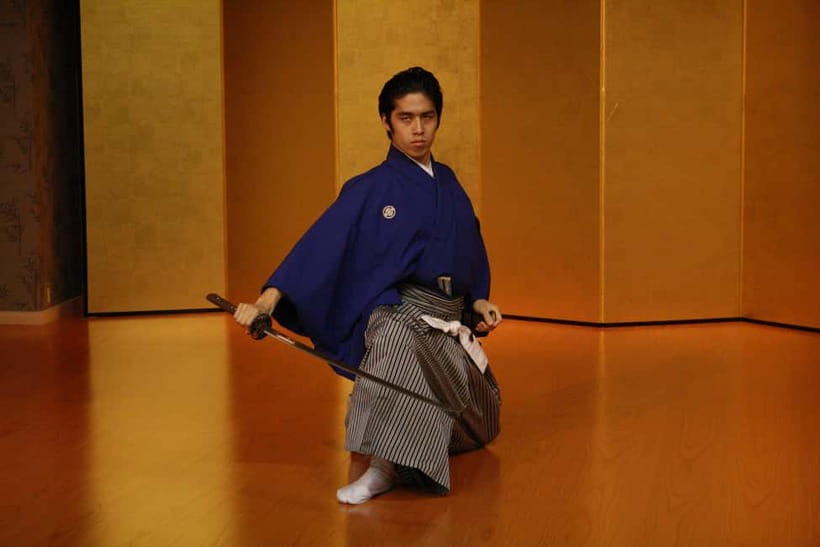
- You handle a real sword: The mini-lesson covers drawing, holding, and gentle swinging under instruction.
- The show mixes old and new styles: You see traditional Kenbu alongside newer performance forms.
- Photos wait until the end: Cameras and video are not allowed during the show, but a post-show photo session is provided.
- It is easy to reach: The theater is a four-minute walk from Sanjo Keihan Subway Station and five minutes from Keihan Sanjo Station.
Kyoto’s samurai show is more graceful than combative
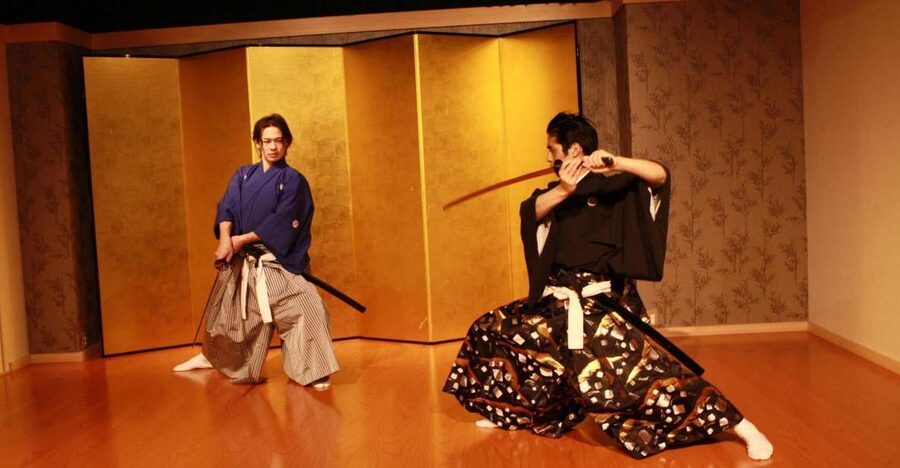
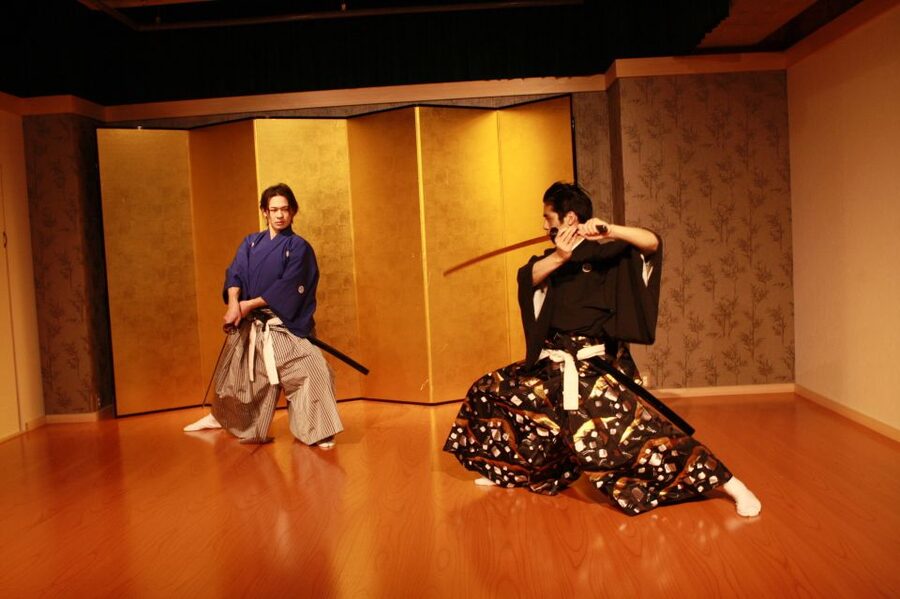
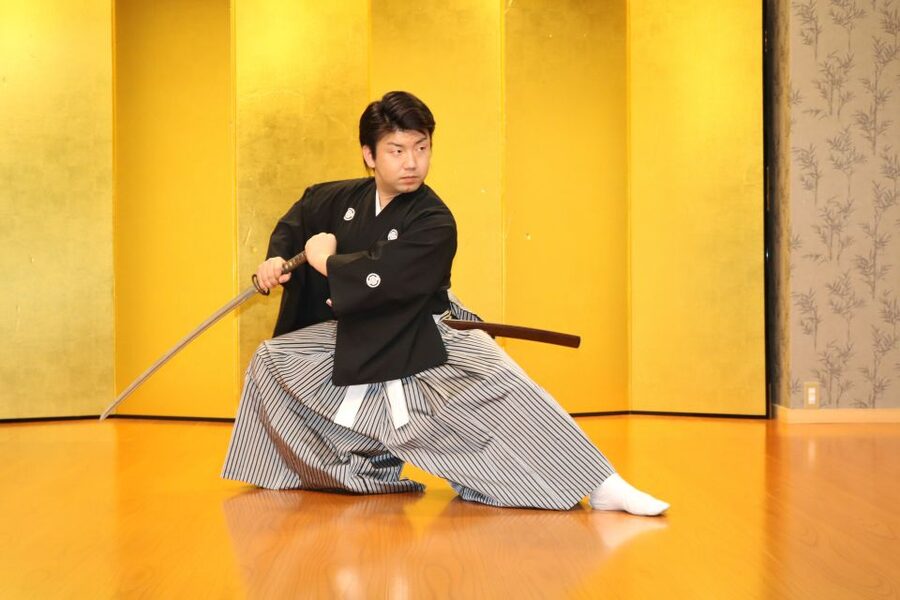
Kenbu, sometimes written Kembu, is traditional Japanese sword dancing. It is not the same as watching a staged duel or a modern martial arts tournament. The performers use the sword, scabbard, folding fan, posture, and precise footwork to express stories connected with samurai life.
That difference is important. The sword is not simply a weapon in this performance. It carries duty, discipline, status, and the burden of responsibility. The show uses movement to suggest the emotional world of a samurai preparing for conflict, rather than rushing from one fight to another.
I like this approach because it gives you a more thoughtful view of samurai culture. The movement can look calm, even beautiful, but the stories also touch on loyalty, danger, sacrifice, and death. One comic touch in a story, noted by a visitor named Heidi, helped keep the performance from becoming too solemn.
The program looks back more than 700 years, covering the feudal period from the 12th through the 19th centuries. You hear an English introduction to Kenbu and short background explanations before the dances. These explanations help you understand what the performers are expressing instead of leaving you to guess.
More Castles and Historic Sites in Kyoto
- Kyoto Samurai Experience
★ 5.0 · 1,294 reviews - Kyoto: Nijo-jo Castle and Ninomaru Palace Guided Tour
★ 4.7 · 1,020 reviews - Kyoto: Kendo and Samurai Experience with Uniform and Gear
★ 4.9 · 815 reviews
Arriving at the Samurai Kenbu Theater
The theater is in central Kyoto, close to two useful train and subway connections. From Sanjo Keihan Station on the Kyoto City Subway, it is about a four-minute walk. From Sanjo Station on the Keihan Main Line, allow about five minutes.
I would arrive 5 to 15 minutes before the scheduled start. That gives you time to find the entrance, confirm your reservation name at reception, and remove your shoes. Taking off your shoes is part of the local custom here, so wear socks you are comfortable being seen in.
The venue does not have room for large luggage or travel bags. You also cannot use the room as a waiting area if you arrive without an appointment. That makes this a poor place to visit directly from a train station with a large suitcase. Leave bulky bags at your hotel or arrange storage before you come.
The theater is wheelchair accessible, which makes the activity easier to consider for a wider range of visitors. Since the supplied details do not explain the exact seating arrangement or floor transitions, you may want to confirm any specific mobility needs before booking.
The opening lesson explains what Kenbu means
The performance begins with an introduction to the history and techniques of Kenbu. The instructor speaks in English and Japanese, and the English narration is designed to help an international audience follow the action.
This opening is not filler. Kenbu can look mysterious if you do not know why the dancer pauses, turns, lowers the sword, or raises the fan. The introduction gives you a basic visual vocabulary for the rest of the show.
You learn that samurai once recited poems before going into battle. The dancers then use their swords to follow the mood and images of those poems. A sweeping motion might suggest resolve or sorrow. A sudden change in stance can signal danger or a challenge.
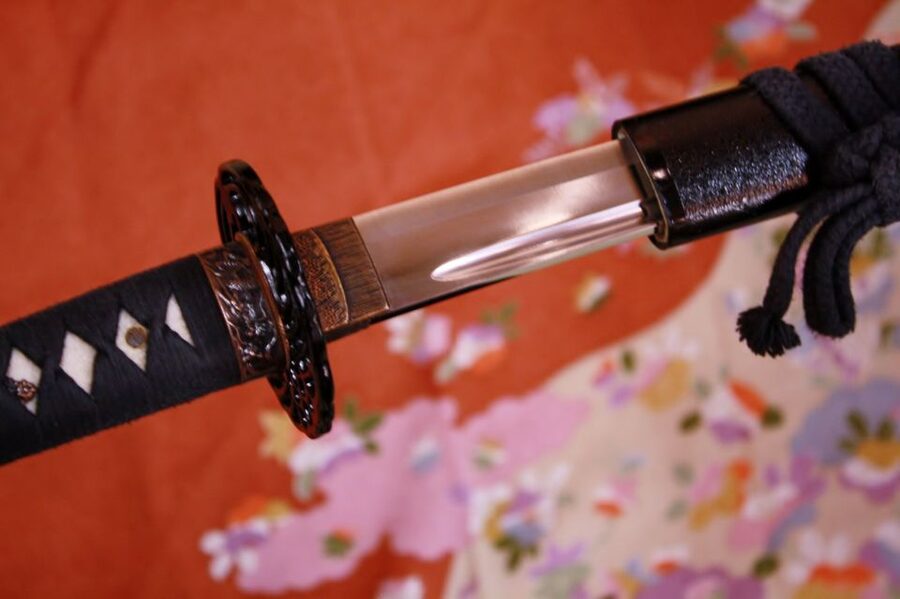
The show also explains the responsibility of carrying a samurai sword. That point adds weight to the later sword lesson. You are not simply handed a prop for a quick photo. The instructors first place the katana within a larger set of customs and obligations.
Some English explanations may be easier to follow than others. Heidi found parts of the narration difficult to understand, while other visitors praised the educational content. If English is not your first language, pay attention to the demonstrations as well as the spoken explanation. The movements often make the story clearer.
Short stories bring samurai culture onto the stage
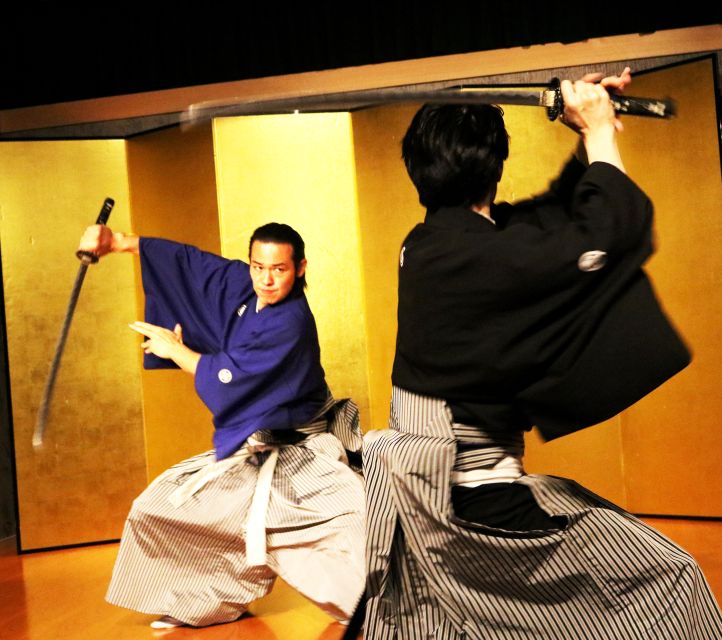
The main performance is arranged as a series of short pieces. Each section comes with a brief explanation of the samurai culture and historical setting behind it. This structure is useful because you get several examples of Kenbu instead of one long story that might be hard to follow.
The performers swing their swords in carefully controlled sequences. The blade, scabbard, and body all work together. A dancer may draw the sword slowly, hold a formal stance, turn with a wide arc, then return to stillness. The contrast between sudden movement and quiet control is part of the art.
The stage is not described as large, and one older comment wished for a bigger stage and more fighting. Keep that in mind. The compact setting favors precision and close observation, not huge stage effects.
I think that smaller scale suits Kenbu. You can focus on the performers’ balance, hand positions, and timing. Three dancers may seem to fill the stage through movement alone, even without elaborate scenery.
The presentation includes traditional-style Kenbu and newer-style Kenbu. That gives you a useful comparison. The traditional pieces connect more directly with historical forms, while the newer material shows how the art can be presented to a modern audience.
The performers also use folding fans. In samurai culture, the fan was more than decoration. Here it becomes part of the movement vocabulary, adding a different shape and rhythm to the sword work. If you are interested in Japanese performance traditions, this is one of the more distinctive parts of the hour.
A completely different kind of day out:
- PERFECT KYOTO 1-Day Bus Tour
★ 5.0 · 13,518 reviews - [Kyoto & Nara Day Tour] Sagano Scenic Railway & Nara Park & Fushimi Inari Taisha Thousand Torii Gates & Togetsukyo Bridge & Bamboo Grove & Kimono Forest (Departing from Osaka)
★ 4.9 · 10,942 reviews - Kyoto: Fushimi Inari, Kinkakuji, Bamboo Grove 1 Day Bus Tour
★ 4.8 · 4,316 reviews - Kyoto: Tea Ceremony in a Traditional Tea House in Kiyomizu
★ 4.9 · 3,519 reviews
English narration gives the show useful context
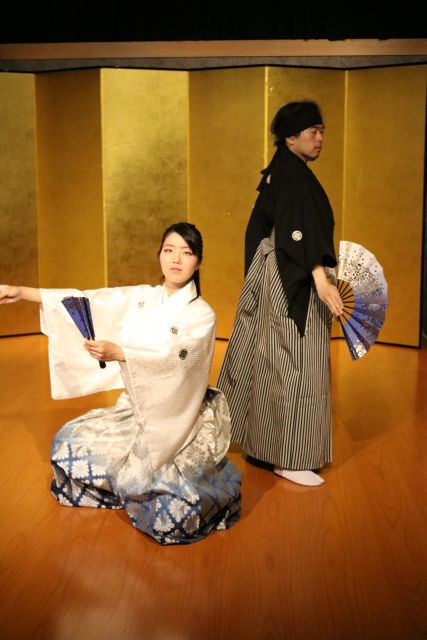
The English narration is one of the strongest reasons to choose this performance over a purely visual stage show. You receive the story before the dance, then watch the performers turn that explanation into movement.
That format works especially well for first-time visitors to Japan. You do not need prior knowledge of samurai history or Japanese theater. The material remains accessible, while the performance gives you something more substantial than a costumed photo opportunity.
The tone is usually serious, but not stiff. The instructors use humor during the audience lesson, and the performers are described as friendly and welcoming. Chris, who attended in February 2025, particularly enjoyed the combination of drama, information, and relaxed teaching at the end.
The narration is still a live presentation, not an audio guide. Pace, pronunciation, and subject matter can affect how easily you follow every detail. If a particular historical point interests you, treat the show as an introduction and continue reading later.
The sword lesson is short, careful, and fun
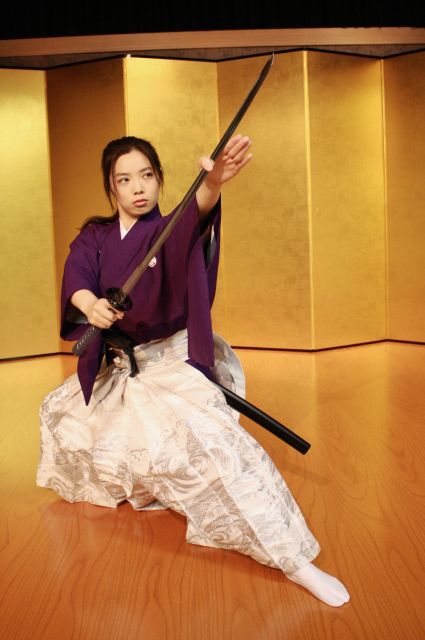
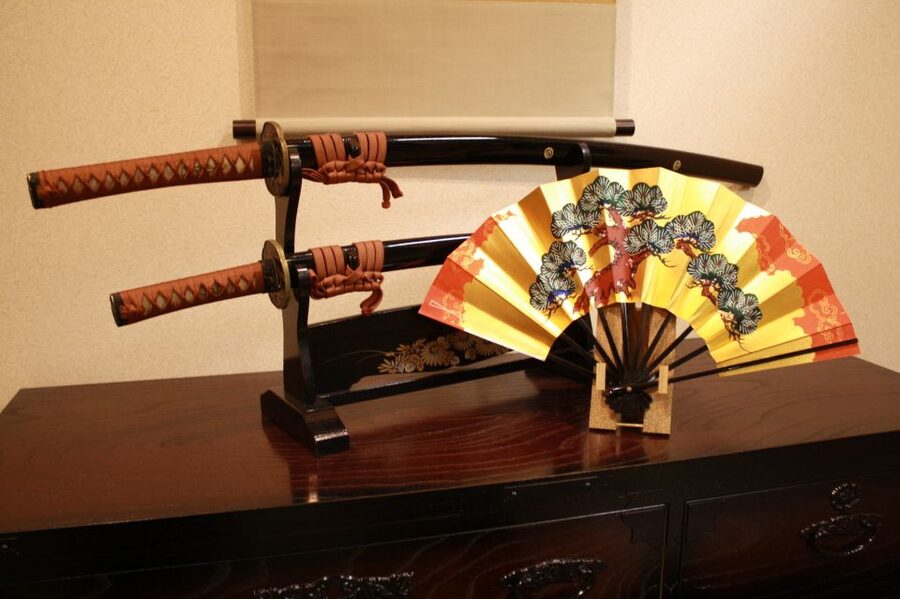
After the main show, the performers return for the interactive part. You get the chance to hold a sword, draw it slowly from the scabbard, and practice basic movements under an instructor’s direction.
The lesson begins gently. You learn how to grip the sword and follow simple commands before swinging with more force. This is not a full martial arts class, and the short format does not turn you into a samurai. It does, however, give you a better sense of the weight, balance, and control required to make the performance look effortless.
That physical contrast is valuable. On stage, the swordsmen make each movement appear easy. Once you hold and swing a katana yourself, you may notice how much posture and timing matter.
Depending on time, you may also learn how to use the folding fan. The lesson can be slightly less organized than the show itself, according to Snehal, but the informal style appears to be part of the charm. The instructors use humor and encouragement to put people at ease.
You may hear traditional shouts or practice basic stances. The details of the lesson can vary with the group and the time available, so think of it as a short taste rather than a fixed training program.
Save your camera for the final photo session
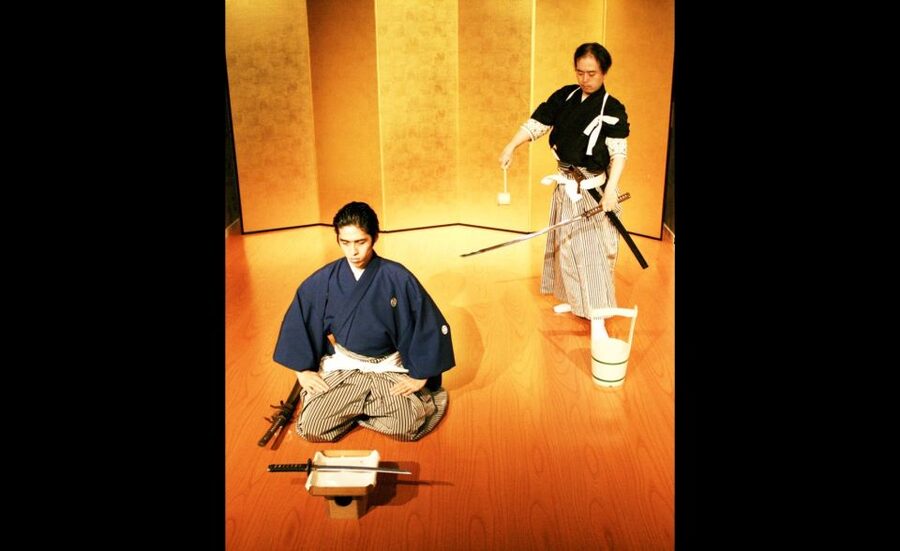
Photography and video are not allowed during the performance. That rule may disappoint you at first, especially when the dancers make a dramatic turn or hold a beautiful pose. It also means the audience can watch without phones raised in front of them.
After the show, you have time to take photographs with the performers. You can pose while holding the sword, and the staff can take pictures for you. This is when you should bring out your camera.
The final photo session adds a friendly, informal finish. It also gives families and groups a chance to leave with a record of the activity without interrupting the stage presentation. Several people particularly enjoyed this part, and it often becomes the most playful moment of the hour.
Remember that the sword handling remains supervised. Follow the instructor’s commands and handle the equipment with care. The point is to experience the form and ceremony, not to swing wildly for a dramatic picture.
Is $32 good value for one hour?
The price is $32 per person. That includes theater admission, the Kenbu performance, and the short sword lesson. Food, drinks, and transportation are not included, but neither is necessary for such a compact activity.
I see the value in the combination. A standard stage show might give you entertainment but no chance to handle the equipment. A cultural demonstration might explain the tradition but lack the polish of a formal performance. This hour provides history, live theater, a short practical lesson, and photographs afterward.
The value is strongest if you enjoy Japanese culture, history, traditional arts, or family activities. It also works well for a first visit to Kyoto because the explanations help place the samurai within a wider cultural setting.
The value is weaker if you expect a large production, extended sword combat, or a full afternoon activity. One person felt the program ran 5 to 10 minutes too long, while another felt the time passed quickly. That difference reflects personal taste. The show is tightly timed, but the narration and several performance pieces may feel slow if you want constant action.
With an overall rating of 4.5 from 426 ratings, the experience has a strong record of satisfaction. More important than the number is the pattern: praise centers on the performers’ skill, the clear cultural explanation, the friendly teaching, and the hands-on sword practice.
Who will enjoy this Kyoto activity most?
I would recommend the show to:
- Families looking for a short cultural activity, including families with older children
- History fans who want more than a samurai costume photo
- Visitors who enjoy theater, dance, and traditional Japanese arts
- First-time visitors who want an English introduction to samurai culture
- Couples or friends who want a shared activity with photographs afterward
- Anyone curious about how a katana feels in the hand
The performance also suits people who prefer a calm, indoor activity. It does not depend on weather, and the one-hour length leaves room for nearby sightseeing, dinner, or an evening walk through Kyoto.
I would think twice if you have no interest in history or staged performance. You may also be disappointed if your main goal is realistic sword fighting. The show presents controlled artistic movement and historical storytelling, not a combat lesson.
Practical booking advice for a smooth visit
Book a starting time that leaves you enough margin to reach central Kyoto without rushing. The theater asks you to arrive 5 to 15 minutes early, and you will need time to remove your shoes and check in.
Keep your luggage small. Large travel bags have no place in the theater, and there is no waiting room for people who arrive without an appointment. Do not arrive under the influence of alcohol, since the venue specifically asks you not to do so.
The experience is offered in English and Japanese. Confirmation is provided at booking, and staff confirm the reservation name at reception. If your plans change, you can cancel up to 24 hours in advance for a full refund, or use the reserve-now, pay-later option to keep your schedule flexible.
Should you book the Samurai Kenbu show?
Book it if you want an hour that combines elegant performance, samurai culture, and hands-on practice. The English narration makes the stories accessible, and the sword lesson gives the activity a satisfying personal touch.
Skip it if you are seeking a big theater, extended fight scenes, or a serious martial arts course. For everyone else, $32 is a fair price for a polished cultural introduction with skilled performers, a practical lesson, and a photo session that lets you play samurai for a few minutes.
FAQ
How long does the Samurai Kenbu show last?
The activity lasts one hour, including the Kenbu performance and the short sword lesson.
How much does the experience cost?
The price is $32 per person.
Where does the activity take place?
It takes place at the Samurai Kenbu Theater in Kyoto, on Honshu.
How do I reach the theater?
The theater is a four-minute walk from Sanjo Keihan Subway Station and a five-minute walk from Sanjo Station on the Keihan Main Line.
How early should I arrive?
You should arrive 5 to 15 minutes before the activity begins.
Is the show available in English?
Yes. The instructors speak English and Japanese, and the traditional stories receive English narration.
Can I take photos during the performance?
No. Photos and videos are not allowed during the show. You can take photographs after the performance when the performers return for the photo session.
Can I handle a samurai sword?
Yes. The included short lesson lets you hold a sword, draw it from the scabbard, and practice gentle swings under instruction. If time permits, you may also learn to use a folding fan.
More Show in Kyoto
- Kyoto Sumo Show with Experience & Photo, 2 Drinks Included
★ 5.0 · 941 reviews - Kyoto: Sumo Experience (with Live Show & Audience Challenge)
★ 5.0 · 519 reviews - Kyoto Gion Cultural Walk & Geisha Show with Dining Options
★ 5.0 · 518 reviews - Kyoto Gion Cultural Walk & Geisha Show with Dining Options
★ 5.0 · 483 reviews
Just added in Kyoto
- The “Golden Route” and Ancient Japan by DIAMIR Erlebnisreisen – 14-Day Tour★ 2.0 · 2 reviews
- Japan: Castles & Cuisine by G Adventures – 6-Day Kyoto to Osaka Tour★ 4.5 · 4 reviews
- Cycle Japan by Explore! – 13-Day Kyoto to Tokyo Tour★ 4.7 · 12 reviews
- Cycle Japan by Intrepid Travel – 11-Day Kyoto to Tokyo Tour★ 4.8 · 2 reviews
- Classic Japan by Intrepid Travel – 11-Day Kyoto to Tokyo Tour★ 4.4 · 14 reviews
- Ancient & Modern Japan 14-Day Tour by Exodus Adventure Travels★ 4.4 · 40 reviews
- 5 Day Cultural Adventure of Kyoto, Nara & Osaka by Tourist Journey★ 2.5 · 2 reviews
- 12 Days Kinosaki Onsen Escape: A Journey Through Japan’s Timeless Towns by UME Travel★ 4.8 · 5 reviews
Castles and Historic Sites, compared.


Imperial Palace and Shogun Historical Walking Tour
Read our review →
Tokyo Castle & Imperial PalaceーShogun Walking Tour
Read our review →
Nijo-jo Castle and Ninomaru Palace Guided Tour
Read our review →
Samurai Ninja Museum Guided tour and Experience
Read our review →Browse the lists this tour appears in