
Reviewed · MUSEUMS AND GALLERIES
Kyoto: Samurai Ninja Museum guided tour
History gets hands-on here. Kyoto’s Samurai Ninja Museum turns a one-hour visit into a lively lesson, pairing English guidance with armor displays, costume photos, replica weapons, and a shuriken throwing activity. I like the clear focus and the chance to handle themed equipment instead of only looking behind glass. The guides, including Mami, Miu, Sayo, Akiko, and Ko, are repeatedly praised for making the story easy to follow.
I especially like the small-group format and the mix of instruction and play. You learn how samurai and ninja fit into Japanese history, then dress as a samurai, try a katana lesson, and throw ninja stars. The main consideration is depth: at about $28 per person and only one hour, this is a brisk introduction, not a full museum study or a visit to a preserved samurai residence.
If you enjoy costumes, family activities, and a little friendly competition, this is an easy Kyoto add-on. If you want quiet galleries, original historic buildings, or a long scholarly lecture, you may find the presentation too light and theatrical.
In This Review
- Key points to know before you book
- Why samurai and Kyoto belong together
- Starting with the museum displays and guide
- Armor, helmet, and samurai photographs
- Ninja stars and the final challenge
- What the one-hour schedule means for you
- Is $28 a fair price?
- Who will enjoy this most?
- Practical details that affect the visit
- My final call: book it for the fun, not the full academic treatment
- FAQ
- How long does the Kyoto Samurai Ninja Museum tour last?
- What is included in the tour?
- Is the tour offered in English?
- Is the museum wheelchair accessible?
- How many people are in the group?
- Can I cancel or pay later?
Key points to know before you book
- One hour, tightly packed: You get a guided museum visit, costume time, weapon displays, and a shuriken activity without giving up half a day.
- English guidance matters: Guides such as Miu, Akiko, Ko, Sayo, and Mami are praised for clear explanations and audience interaction.
- Hands-on samurai experience: You can wear a samurai costume, put on a real samurai helmet, and hold a replica sword for photographs.
- Shuriken throwing is the crowd favorite: The activity gives children and teenagers a reason to stay involved, while adults can join the fun too.
- Good for families: The format combines short historical explanations with action, questions, and photo opportunities.
- Check the group wording: The activity is described as limited to 10 participants, while the important information also gives a maximum of 30 travelers. Confirm the group size when you book.
Why samurai and Kyoto belong together
Kyoto was Japan’s imperial capital for more than a thousand years, and samurai power shaped much of the city’s later story. From the early Heian period through the Tokugawa shogunate and its collapse, military families, retainers, officials, and covert agents played a major role in Japan’s political life.
The museum uses that connection as its starting point. You are not simply looking at swords and helmets. You are given a basic framework for understanding how samurai and ninja fit into Japanese culture, warfare, and changing government.
That context is useful because popular culture often blends samurai and ninja into one fantasy world. The tour helps separate the two ideas, at least at an introductory level. Samurai are presented through armor, swords, rank, and formal warrior traditions. Ninja are connected with stealth, specialized tools, and covert work.
I would keep your expectations sensible. The information is delivered in a lively, accessible way rather than as a long academic talk. That is a strength if you have children, limited time, or only a passing interest in Japanese history. It is a limitation if you already know the subject well and want detailed discussion of specific clans, battles, or political periods.
More Castles and Historic Sites in Kyoto
- Kyoto Samurai Experience
★ 5.0 · 1,294 reviews - Kyoto: Nijo-jo Castle and Ninomaru Palace Guided Tour
★ 4.7 · 1,020 reviews - Kyoto: Kendo and Samurai Experience with Uniform and Gear
★ 4.9 · 815 reviews
Starting with the museum displays and guide
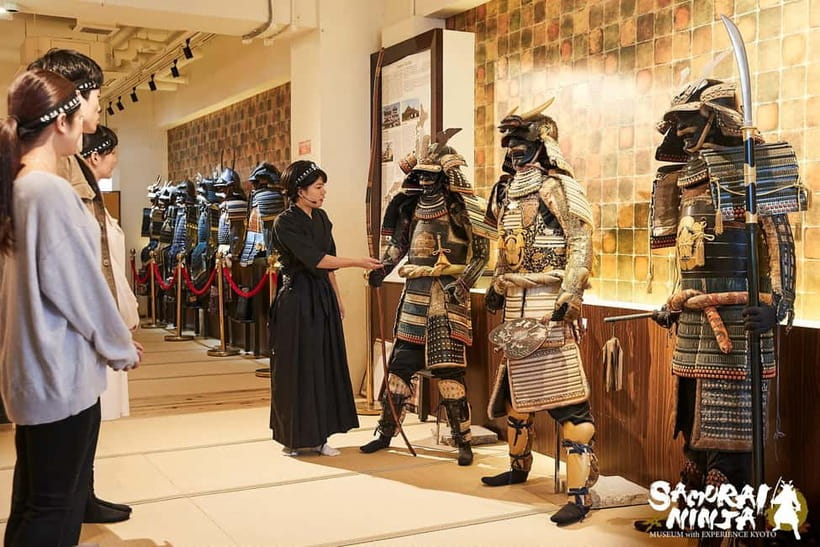
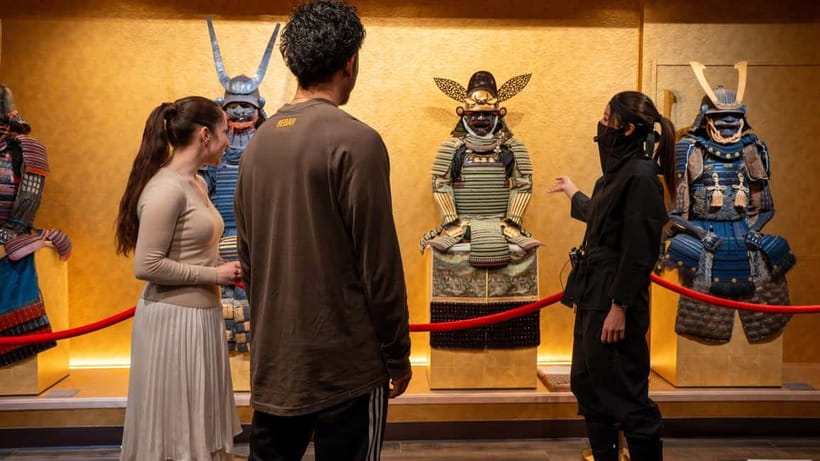
The experience begins with entry to the museum and a guided walk through its collection and displays. An English-speaking guide leads the visit, explains the objects, and connects the equipment to the broader story of samurai and ninja life.
The displays include armor, weapons, and related equipment. One especially useful detail is the attention given to craftsmanship. The objects are not presented only as movie props. Your guide explains what the warriors used and why the equipment mattered.
Guide quality is a major part of the value. Mami is praised for combining historical facts with a warm manner. Miu is repeatedly described as clear, helpful, and well informed. Akiko receives high marks for thoughtful explanations and good photographs, while Ko is praised for easy-to-understand English and strong audience engagement.
You may also be led by Sayo, Aya, Saku, Taka, Aoi, Jukia, Taku, or another member of the English-speaking team. The names change, but the pattern is consistent: the guide makes a short visit feel more personal by asking questions and drawing people into the discussion.
That interaction matters. In a traditional museum, you can walk past a display without knowing what to notice. Here, the guide points out the main details and gives you a reason to look closer. You are likely to remember more because the lesson is tied to a physical object, a costume, or an activity.
Armor, helmet, and samurai photographs
The dressing-up portion is the tour’s most visible photo opportunity. You can put on a samurai costume, wear a real samurai helmet, and hold a replica sword.
The combination is effective because it gives you a sense of the weight and appearance of samurai equipment without pretending that you are handling fragile historic weapons. The real helmet adds a special touch, while the replica sword keeps the activity suitable for a public demonstration.
I like this part most for families and groups of friends. It gives everyone a natural break from listening and creates photographs that feel connected to the museum rather than like generic souvenir portraits. Teenagers who might lose interest during a history talk often perk up when the costume appears.
You should also understand what this is and what it is not. You are not being fitted for a full battle-ready suit of armor or trained as a swordsman. The costume session is a short, supervised introduction designed for participation and pictures.
The experience also includes a katana lesson according to the activity description. Since the visit lasts only an hour, expect an introductory demonstration or practice segment rather than a full martial arts class. The main value is cultural and theatrical: you see how the sword fits into the samurai image and get to participate in a controlled way.
Ninja stars and the final challenge
The shuriken, or ninja star, throwing activity is the clearest action segment. You are shown how to throw the stars, then get a chance to try for yourself. Several people describe this as the best part of the hour, and I can see why. It is simple, quick, and gives the group an immediate goal.
The activity works particularly well with children and teenagers. One family found that a ninja throwing competition kept two teenage boys interested throughout the visit. Adults can join too, and a little competition adds energy without requiring athletic ability.
The museum also describes a ninja fukiya experience, a blowgun-style tool associated with ninja demonstrations. The listed inclusions specifically name the museum tour, samurai costume, and ninja star throwing, so you should confirm exactly which activities are operating during your time slot. The shuriken activity is the safest feature to count on from the stated inclusions.
Because the tour ends with an activity, the hour has a good rhythm. You begin with explanation, move to equipment and costume, then finish with something you can do. That pacing is one reason the experience suits first-time visitors to Japan.
Do not expect an outdoor ninja course or a long weapons workshop. The attraction is an indoor museum experience with a brief hands-on element. It gives you a taste, not professional training.
More Museums and Galleries in Kyoto
- teamLab Biovortex Kyoto ticket
★ 4.8 · 3,186 reviews - Kyoto: Tea Museum Tickets and Matcha Grinding Experience
★ 4.9 · 739 reviews - Skip the lines Basic Ticket at SAMURAI NINJA MUSEUM KYOTO
★ 4.5 · 632 reviews - Kyoto : Geiko Maiko Dance of Kyoto & Visits of Gion Museum
★ 4.6 · 415 reviews
What the one-hour schedule means for you
One hour is both the tour’s strength and its limit. You can fit it between other Kyoto plans, and you will not need to devote a full morning or afternoon to the visit. That is helpful in a city where temples, gardens, markets, and neighborhoods compete for your time.
The short duration also keeps the activities moving. There is little room for the presentation to become tiring, especially when the guide asks questions and brings out costumes or equipment.
The trade-off is that each part receives only a little attention. You will not get an extended examination of every display. You may leave with a good grasp of the main ideas, but not a detailed account of samurai government from the Heian period to the end of the Tokugawa shogunate.
I would book this early in your Kyoto stay if samurai and ninja are new subjects for you. It gives you useful background before you encounter castles, shrine legends, or other military-era sites. You can also schedule it on a busy sightseeing day because the time commitment is modest.
The activity offers free cancellation up to 24 hours before the start time, and you can reserve now and pay later. Those terms help if your Kyoto schedule is still shifting. Transportation to and from the museum is not included, so you need to make your own way there.
Is $28 a fair price?
At $28 per person, the value depends on how much you want from a short, interactive attraction. You are paying for admission, an English-speaking guide, costume access, and the shuriken activity. You are also paying for convenience: the guide organizes the story and the hands-on portions in one place.
I consider the price reasonable for families and first-time visitors who would otherwise struggle to keep children engaged in a standard museum. The costume, helmet, sword, and throwing activity give you more than a simple entry ticket.
The value is less clear for a history specialist or a solo adult seeking original artifacts and long-form interpretation. One criticism describes the cost as an unnecessary upcharge for museum entry and a regular guide. That concern is worth taking seriously. The tour is not a bargain basement museum visit, and the experience relies as much on presentation and participation as on the displays themselves.
In practical terms, ask yourself what you want to remember from the hour. If you want photographs, a friendly English explanation, and a few activities, $28 is a fair package. If you mainly want to inspect historic objects in silence, you may feel the price is high for the time available.
Who will enjoy this most?
I would recommend the tour to:
- Families with children or teenagers
- First-time visitors who want a simple introduction to samurai and ninja culture
- Adults who enjoy costume photographs and light hands-on activities
- Visitors with only an hour between larger Kyoto plans
- People who prefer an English guide to reading display text alone
- Anyone who wants a friendly, low-pressure cultural activity
I would be more selective if you are looking for serious martial arts instruction, a large collection of original artifacts, or a full-day treatment of Japanese military history. The museum is designed to entertain while it teaches.
The guide’s manner can shape your experience. The strongest sessions seem to come from guides who ask questions, explain the objects clearly, and make room for participation. Names that receive especially warm praise include Miu, Akiko, Sayo, Mami, Ko, Aya, and Saku. You may not choose your guide, but the English-speaking format is central to the experience.
Practical details that affect the visit
The museum is in Kyoto on Honshu, but transportation to the attraction is not included. Plan your route separately and allow enough time to arrive before the scheduled start.
The activity is described as wheelchair accessible. It is also promoted as a small-group tour, limited to 10 participants, although the important information gives a maximum of 30. Since those numbers do not match, I would confirm the expected group size before booking if personal space or a quieter visit matters to you.
The tour skips the ticket line, which can be useful when your day is tightly planned. Starting times vary, so you need to check availability for your chosen date.
English is the stated tour language. That makes the activity a practical choice if you want explanations without relying on translation tools or display labels.
Wear something that allows easy movement for the costume and throwing activity. The supplied information does not specify clothing rules, so I would avoid planning an elaborate outfit or carrying anything that could make changing awkward.
My final call: book it for the fun, not the full academic treatment
I would book the Kyoto Samurai Ninja Museum guided tour if you want a compact, friendly introduction with real participation. The combination of clear English guidance, armor and weapon displays, a samurai costume, a real helmet, replica sword photographs, and shuriken throwing gives you plenty to do in one hour.
I would skip it if your main goal is a quiet, artifact-heavy museum or advanced instruction. The presentation is brisk and interactive, and the $28 price makes the most sense when you take part in every activity.
For families, first-time visitors, and anyone who wants a memorable break between Kyoto temples, this is a good pick. Book it for the chance to learn, dress up, and throw a few ninja stars, while keeping your expectations focused on entertainment and introduction rather than exhaustive history.
FAQ
How long does the Kyoto Samurai Ninja Museum tour last?
The tour lasts one hour. Starting times vary, so you need to check availability for your chosen date.
What is included in the tour?
The tour includes museum entry, a professional English-speaking guide, a samurai costume, and ninja star throwing. The experience also describes samurai armor, a real samurai helmet, a replica sword, a katana lesson, and ninja equipment.
Is the tour offered in English?
Yes. The activity includes a live English-speaking guide, and English is the stated tour language.
Is the museum wheelchair accessible?
Yes, the activity is listed as wheelchair accessible.
How many people are in the group?
The activity is described as a small group limited to 10 participants. Its important information also lists a maximum of 30 travelers, so confirm the expected group size when booking.
Can I cancel or pay later?
You can cancel up to 24 hours in advance for a full refund. You can also reserve now and pay later. Transportation to and from the museum is not included.
Just added in Kyoto
- The “Golden Route” and Ancient Japan by DIAMIR Erlebnisreisen – 14-Day Tour★ 2.0 · 2 reviews
- Japan: Castles & Cuisine by G Adventures – 6-Day Kyoto to Osaka Tour★ 4.5 · 4 reviews
- Cycle Japan by Explore! – 13-Day Kyoto to Tokyo Tour★ 4.7 · 12 reviews
- Cycle Japan by Intrepid Travel – 11-Day Kyoto to Tokyo Tour★ 4.8 · 2 reviews
- Classic Japan by Intrepid Travel – 11-Day Kyoto to Tokyo Tour★ 4.4 · 14 reviews
- Ancient & Modern Japan 14-Day Tour by Exodus Adventure Travels★ 4.4 · 40 reviews
- 5 Day Cultural Adventure of Kyoto, Nara & Osaka by Tourist Journey★ 2.5 · 2 reviews
- 12 Days Kinosaki Onsen Escape: A Journey Through Japan’s Timeless Towns by UME Travel★ 4.8 · 5 reviews
Museums and Galleries, compared.

teamLab Borderless Tickets: MORI Building DIGITAL ART MUSEUM
Read our review →

teamLab Planets TOKYO Digital Art Museum Entry Ticket
Read our review →



Browse the lists this tour appears in