
Reviewed · KIMONO AND CULTURAL DRESS
Kyoto: Lunch or Dinner with Maiko
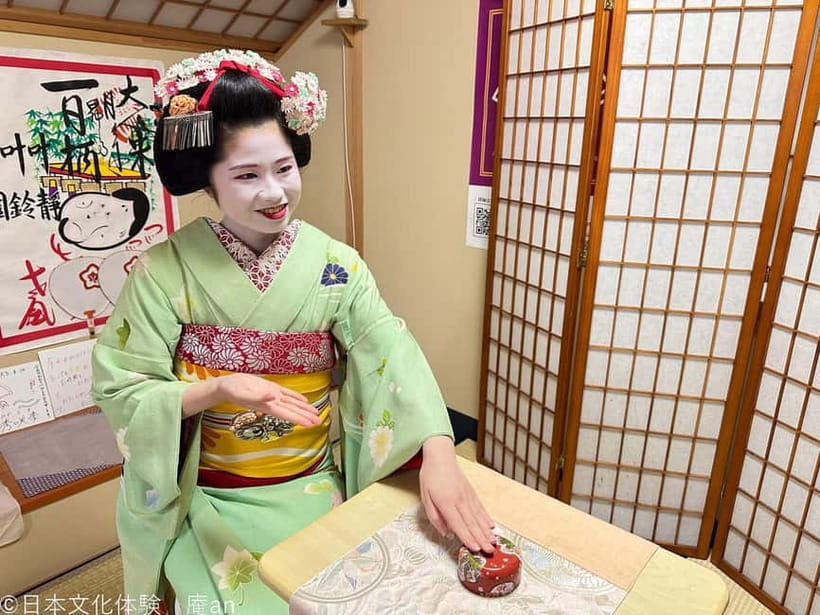
Meet Kyoto’s living tradition up close. This 90-minute program combines a traditional Kyoto meal with a maiko tea ceremony, two elegant dances, questions, games, and a photo opportunity. I like the direct contact with the performer, especially the chance to ask about her daily life rather than simply watch from a distance. I also like the small souvenir senjafuda, a lucky paper charm presented after the photo.
The main consideration is the setting. This is not an ochaya or an old wooden teahouse, but a room in a modern building near Gojo Station. The atmosphere is relaxed and friendly, though the plain furnishings may feel more like a function room than a carefully decorated traditional space. The meal also receives mixed reactions, so I would book this mainly for the cultural program, not as a destination meal.
In This Review
- Key things to know before booking
- Why this maiko program is different from a stage show
- Finding the room near Gojo Station
- The opening tea ceremony and meal
- Asking direct questions about maiko life
- A close-up photo and the senjafuda gift
- Two dances that show the maiko’s skill
- The playful side: games with the maiko
- Is $63 good value?
- Who should book this experience?
- Practical details that can affect your visit
- Should you book Kyoto Lunch or Dinner with Maiko?
- FAQ
- Where is the maiko experience held?
- How long does the program last?
- Is dinner included in the price?
- Is this held in an ochaya?
- Can I make my own tea?
- How many dances will I see?
- Can I ask the maiko questions?
- Is English available?
- Are children under two free?
- Is the venue accessible by elevator?
- What happens if I arrive late?
- Can a geiko appear instead of a maiko?
Key things to know before booking
- Two maiko dances: You see two traditional dances tied to the seasons, love stories, or everyday Japanese life.
- A real question-and-answer session: You can ask about the maiko’s routines and work, with English help available as much as possible if requested.
- Tea ceremony included: A maiko demonstrates the ceremony, while making your own tea costs an additional 1,600 JPY.
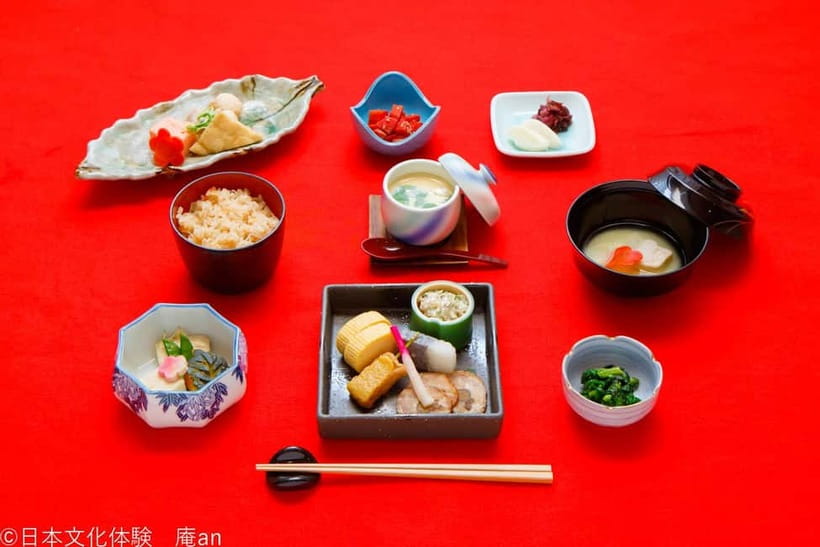
- A meal from a long-established Kyoto restaurant: Expect traditional dishes using ingredients and methods associated with Kyoto cuisine, including dashi.
- Photo and senjafuda souvenir: You can take a commemorative photograph beside the maiko and receive a lucky charm.
- Extra seating costs apply: First-row SS seats cost 3,300 JPY, second-row S2 seats cost 2,200 JPY, and third-row S3 seats cost 1,100 JPY.
Why this maiko program is different from a stage show
A maiko is an apprentice geiko, trained in dance, music, hospitality, and traditional presentation. Her kimono, hairstyle, makeup, and daily schedule all require care. That makes the meeting more than a short cultural performance. You get a look at a living custom that still has a place in modern Kyoto.
I like the way this program brings several parts of that world together. You are not asked to sit silently through a dance and leave. The tea ceremony shows controlled movement and etiquette. The questions put a human face on the work. The games loosen the mood. Then the dances give you the polished performance you came to see.
Depending on the day, a geiko may appear instead of a maiko. A geiko is a fully trained entertainer rather than an apprentice, so this change is not a lesser substitute. It simply means the person representing Kyoto’s traditional arts may differ from the original plan.
The program is conducted in Japanese. English translation is offered as much as possible if you contact the provider and request it. I would make that request before arrival, especially if the question-and-answer portion is important to you.
More Kimono Experiences in Kyoto
- [Kyoto & Nara Day Tour] Sagano Scenic Railway & Nara Park & Fushimi Inari Taisha Thousand Torii Gates & Togetsukyo Bridge & Bamboo Grove & Kimono Forest (Departing from Osaka)
★ 4.9 · 10,942 reviews - Kyoto Geisha Walking Tour: Gion District & Hidden Gems
★ 4.7 · 3,273 reviews - Kyoto: Gion Magical Night Walking Tour with Geisha Trivia
★ 4.9 · 2,393 reviews
Finding the room near Gojo Station
The meeting point is one minute from Exit 1 of Gojo Station on the Subway Karasuma Line. The entrance faces Gojo-dori, the main street, which makes the location fairly simple to find once you are above ground.
The building has no elevator. You need to use stairs to reach the venue, so this experience is not a good choice if stairs are difficult for you. The operator also will not hold the event for late arrivals. Kyoto’s subway is easy to use, but I would arrive early rather than try to time your arrival to the last minute.
The room is in a building, not a traditional Japanese house or ochaya. Some seating areas may feel basic, and the decor may not provide the screens, woodwork, and old-Kyoto atmosphere you imagine from photographs of geisha districts. That plain setting can be disappointing if you are paying for a highly theatrical backdrop.
On the other hand, the lack of ceremony at the door may make the program less intimidating. You do not need special clothing or preparation. The staff aims for a friendly, relaxed atmosphere, and you can focus on the maiko rather than worry about following strict rules.
The opening tea ceremony and meal
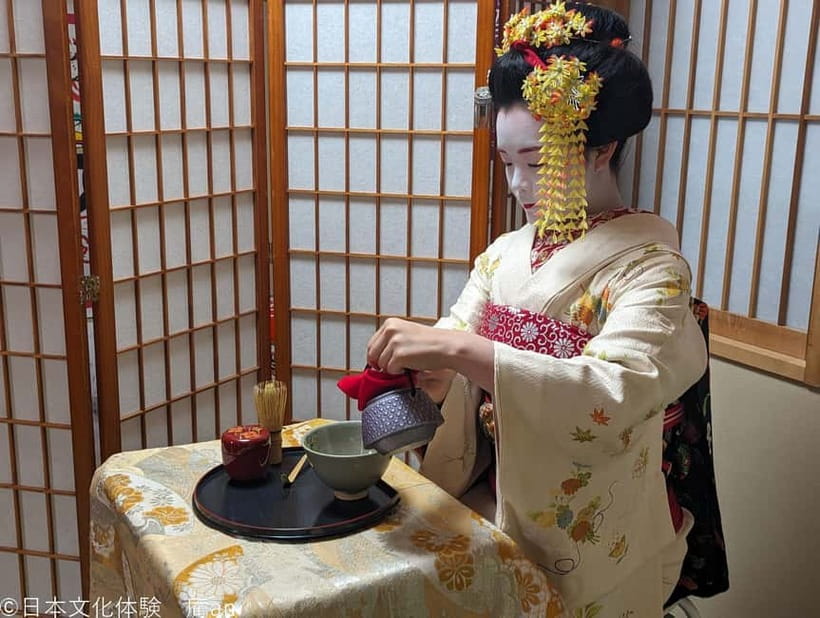
The program begins with a tea ceremony demonstration by the maiko. Watch her movements closely. The appeal is not speed or spectacle, but the care given to each gesture, from handling the utensils to presenting the tea.
You can add a hands-on tea-making option for 1,600 JPY. The standard price includes the demonstration, not the chance to prepare your own tea. If participating matters to you, select the option when you apply or contact the provider in advance.
The meal follows the tea demonstration. It comes from a long-established Kyoto restaurant and is based on traditional local dishes. Kyoto cooking often relies on dashi, a stock that provides a subtle savory base to soups and other dishes. This is not usually the bold, heavily seasoned style found in some other parts of Japan.
The meal may arrive in a delivery-style presentation called shidashi. In Kyoto, ordering prepared food in this manner is itself a familiar traditional practice. That gives the meal a useful cultural connection, although it also means you should not expect an elaborate restaurant dining room or a chef preparing each course in front of you.
Food is the least predictable part of the experience. Some diners find the dishes pleasantly typical of Kyoto, while others find the flavors too mild. There has also been a complaint about food arriving barely thawed, so I would keep expectations sensible. The cultural program carries the experience; the meal is an included part of the package rather than the main reason to reserve it.
Because some participants may have chosen the tea-making option while others have not, the room can include people following slightly different versions of the program. That shared setup helps keep the price down, but it may feel less private and less tightly staged.
Asking direct questions about maiko life
The question-and-answer session is one of the most valuable parts of the event. You can ask the maiko directly about her world, including her routines and the demands of maintaining a traditional lifestyle.
This is where the program moves beyond costume and performance. A kimono and elaborate hairstyle are easy to photograph, but the questions help explain the discipline behind them. You get a better sense of why maiko remain such distinctive figures in Kyoto.
The language issue matters here. The official language is Japanese, and English translation is provided as much as possible when requested. Do not assume every answer will be translated in full without arranging help beforehand.
Group participation also affects the session. The event may be held with people who are not eating the same dishes or who booked a different option. If you want a quiet, private interview, this is not the right format. If you are comfortable sharing questions and listening to others, the group setting can make the exchange lively.
A completely different kind of day out:
- PERFECT KYOTO 1-Day Bus Tour
★ 5.0 · 13,518 reviews - Kyoto: Fushimi Inari, Kinkakuji, Bamboo Grove 1 Day Bus Tour
★ 4.8 · 4,316 reviews - Kyoto: Tea Ceremony in a Traditional Tea House in Kiyomizu
★ 4.9 · 3,519 reviews - Kyoto: Gion Make Your Own Chopsticks with Engraving Option
★ 5.0 · 3,465 reviews
A close-up photo and the senjafuda gift
After the questions, you have a chance to take a commemorative photo beside the maiko. This is a more personal keepsake than a distant stage photograph, though the exact flow depends on the group and venue arrangements.
The maiko also presents a senjafuda. Traditionally, a senjafuda is a small paper name card or charm associated with Japanese shrine and entertainment culture. Here it serves as a lucky souvenir from the meeting.
I would treat the photo opportunity with respect. The kimono, hairstyle, and makeup are part of professional training and take considerable work. Listen to the staff’s directions, keep the moment brief, and let everyone in the group have a turn.
The room may not provide a dramatic background. A plain wall or simple furnishings can make the photo feel less cinematic than you hoped. Still, the value is in standing beside the performer and having a record of the encounter, not in getting a carefully staged studio portrait.
Two dances that show the maiko’s skill
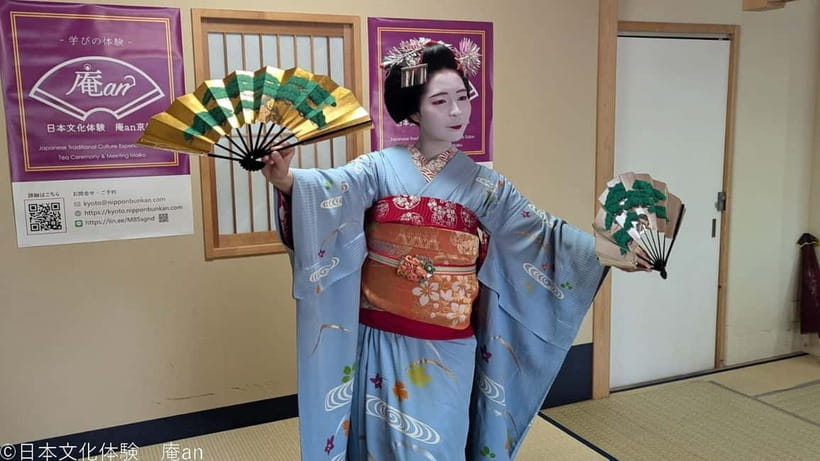
The dance performance includes two traditional numbers. Their subjects may relate to the seasons, romance, or ordinary life. You may not understand every story without translation, but you can still follow the mood through posture, timing, costume, and hand movements.
The maiko’s style is controlled rather than flashy. Small gestures matter. A turn of the head, a lowered fan, or a pause can carry as much weight as a large movement. I would watch the hands and feet as much as the face, since the precision of the performance is easy to miss if you focus only on the costume.
The dances are widely regarded as the high point of the program. They give you a direct look at an art form that is difficult to encounter casually. Kyoto has many cultural shows, but the combination of a live maiko, two dances, and a question period gives this one a personal edge.
The main limitation is the room. Without traditional screens or a carefully designed stage, the performance may not have the visual setting you expect. The art remains compelling, but the presentation is more practical than lavish.
The playful side: games with the maiko
After the dances, the maiko leads a simple interactive game. Volunteers may join, while everyone else can clap and cheer. These games are designed as hospitality, not as a serious contest, but they help break down the distance between performer and audience.
You may find the mood changes quickly here. The tea ceremony is quiet and formal. The dance is graceful and focused. The game is lighter and more social. That variety helps the 90-minute schedule feel full without making every minute solemn.
If you dislike being called on, you can simply watch. Volunteers are welcome, but participation is not required. If you enjoy a little harmless competition, this may be your favorite part, since the maiko is a professional at entertaining people.
The formal program ends at about 75 minutes when the maiko leaves the room. The remaining 15 minutes are set aside for chatting before you depart. That final gap is useful because it avoids an abrupt exit and gives you time to gather your belongings and speak with the staff.
Is $63 good value?
At $63 per person, the price is reasonable if you value direct cultural access. You receive a meal, a tea ceremony demonstration, a question session, a photo opportunity, two dances, a game, and a souvenir in a compact 90-minute program.
The value is less convincing if you are mainly seeking a high-end dinner or a beautifully historic venue. The room is in a modern building, the meal can be mild, and the event may bring together people on different packages. You are paying for access to the performance and interaction, not luxury surroundings.
The optional costs can change the final price. Making your own tea adds 1,600 JPY. Front-row SS seating adds 3,300 JPY, second-row S2 seating adds 2,200 JPY, and third-row S3 seating adds 1,100 JPY. Standard seating may be enough for many people, but a closer position could help if you want a better view of the dance and tea movements.
Children under two are free when sitting on a parent’s lap. If a child under two needs a separate seat or meal, the regular one-person fee applies. Anyone who is not participating cannot enter the experience, so do not plan to bring a nonparticipating companion into the room.
Who should book this experience?
I would recommend it to first-time Kyoto visitors who want an approachable introduction to maiko culture. It suits people who enjoy live performance but also want conversation, photographs, and a small amount of audience participation.
It is also a good fit for families with older children who can sit through a demonstration and performance. The game adds energy, and the short duration is easier than a long formal theater event. Very young children may find the quiet tea ceremony less engaging, and a separate seat for a child under two changes the price.
This program works well for anyone with limited time in Kyoto. The station access is convenient, and the 90-minute format leaves most of your day open. You could place it between sightseeing stops rather than commit an entire afternoon to a cultural show.
I would be more cautious if you want a private meeting, a refined kaiseki meal, or a historic teahouse interior. This is a shared event in a functional building. It offers substance through the maiko’s presence and skills, not through luxury design.
Practical details that can affect your visit
Reservations are processed during operating hours from 10:00 to 17:00. Requests received after 17:00 are handled the next day, so do not expect an immediate answer to a late evening message.
Cancellation is free up to eight days in advance for a full refund. After that point, a cancellation fee applies, and changing the date or time after a fee has been incurred may bring another specified charge. The provider does not cover your travel costs if you cancel.
Plan your route carefully. The event cannot wait for late arrivals, and the building has stairs rather than an elevator. Contact the provider before booking if you need English translation or want to reserve one of the optional tea or seating upgrades.
The standard program does not require special preparation. You can arrive in ordinary sightseeing clothes, follow the staff’s instructions, and enjoy the event without prior knowledge of maiko traditions.
Should you book Kyoto Lunch or Dinner with Maiko?
Book it if your priority is meeting a maiko, seeing two dances, and taking part in a compact cultural program. The question session, game, photo, and senjafuda make it more personal than a performance viewed from far away.
Skip it if your priority is a grand traditional setting or a memorable gourmet dinner. The room may feel plain, and the food is the part most likely to divide opinion. At $63, I see the meal as a useful addition, while the maiko interaction and dance performance provide the real value.
For the best experience, request English support early, arrive well before the start time, and consider the tea-making option if you want more than a demonstration. Standard seating should suit most people, but a paid upgrade may help if close viewing matters to you.
FAQ
Where is the maiko experience held?
It is one minute from Exit 1 of Gojo Station on the Subway Karasuma Line. The entrance faces Gojo-dori.
How long does the program last?
The full experience lasts 90 minutes. The formal program ends at about 75 minutes, followed by chatting time before departure.
Is dinner included in the price?
Yes. The price includes dinner prepared by a long-established Kyoto restaurant. The meal features traditional Kyoto-style dishes.
Is this held in an ochaya?
No. The venue is in a building and is not an ochaya or traditional Japanese house. It offers a relaxed atmosphere with friendly staff.
Can I make my own tea?
Yes, but the tea ceremony experience is an optional add-on costing 1,600 JPY. The standard program includes a tea ceremony demonstration.
How many dances will I see?
The program includes two traditional maiko dances.
Can I ask the maiko questions?
Yes. A question-and-answer session is part of the program, allowing you to ask about the maiko’s world and daily life.
Is English available?
The official language is Japanese. English translation is provided as much as possible if you request it by contacting the provider.
Are children under two free?
Children under two are free when sitting on a parent’s lap. If a separate seat or meal is required, the regular fee for one person applies.
Is the venue accessible by elevator?
No. The building has no elevator, and you need to use stairs to reach the venue.
What happens if I arrive late?
The event will not be held for delayed arrivals. Plan to reach the Gojo Station area early.
Can a geiko appear instead of a maiko?
Yes. Depending on the situation, a geiko may be invited instead of a maiko.
More Lunch Experiences in Kyoto
- Bike Tour Exploring North Kyoto plus Lunch
★ 5.0 · 1,087 reviews - Osaka/Kyoto: Arashiyama, Nara & Fushimi Inari Shrine w/Lunch
★ 4.4 · 754 reviews - Kyoto Zen Meditation & Garden Tour at a Zen Temple with Lunch
★ 5.0 · 441 reviews - 4.5-Hour Kyoto Bike Tour with Lunch and UNESCO Zen Temples
★ 5.0 · 122 reviews
More Dining Experiences in Kyoto
- Kyoto Gion Cultural Walk & Geisha Show with Dining Options
★ 5.0 · 518 reviews - Kyoto Gion Cultural Walk & Geisha Show with Dining Options
★ 5.0 · 483 reviews - Dinner with Maiko in a Traditional Kyoto Style Restaurant Tour
★ 5.0 · 175 reviews - Kyoto: Geisha Dinner & Gion Cultural Walk
★ 5.0 · 73 reviews
Just added in Kyoto
- The “Golden Route” and Ancient Japan by DIAMIR Erlebnisreisen – 14-Day Tour★ 2.0 · 2 reviews
- Japan: Castles & Cuisine by G Adventures – 6-Day Kyoto to Osaka Tour★ 4.5 · 4 reviews
- Cycle Japan by Explore! – 13-Day Kyoto to Tokyo Tour★ 4.7 · 12 reviews
- Cycle Japan by Intrepid Travel – 11-Day Kyoto to Tokyo Tour★ 4.8 · 2 reviews
- Classic Japan by Intrepid Travel – 11-Day Kyoto to Tokyo Tour★ 4.4 · 14 reviews
- Ancient & Modern Japan 14-Day Tour by Exodus Adventure Travels★ 4.4 · 40 reviews
- 5 Day Cultural Adventure of Kyoto, Nara & Osaka by Tourist Journey★ 2.5 · 2 reviews
- 12 Days Kinosaki Onsen Escape: A Journey Through Japan’s Timeless Towns by UME Travel★ 4.8 · 5 reviews
Kimono and Cultural Dress, compared.
![[Kyoto & Nara Day Tour] Sagano Scenic Railway & Nara Park & Fushimi Inari Taisha Thousand Torii Gates & Togetsukyo Bridge & Bamboo Grove & Kimono Forest (Departing from Osaka)](https://media.japanvisits.com/wp-content/uploads/kyoto-nara-day-tour-sagano-scenic-railway-nara-park-fushimi-inari-taisha-thousand-torii-gates-togetsukyo-bridge-bamboo-grove-kimono-forest-departing-from-osaka-k110001-400x257.jpg)

Tokyo Asakusa Kimono&Yukata Rental at Kimono Miyabi Asakusa Station
Read our review →
Kyoto Geisha Walking Tour: Gion District & Hidden Gems
Read our review →
Gion Magical Night Walking Tour with Geisha Trivia
Read our review →
Gion Geisha District Walking Tour – Stories of Geisha
Read our review →
Best of Kyoto: Gion, Geisha, Pagodas & Cobblestones
Read our review →
Kyoto Kimono Rental Experience (Optional Exquisite Hair Styling/Japanese Makeup/Photography) (Ookini Kiyomizu-dera Main Store)
Read our review →Browse the lists this tour appears in