
Reviewed · COOKING CLASSES
3-Hour Small-Group Sushi Making Class in Tokyo
Sushi tastes better when you make it. This three-hour class in Tokyo gives you hands-on practice with nigiri, inari, hosomaki, and California rolls, then lets you eat the results. I especially like the small class size of up to nine people and the friendly English-speaking instructors, including teachers such as Yuki, Yuma, Yuko, Aya, Miki, and Yummy.
I also like that the ingredients, apron, towel, and recipes are supplied, so you can focus on the cooking rather than shopping and packing. The main limitation is clear: you will work with pre-sliced fish, so this is a sushi assembly and preparation lesson, not a course in cutting whole fish.
In This Review
- Key things to know before you book
- A quiet Shinanomachi start at 1:30 pm
- The first lesson: dashi, miso, rice, and Japanese seasonings
- Making tamagoyaki, the tricky but rewarding part
- Preparing sushi rice and toppings
- Four sushi styles, four different techniques
- Friendly instruction makes the class work
- Sitting down to eat what you made
- Is $72.67 a fair price?
- Who should book this Tokyo cooking class?
- Useful planning details for your afternoon
- My recommendation
- FAQ
- Where does the sushi class meet?
- What time does the class start?
- How long does the sushi-making experience last?
- What sushi styles will I make?
- Does the class include raw fish cutting?
- Is the class taught in English?
- Are ingredients and equipment included?
- Is a meal included?
- Can children join the class?
- Is a vegetarian option available?
Key things to know before you book
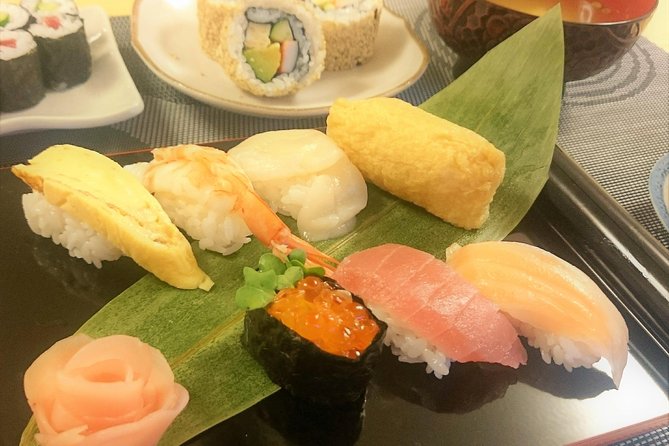
- You make several sushi styles: Prepare nigiri, inari, hosomaki, California rolls, tamagoyaki, sushi rice, and miso soup.
- The class is genuinely hands-on: You roll, press, cook, and assemble your own food with guidance from the instructors.
- English support is built in: The instructors explain ingredients, methods, and some Japanese food traditions in English.
- The final meal is substantial: You sit down with your sushi, miso soup, fresh wasabi, and pickled ginger.
- The setting is quiet: Cooking Sun Tokyo is at 18-39 Shinanomachi in Shinjuku City, away from the main roads in a residential area.
- The price is $72.67 per person: For three hours of instruction, ingredients, equipment, and a full meal, I consider it a fair Tokyo activity price.
A quiet Shinanomachi start at 1:30 pm
You meet at Cooking Sun Tokyo, 18-39 Shinanomachi, Shinjuku City, at 1:30 pm. The studio is described as being in a quiet residential area set back from the main roads, which gives the class a calmer feel than a lesson in a busy commercial kitchen.
The location is near public transportation, but hotel pickup and drop-off are not included. You need to make your own way there and allow enough time to find the studio. Since the class begins in the afternoon and lasts about three hours, it fits well between a relaxed morning and an evening meal.
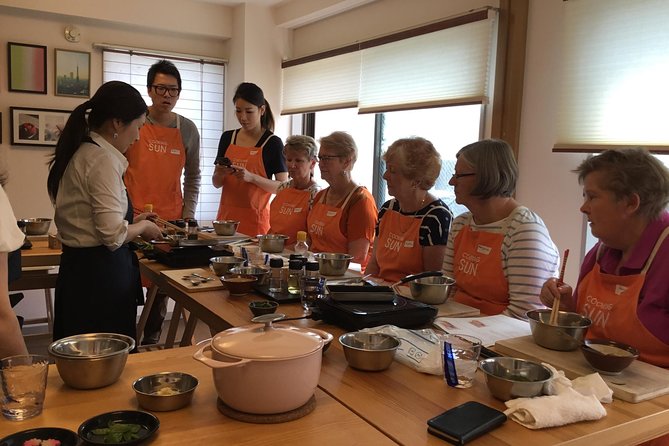
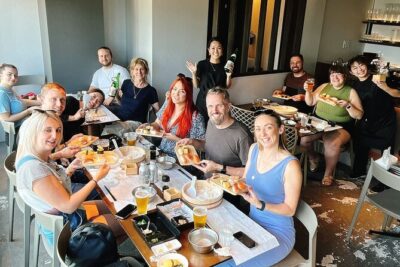
The group can include no more than nine people. That number matters. You are not watching a chef work from the back of a crowded room. You get a place at the kitchen and repeated chances to ask for help, which is especially useful when your first roll comes out loose or your tamagoyaki looks less tidy than the instructor’s.
The studio has been described as clean, well equipped, and comfortably cooled. That last point may matter during Tokyo’s hot summer months. You get a practical break from the heat while still doing something connected to Japanese food and culture.
More Cooking Classes in Tokyo
- Sushi Making Tokyo Roll and Authentic Japanese Sushi Class
★ 5.0 · 3,971 reviews - Tokyo: Roll and Authentic Sushi Making Class in Asakusa
★ 4.9 · 1,957 reviews - Tokyo Shinjuku Chopsticks Making Class
★ 5.0 · 1,763 reviews
The first lesson: dashi, miso, rice, and Japanese seasonings
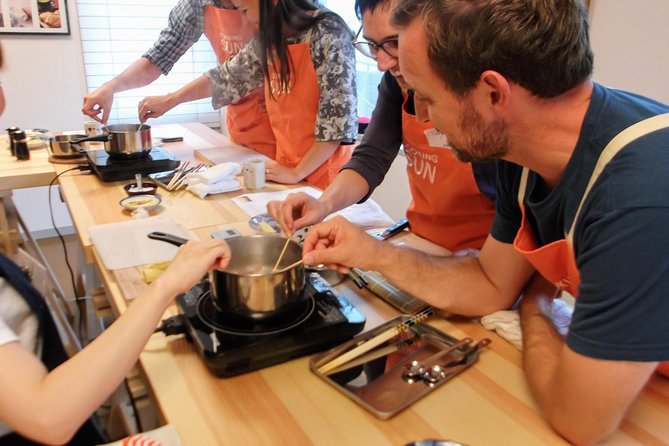
The class begins with an introduction to basic Japanese ingredients. You learn about dashi, miso, and traditional seasonings before the main sushi work starts.
This opening gives you more than a list of ingredients. It helps explain why Japanese cooking often depends on small changes in seasoning and texture. Dashi forms the base of the miso soup, while rice vinegar and carefully prepared sushi rice give the sushi its familiar balance.
The lesson also includes miso soup and dashi made from scratch. That is a useful bonus because many short sushi classes focus only on rolling. Here, you get a small look at the wider meal that surrounds sushi in Japan.
You should not expect a formal culinary lecture. The value is practical. The instructors explain what you are using, demonstrate the method, and then let you try it yourself. Several instructors have been praised for their clear English and for sharing background about Japanese cooking and the history of sushi.
Making tamagoyaki, the tricky but rewarding part
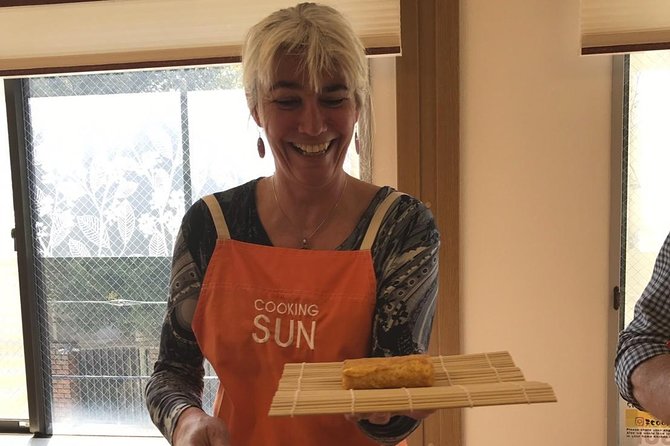
Next comes tamagoyaki, the Japanese rolled omelet. You prepare it as a filling for the sushi, but it also becomes one of the class’s most useful cooking lessons.
Tamagoyaki can look simple until you try to roll it. You need to cook thin layers of egg, fold them, and build the omelet into a neat shape. I like that the class includes this step because it gives you a technique you can use at home, even if you never make sushi again.
The instructors guide you through the process and adjust their help to your experience. Children and first-time cooks are welcome, and the minimum age is six. Families have found the class manageable for children, with instructors offering patient support when small hands and unfamiliar tools do not quite cooperate.
Do not worry if your tamagoyaki is not perfect. The point is to understand the steps and get a feel for the texture. Your omelet may look uneven, but it will still taste good inside the sushi.
Preparing sushi rice and toppings
Once the omelet is ready, you work on sushi rice and toppings such as shrimp. Rice is the foundation of good sushi, and the class gives you a chance to understand how it is prepared rather than treating it as a ready-made ingredient.
You then prepare the fillings and toppings needed for the different sushi styles. The exact amount of food can be generous. Several participants have found the finished meal large enough that you should arrive hungry.
One important detail is the seafood preparation. The fish is pre-sliced, so you do not learn how to break down or cut a whole fish. That keeps the class suitable for beginners and makes the three-hour schedule realistic, but it also limits the lesson for anyone hoping to study professional sushi knife work.
I see this as a fair trade for the target audience. You get to spend more time shaping and eating sushi, and less time watching a specialist handle a fish you will not be asked to prepare yourself.
A completely different kind of day out:
- Tokyo Disney Resort – Tokyo Disneyland & Tokyo DisneySea Park Tickets
★ 4.8 · 99,488 reviews - SHIBUYA SKY Ticket
★ 4.7 · 46,509 reviews - JR Whole Japan Rail Pass
★ 4.8 · 29,150 reviews - Mt Fuji and Hakone 1-Day Bus Tour Return by Bullet Train
★ 5.0 · 26,383 reviews
Four sushi styles, four different techniques
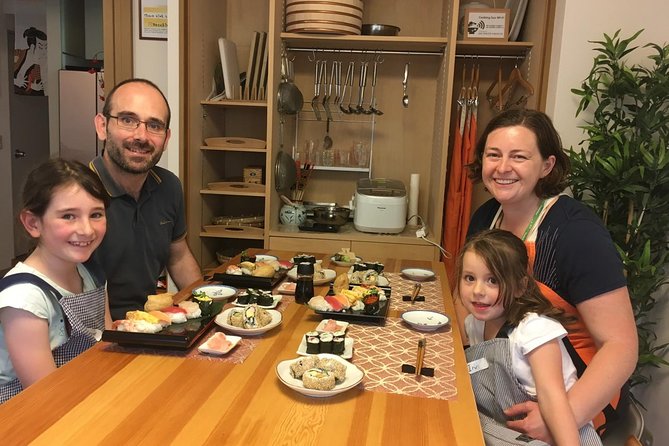
The heart of the class is learning how different sushi styles are put together. You make several kinds, each with its own shape and method.
Nigiri is hand-pressed sushi. You form the rice and place a topping over it, learning how much pressure to use without crushing the rice. It looks easy when a sushi chef does it. Doing it yourself shows why the shape, size, and firmness matter.
Inari uses a sweet tofu pouch filled with sushi rice. It is forgiving and fun to assemble, making it a good choice for children and beginners. Its sweet flavor also gives you a contrast to the savory toppings.
Hosomaki is a thin roll. You spread rice, add a narrow filling, and use a bamboo mat or similar rolling method to form a compact cylinder. The amount of rice is important. Too much makes the roll difficult to close, while too little leaves it flimsy.
California roll gives you a more familiar starting point if you regularly eat sushi outside Japan. Making it in Tokyo lets you compare a widely known roll with more traditional forms such as nigiri and inari.
Some sessions produce an even broader meal, including tamago sushi, shrimp nigiri, four-piece nigiri, inari age, hosomaki, California roll, tamagoyaki, and miso soup. The precise selection can vary, but you should expect a range of styles rather than one single roll.
Friendly instruction makes the class work
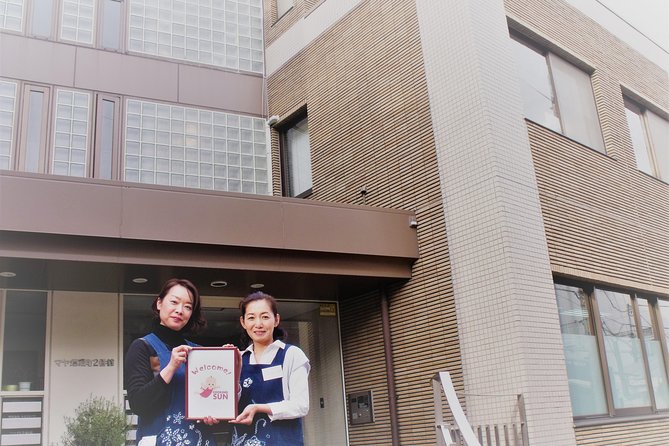
The best part of this experience is not simply the menu. It is the way the instructors keep the work accessible.
Teachers such as Miki, Yuki, Yuma, Yuko, Aya, and Yummy have been praised for being warm, patient, and clear. The names and staff can vary by session, but English support is part of the experience. You can ask questions as you work instead of trying to copy a demonstration without knowing why each step matters.
The small group helps here. With a maximum of nine people, the instructors can watch your technique and step in when needed. That is more useful than a large demonstration where you only discover your mistake after the class has moved on.
You also get an apron and towel rental, plus all recipes and ingredients. Those details reduce the usual friction of a cooking class. You do not need to carry special equipment or buy ingredients beforehand, and the recipes give you a way to repeat the meal at home.
The teaching style appears personable rather than formal. You will learn, but you will also laugh at imperfect rolls and compare results around the table. That relaxed approach works particularly well for families, couples, solo visitors, and anyone who does not think of themselves as a cook.
Sitting down to eat what you made
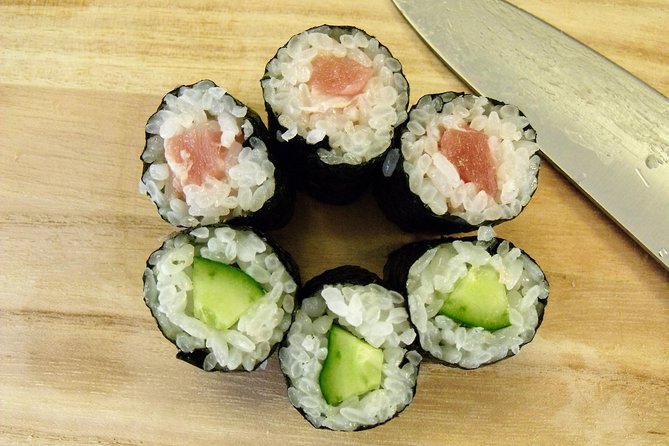
After the preparation, you sit down and eat your sushi. The meal includes your creations along with miso soup, fresh wasabi, and pickled ginger.
This final stage gives the class a satisfying finish. You are not simply practicing shapes and then leaving. You see how the separate pieces fit into a complete Japanese meal, and you can judge the rice, fillings, omelet, and seasonings for yourself.
The quantity may surprise you. Some people have found they could barely finish everything they made, so do not plan a large meal immediately afterward. The food is also a useful reminder that appearance is only part of sushi. Your rolls may not match the instructor’s neat examples, but they can still be delicious.
You should keep your expectations sensible about fish quality. This is a hands-on beginner class, not an expensive omakase meal or a lesson in high-end sushi preparation. One participant specifically noted that the fish was not the highest quality, while also finding the meal tasty and the instruction worthwhile.
For me, that is the right way to judge the food. You are paying to learn, cook, and eat a generous meal. If your main goal is exceptional seafood, book a sushi restaurant instead. If you want to understand how sushi comes together, the meal does its job.
Is $72.67 a fair price?
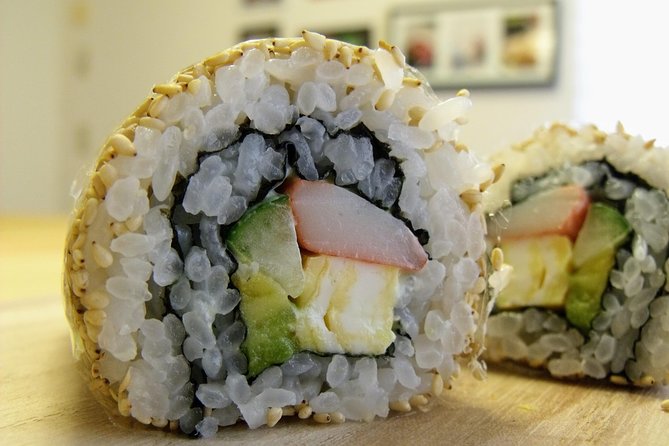
At $72.67 per person, the class is not a bargain-basement activity, but it offers solid value for Tokyo. Your fee covers about three hours, an English-speaking local instructor, ingredients, recipes, apron and towel rental, instruction across several sushi styles, and the meal at the end.
You also avoid the extra cost and effort of buying Japanese ingredients in unfamiliar quantities. The class gives you dashi, miso, sushi rice, shrimp, egg, tofu pouches, and other ingredients in one organized session.
The value improves if you are traveling with children or with someone who does not want another sightseeing stop. You get an activity that works in hot weather, gives you a cultural connection, and ends with lunch or an early dinner. It also provides skills you can try at home.
I would not choose it for professional culinary training. There is no fish-cutting instruction, and three hours is enough for basic methods rather than advanced knife work or restaurant-level sushi technique.
Who should book this Tokyo cooking class?
I would recommend it most strongly to first-time sushi makers. You do not need previous cooking experience, and the instructors adapt their help to beginners.
Families are a good match, since the minimum age is six and the class has worked well for children aged 10 and 12. The calm room, clear English, and hands-on format give younger cooks something real to do instead of asking them to sit through a long food talk.
Solo visitors and couples can also fit comfortably into the small group. The class naturally creates conversation because everyone is working with the same rice, omelet, and fillings, then comparing the final results.
Vegetarians can request a vegetarian option at booking. You should give the provider any dietary requirements in advance, rather than waiting until you arrive.
I would be more cautious if you want raw fish preparation, advanced knife skills, or a lesson centered on premium seafood. You should also check the weather forecast because the activity requires good weather and may be moved or refunded if poor weather causes cancellation.
The class has a 100 percent recommendation rate and a five-star rating from 166 reviews, which fits the repeated strengths: friendly teaching, clean facilities, good English, a small group, and plenty of food. The strongest praise is aimed at the people leading the class and the amount of real participation, not at luxury surroundings.
Useful planning details for your afternoon
Book ahead if your Tokyo schedule is tight. The experience is booked an average of 53 days in advance, so last-minute availability may be limited, especially for family groups or a preferred date.
You receive confirmation at booking, and the ticket is mobile. The class begins at 1:30 pm and ends back at the meeting point, so you do not need to arrange a separate return transfer.
Free cancellation is available if you cancel at least 24 hours before the start time. Changes or cancellations inside that window are not accepted and are not refunded. If poor weather causes the provider to cancel, you are offered another date or a full refund.
Wear something comfortable for a kitchen setting and arrive ready to eat. The provider supplies an apron and towel, but you still need to handle food and participate throughout the session.
My recommendation
Book this class if you want to do more than photograph sushi in Tokyo. You will learn several basic styles, make tamagoyaki and miso soup, work with English-speaking instructors, and eat a full meal in a small, friendly setting.
Skip it if you are looking for whole-fish cutting, advanced sushi craft, or a premium restaurant meal. For most first-time cooks, families, and sushi fans, the combination of clear teaching, generous food, and a manageable three-hour schedule makes $72.67 a reasonable use of an afternoon.
FAQ
Where does the sushi class meet?
It meets at Cooking Sun Tokyo, 18-39 Shinanomachi, Shinjuku City, Tokyo 160-0016, Japan.
What time does the class start?
The class starts at 1:30 pm.
How long does the sushi-making experience last?
The experience lasts approximately three hours.
What sushi styles will I make?
You will learn to make nigiri, inari, hosomaki, and California rolls. The class may also include tamago sushi and several pieces of nigiri.
Does the class include raw fish cutting?
No. The fish is pre-sliced, so raw fish cutting instruction is not included.
Is the class taught in English?
Yes. A local, English-speaking cooking instructor leads the class, and the instructors provide guidance in English.
Are ingredients and equipment included?
Yes. Recipes and ingredients are included, along with apron and towel rental.
Is a meal included?
Yes. You eat the sushi you make, along with miso soup, fresh wasabi, and pickled ginger.
Can children join the class?
Yes. The minimum age is six years old.
Is a vegetarian option available?
Yes. A vegetarian option is available, but you must request it when booking.
Just added in Tokyo
- Tokyo Cute Bento Cooking Class – Make a Kawaii Character Lunchbox★ 5.0 · 126 reviews
- Japanese Home Cooking Class & Walk in Todoroki Temple Tokyo★ 5.0 · 88 reviews
- A One-of-a-Kind Sushi Experience in a Special Place of Japan★ 5.0 · 15 reviews
- Japan Tokyo Tower Observatory Deck E-Ticket★ 4.0 · 34 reviews
- Catch a Baseball Game in Tokyo with a Local – Tickets Included★ 5.0 · 24 reviews
- JDM Experience with Fast&Furious RX-7 (English speaking Driver)★ 5.0 · 57 reviews
- Tokyo Private Day Tour by Car with English speaking Driver Guide★ 4.0 · 29 reviews
- Japan Classic 10 Day – One Life Adventures★ 5.0 · 129 reviews
Cooking Classes, compared.
Sushi Making Tokyo Roll and Authentic Japanese Sushi Class
Read our review →
Roll and Authentic Sushi Making Class in Asakusa
Read our review →
Ramen Cooking Class at Ramen Factory in Kyoto
Read our review →
Sushi Making Class in a Happi Coat near a Famous Spot
Read our review →
Sushi Making Osaka Roll and Authentic Japanese Sushi Class
Read our review →
Tokyo Sushi Making Class in Tsukiji with Professional Chef
Read our review →
Ramen & Gyoza Cooking Class in Tokyo with Local Supermarket Visit
Read our review →Browse the lists this tour appears in